
Nyack History A to Z

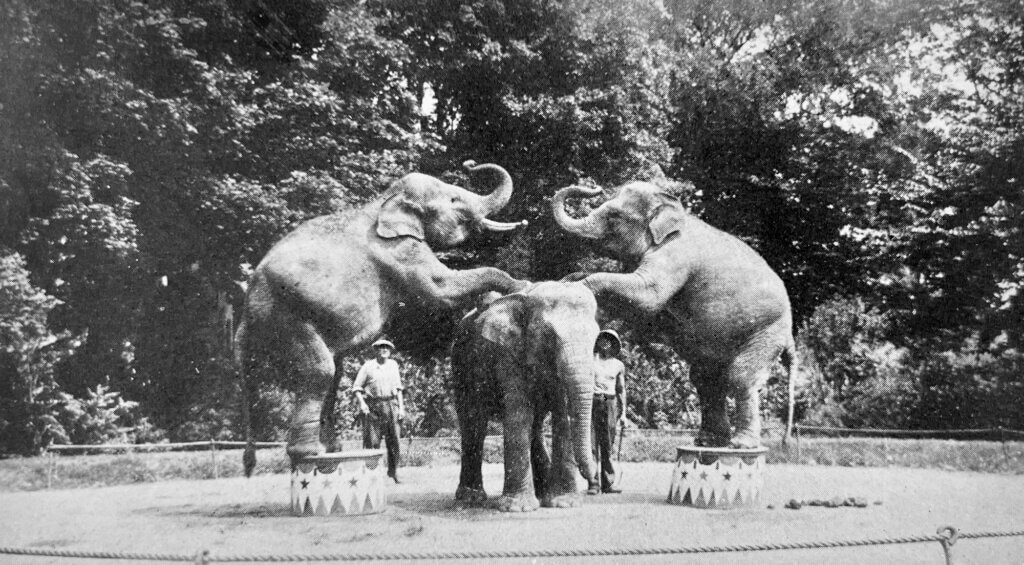
Three young elephants reflect the club’s unusual mix of physical culture, spectacle, and popular entertainment under Pierre Bernard. Courtesy of the Historical Society of the Nyacks.
In 1919, a country club unlike any other arrived in Upper Nyack.The Clarkstown Country Club, the first group to espouse yoga and eastern spirituality in America, relocated to Nyack from New York City . They took over the property of the former Nyack Country Club on North Broadway in Upper Nyack.
Blanche DeVries, America’s first yoga instructor, discovered the property while teaching at River Hook Select School for Young Women in Upper Nyack. DeVries convinced Pierre Bernard, also known as the “Omnipotent Oom” in the media, to move to Nyack with their followers when the property went up for sale. However, as in New York City, the club faced public disapproval in Nyack for its teachings on alternative spirituality, women’s independence, and sexuality.
Bernard’s followers included daughters of some of the wealthiest New Yorkers, including the Vanderbilts. Fascinated by Eastern philosophy and the practice of yoga, these influential individuals encouraged a wider audience to join the club and generously donate to Bernard. Soon, their contributions enabled him to purchase land in Upper Nyack and to acquire the large Stephen Bradley estate on Highland Avenue in South Nyack in 1920.
The Clarkstown Country Club left a lasting mark on Nyack, an unlikely experiment where yoga, spectacle, and modern ideas came together for a brief moment.
The Main Campus in South Nyack

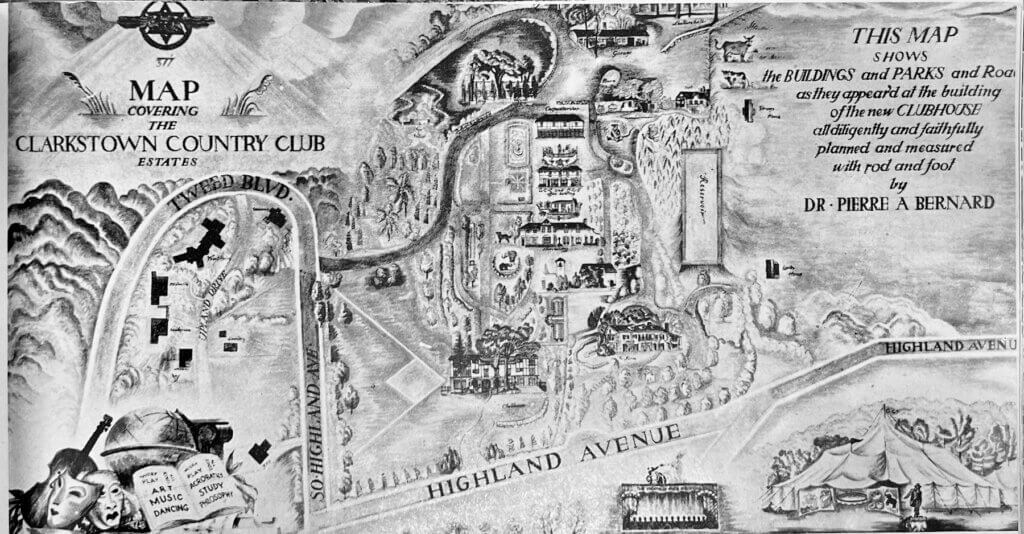
The clubhouse appears at left beside the baseball diamond, while nearby buildings include a theater, classrooms, bell tower, and garage; the Stephen Bradley House at right served as the residence of Pierre Bernard and Blanche DeVries. Courtesy of the Historical Society of the Nyacks.
The club moved its headquarters to the new location, providing Bernard with ample space for his “zoo”, which housed his four trained elephants, and other exotic animals including ten ring-tailed monkeys, two mandrills, a llama, a lioness, a chimpanzee, and a Canadian golden eagle. Bernard constructed a sprawling clubhouse with rentable rooms. The main clubhouse later became a dorm at Nyack College.
The club’s complex included a library, theater, café, swimming pool, classrooms, a baseball field, gardens, fountains, and an open area for a circus tent. The club planted a “gentleman’s garden” and wheat, melons, and corn. A dairy herd, chickens, ducks, pheasants, goats, horses, fruit trees, and grape vines completed the pastoral scene.
Although the club moved its headquarters to Orangetown from Clarkstown, it retained the name Clarkstown Country Club. Over the years, many notable figures resided at the club for brief periods, including Pete Seeger during his childhood.

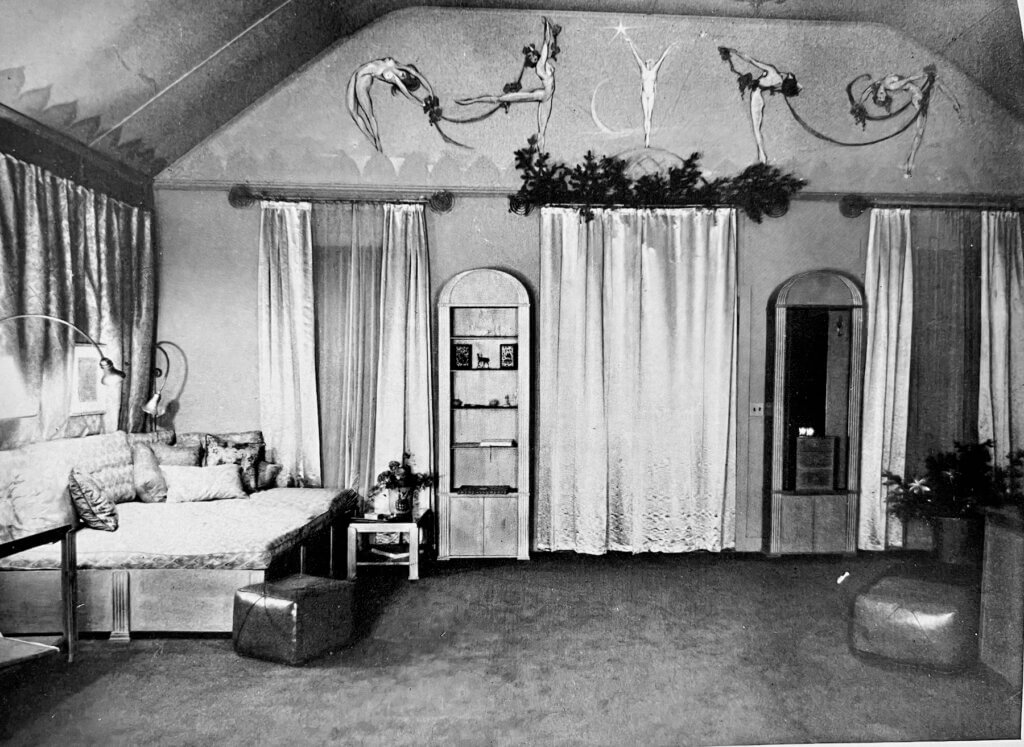
An Art Deco–style room with decorative wall motifs illustrates the comfortable accommodations available to members and guests. Courtesy of the Historical Society of the Nyacks.
Club Performances Attracted a Large Audience

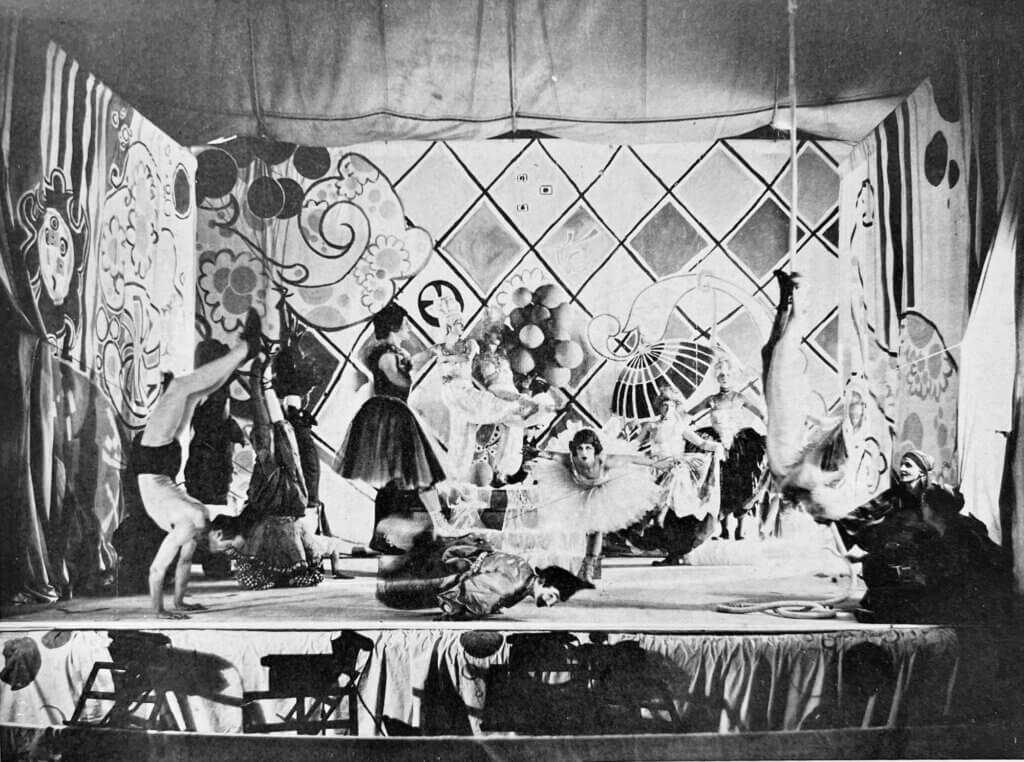
Members combined gymnastics, dance, and theater in elaborate productions that drew large audiences. Courtesy of the Historical Society of the Nyacks.
At the same time, the club developed a reputation for elaborate performances. During its prime, the club organized performances combining poetry, music, dance, and gymnastics. Each summer, Bernard hosted a circus under his 2,000-seat tent, the largest privately owned tent in America. Club members performed on a fifty-foot lit stage and on slack wire, high wire, trapeze, rings, and trampolines.A midway leading into the tent featured an Egyptian cigarette girl, Turkish fruit vendors, and Chinese tea servers along with peanut and lemonade stands.
The Club’s Sports Center

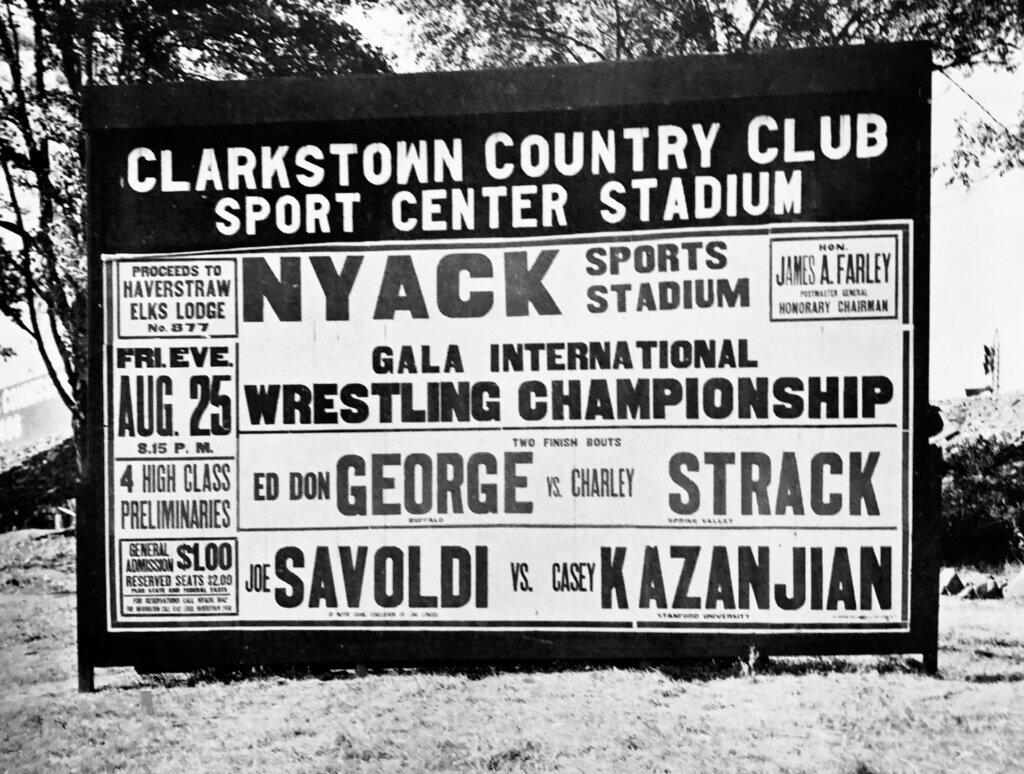
Facing Route 59, the sign advertised athletic events and public performances at the Central Nyack stadium. Courtesy of the Historical Society of the Nyacks.
Beyond the main campus, Bernard expanded the club’s reach. In 1933, he opened the Clarkstown Country Club Sports Center by leveling a hill in Central Nyack, now the location of the Waldron Terrace apartments. The stadium seated 3,500 and featured its own home baseball team, the Nyack Nighthawks. When that team didn’t draw enough people, he added the Black Yankees, a semipro team. He staged soccer, boxing, and wrestling matches the same year it opened. Soon he added lights for night baseball. His attempt to turn the stadium into a dog-racing track failed. Open for one night only, the track was closed by a police raid.

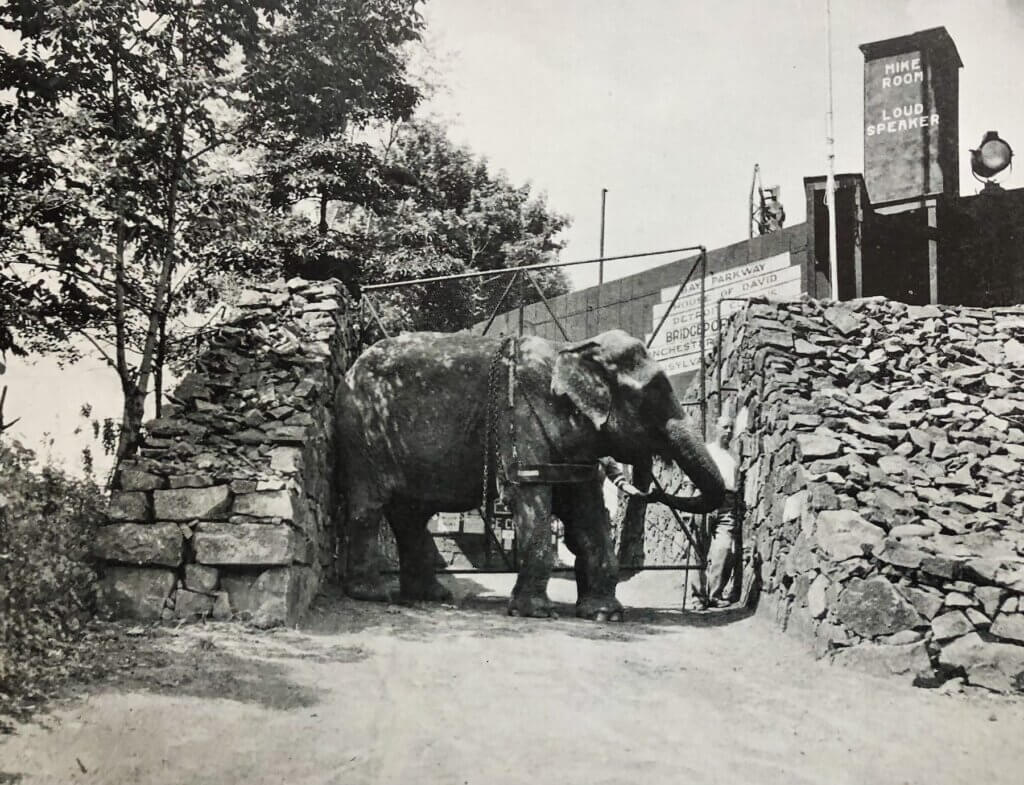
The posed image highlights Bernard’s flair for spectacle and his carefully cultivated public persona. “Old Mom” lived to the age of 93. Her death was noted in a New York Times obituary. Courtesy of the Historical Society of the Nyacks.
Bernard’s Airport
Bernard’s ambitions extended even further. He established Rockland County’s first airport, the Rockland Airport, located on Brewery Road in New City. 2,500 spectators attended the opening on Memorial Day 1928. Some spectators took rides on the planes. Pilots buzzed the crowds with barrel rolls, loops, and the dangerous “falling leaf” stunt. Everyone enjoyed the performance until a young parachutist slipped while exiting the cockpit of a plane and fell to earth, his chute unopened. After the accident, 55 undeterred people still paid $5 for their first plane ride over the county, including Hook Mountain and Rockland Lake.
The Clarkstown Country Club Closes
Over time, the club’s popularity eventually waned, leading to its gradual decline. After his lonely death in 1955, Nyack College and Nyack Middle School purchased the South Nyack property and divided the land between them.

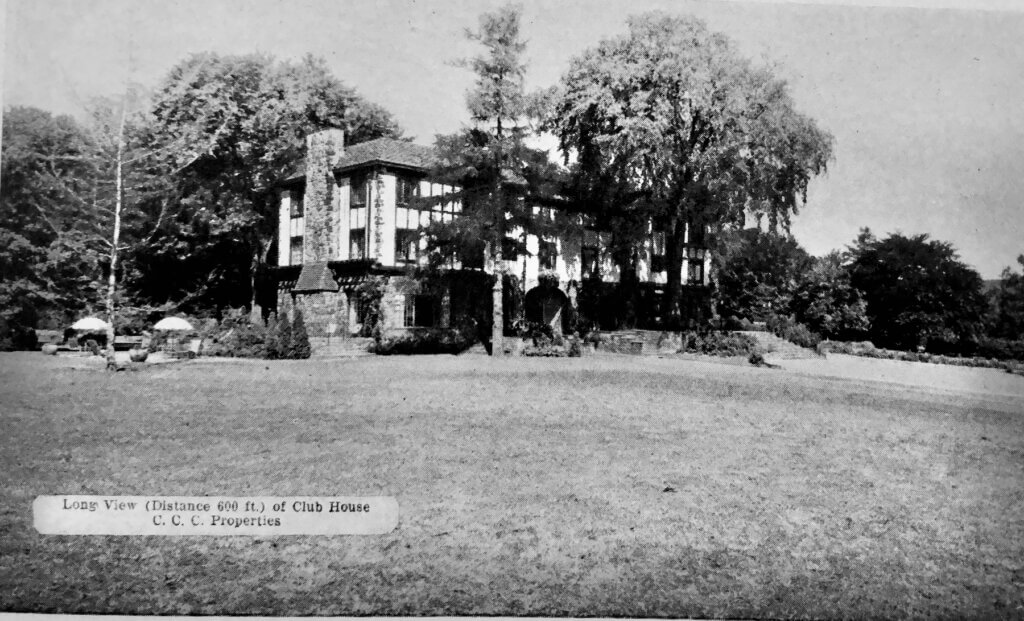
After the club’s closure, Nyack College adapted the building for academic use, preserving one of the site’s most prominent structures. Courtesy of the Historical Society of the Nyacks.
In Upper Nyack, owners sold the properties one by one. The Nyack Field Club now occupies the Midland Avenue side of the property. Various club dwellings and cottages are now private residences.
The Clarkstown Country Club left a lasting mark on Nyack, an unlikely place where yoga, spectacle, and modern ideas briefly converged in one extraordinary experiment.
About the author
Mike Hays has lived in the Nyacks for 38 years. After a career as an executive at McGraw-Hill Education in New York City, he now focuses on researching, writing, and interpreting local history.
He serves as Treasurer and past President of the Historical Society of the Nyacks. He is also a Trustee of the Edward Hopper House Museum & Study Center and Historian for the Village of Upper Nyack. In these roles, he works with community partners to preserve historic resources and expand public understanding of the area’s past.
Since 2017, he has written the popular Nyack People & Places column for Nyack News & Views. The series chronicles the history, architecture, and personalities of the lower Hudson Valley.
Hays has also developed museum exhibitions, written interpretive materials, and led well-attended walking tours that bring Nyack’s history to life.
He is married to Bernie Richey. He enjoys cycling, history walks, and winters in Florida. You can follow him on Instagram at @UpperNyackMike.