
Nyack History A to Z
Discovering the village, one letter at a time
This new series explores Nyack’s history through the alphabet, highlighting the people, places, events, and landmarks that helped shape the village. Some entries focus on famous names, others on forgotten corners of the community. Together they tell the larger story of Nyack’s past.
Burd Street runs through the heart of the village, linking the Hudson River to the village’s interior streets, and carrying with it layers of history. Named after Thomas Burd, an important Nyack resident, this street reflects the evolution of Nyack over the years.

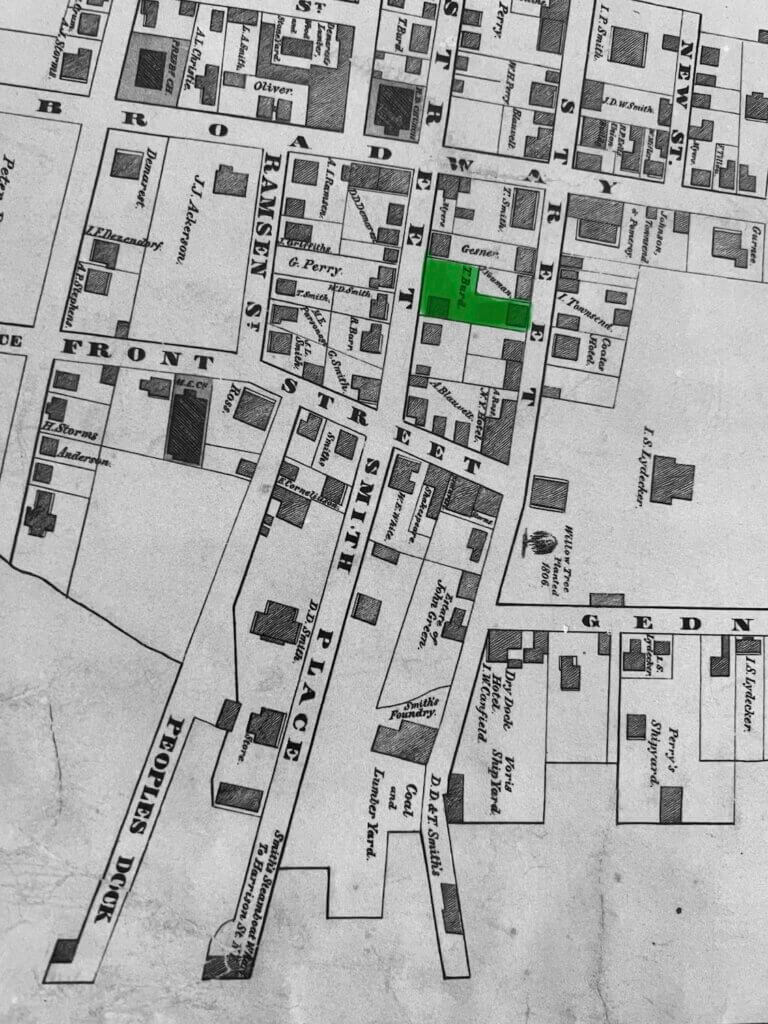
The street runs from the steamboat docks west to Broadway, passing the Dutch Reformed Church. Thomas Burd’s carpentry shop is highlighted in green. Courtesy of the Historical Society of the Nyacks.
Thomas Burd
Born in Haverstraw in 1804, Thomas Burd moved to Nyack around 1830. At 27, he married Emmeline Tallman, daughter of Hermanus Tallman, whose family had settled Nyack in the late 1600s and once owned much of the land from Depew Avenue to the Clarkstown line.
Burd helped shape Nyack’s early institutions. He was a founding member of the Orangetown Fire Company (1834) and a trustee of both Oak Hill Cemetery and the Rockland Female Institute, a women’s boarding school in South Nyack. His carpentry shop on Burd Street extended through the block to Main Street, employing many craftsmen and anchoring the growing village economy.

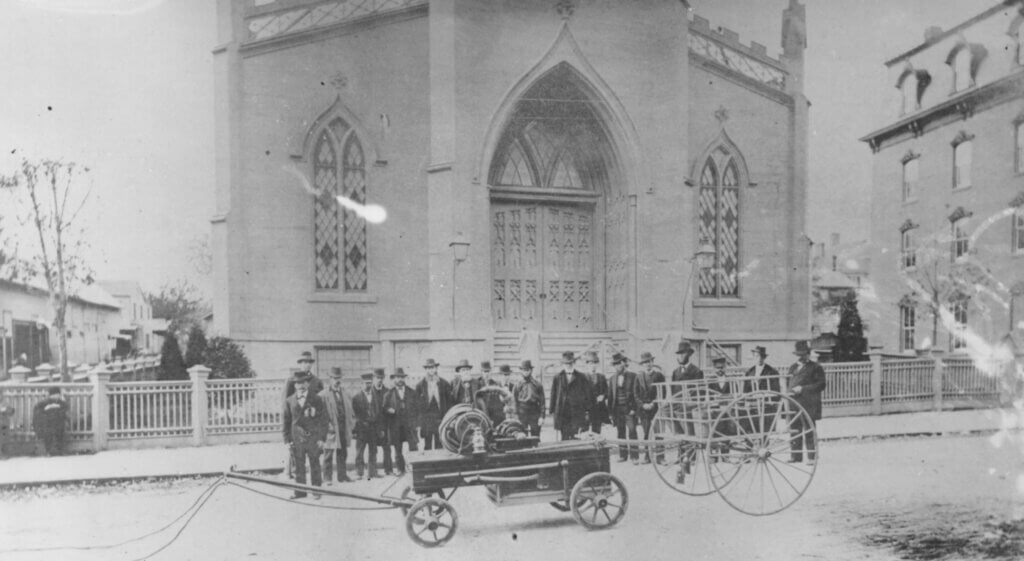
A local fire company stands in front of the building in this 1880 photograph. Courtesy of the Nyack Library.
Built by Burd
In 1835, Burd took on the carpentry contract for the Dutch Reformed Church on South Broadway, completing it in a year for $15,500—about $1.3 million today.
He also built two Italianate residences for Isaac P. and Tunis Smith, owners of the Nyack Steamboat Company. The houses, midway between Broadway and Park Street, ranked among Nyack’s finest, rivaling the Depew House at 50 Depew Avenue. Burd may have built that home as well; its design shares many features with his documented work.
After Tunis Smith’s death, his house became the Mansion House hotel and restaurant. Isaac Smith’s home was later moved to make room for the Harrison & Dalley department store. By the early 1900s, both buildings had disappeared, replaced by new commercial structures.
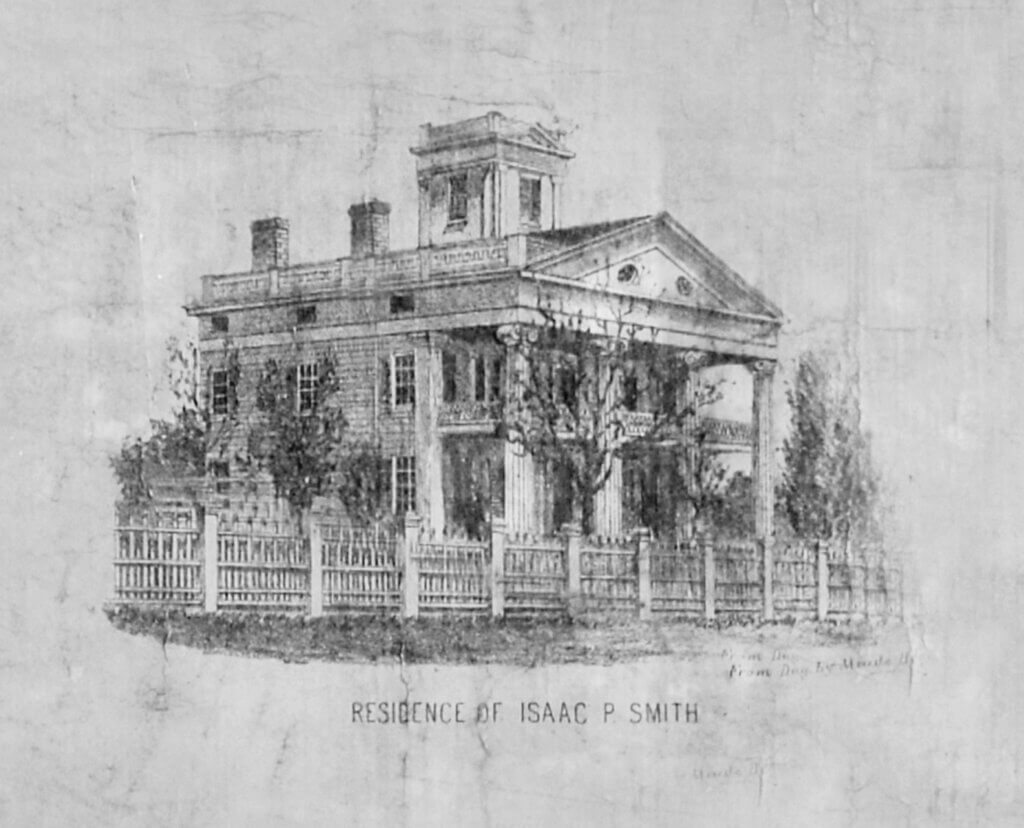
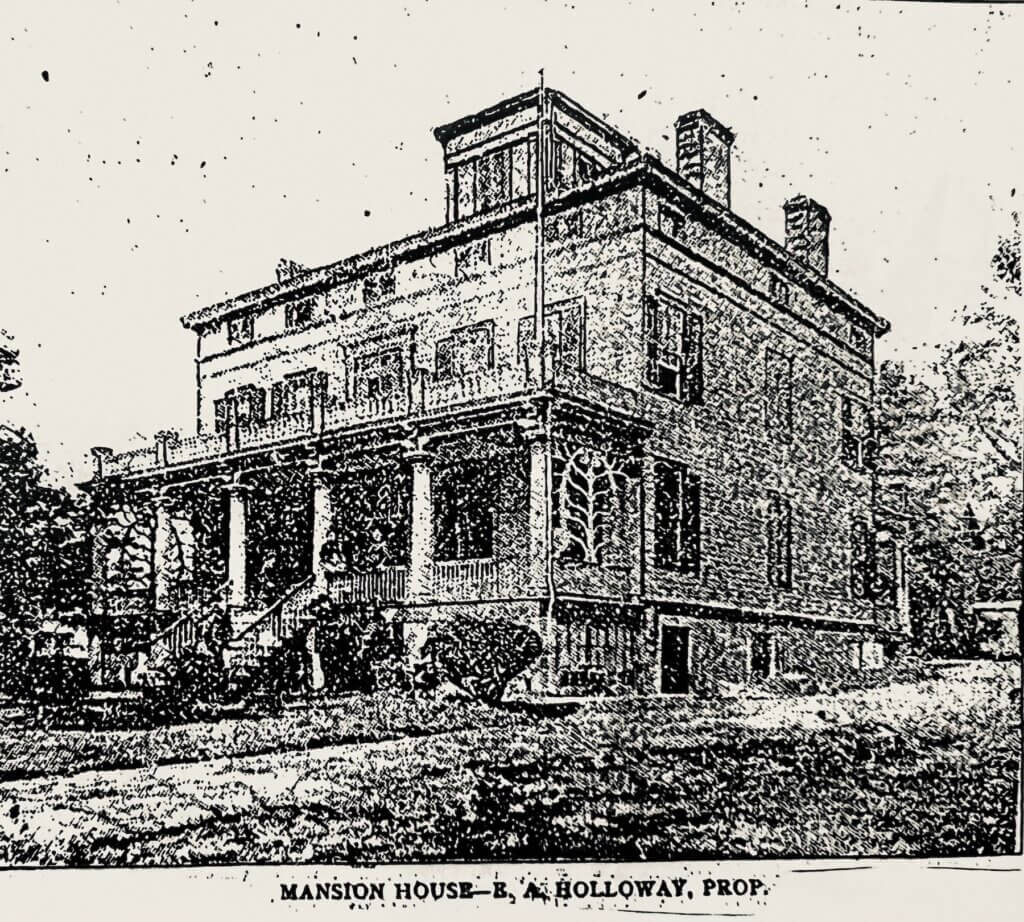
Houses built by Thomas Burd for Isaac Smith (left) and Tunis Smith (right).
These residences illustrate early high-style development along Main Street tied to Nyack’s steamboat economy. From an 1854 map of Nyack (left) and the 1888 Daily Graphic (right).
Burd Residence
The Burds lived northeast of the Pavilion, an early resort overlooking Main Street and Nyack Brook. Their handsome home faced High Avenue. In one memorable evening, the family hosted a musical gathering featuring a two-hour concert directed by their daughter Gertrude to raise funds for Grace Episcopal Church—an event that reflected both their taste and civic pride.


Thomas Burd’s home stood nearby in what was then largely open land overlooking Nyack Brook, before this area filled in with later development. Courtesy of the New York Public Library.
A Street of Many Names
In the early days, the section of Burd Street between the docks and Piermont Street was called Smith Place after the Smith brothers’ steamboat line and store near the docks. West of Piermont Avenue (then Court Street), maps from 1841 labeled it Jackson Street. By 1851, “Burd Street” had replaced both names, recognizing Thomas Burd’s growing prominence and business presence.
A Bustling Waterfront Corridor
Once as busy as Main Street, Burd Street led directly to the Smith brothers’ docks and their 1838 general store, then the largest in Rockland County. D.D. Smith also built an elaborate Italianate home near the river, later expanded into the Smithsonian Hotel. The street pulsed with the rhythm of commerce—wagons hauling lumber, workers heading to the docks, and steamboats arriving daily.

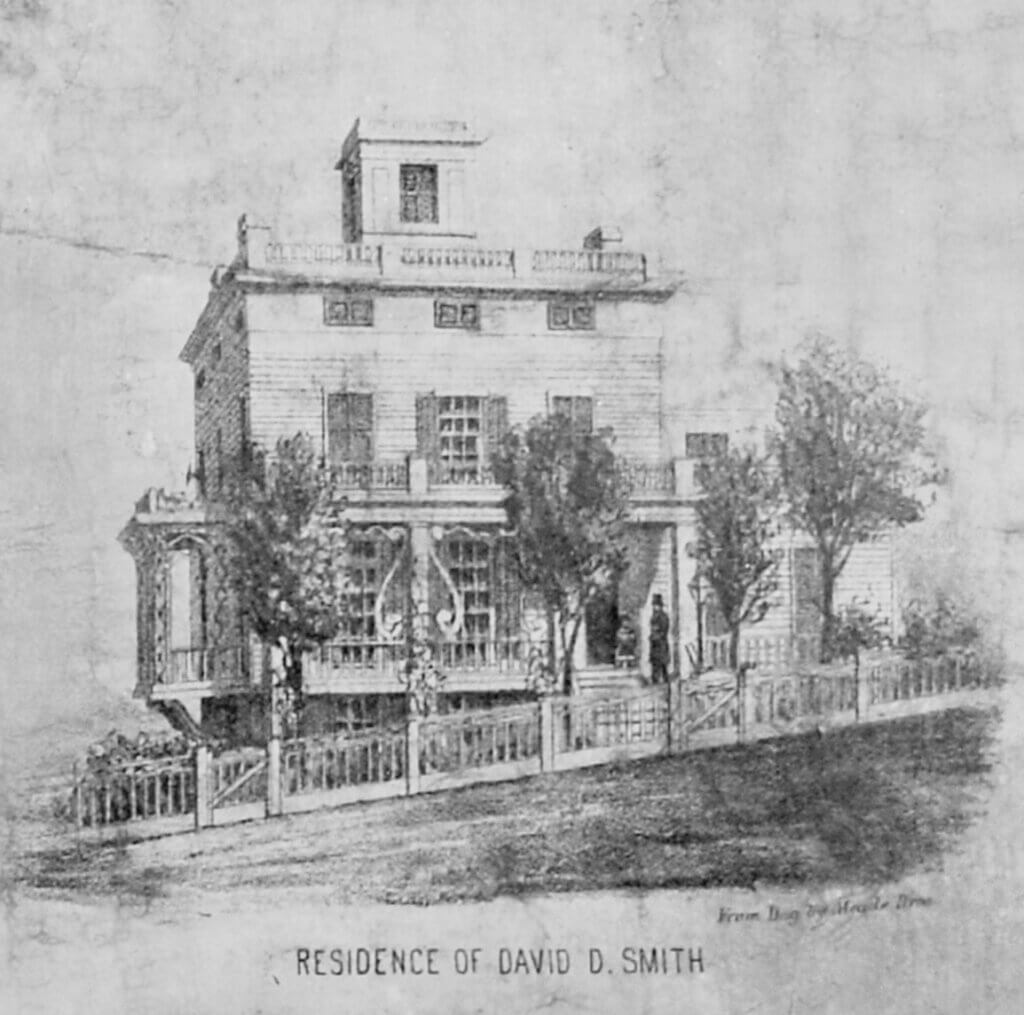
The residence later expanded into the Smithsonian Hotel, reflecting the street’s growing commercial importance. Courtesy of the Historical Society of the Nyacks.
Life Along Burd Street in the 1870s
A rare photograph taken around 1875 by local photographer Isaac Van Wagner captures Burd Street from the Smiths’ dock. To the left stood D.D. Demarest’s lumber yard and, beyond it, Smithsonian Hall, formerly the Smiths’ store, renovated for multiple businesses. Next came the Smithsonian Hotel, an enlarged version of D.D. Smith’s residence. Across the street, the Nyack Foundry operated just out of frame.

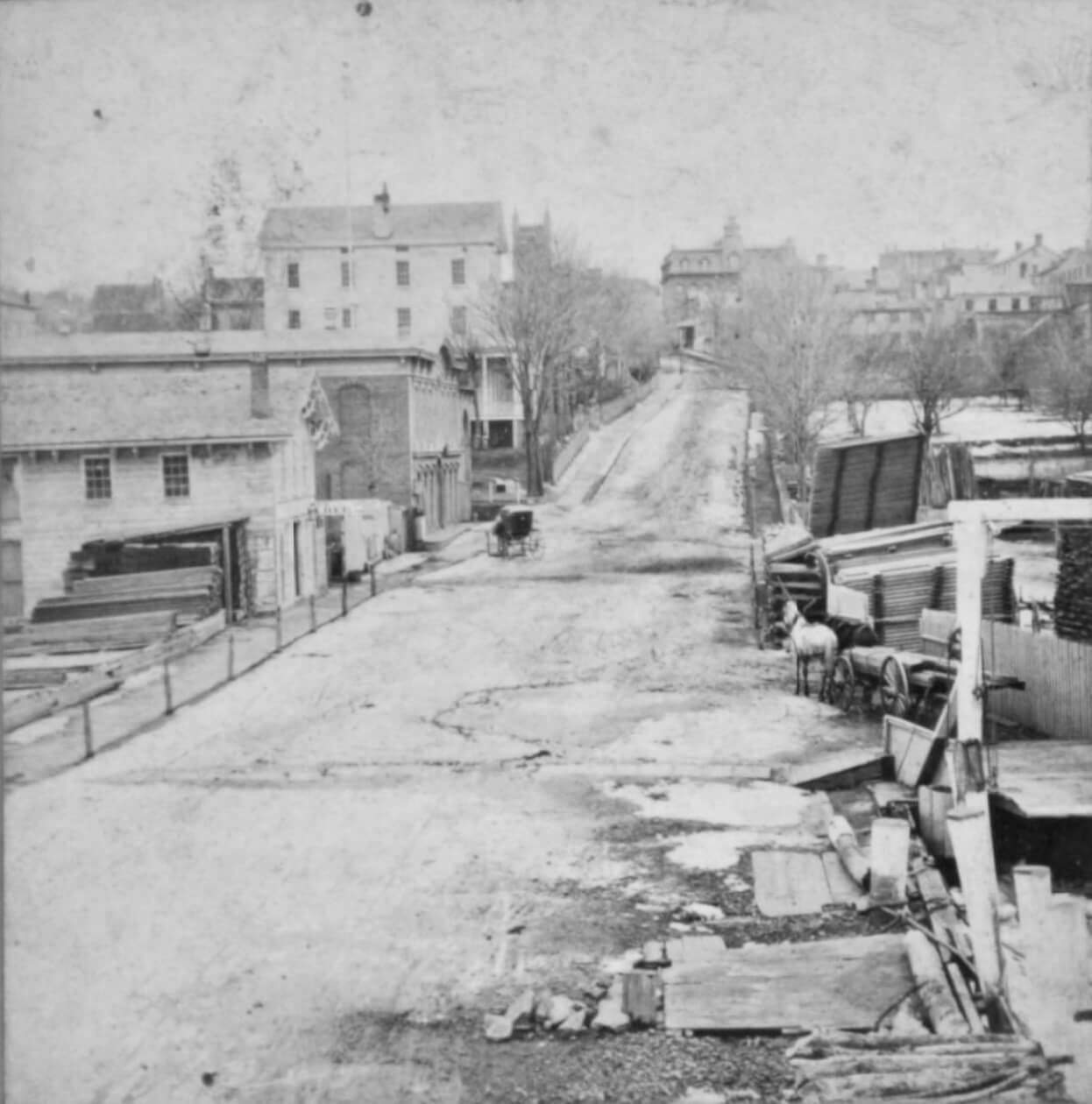
Photographed by Isaac Van Wagner, this stereoscopic image captures Nyack during a period of rapid post–Civil War growth, as the waterfront bustled with industry, commerce, and daily life. Courtesy of the New York Public Library.
The intersection of Burd and Piermont Streets formed one of the village’s busiest commercial corners. The Rockland County National Bank occupied one corner before becoming the Rockland County Hotel and later the office of the Nyack Evening Star. Other corners featured William White’s grocery and liquor store and G.A. Smith’s ice cream saloon.
In the distance, the square tower of the Dutch Reformed Church rose over the horizon. To the north stood the Commercial Building with its mansard roof. In the late 1880s, the Hotel St. George joined the scene, adding to the street’s reputation as one of Nyack’s busiest corridors.
Burd Street Today
Today, Burd Street is quieter. The docks are gone, and business long ago shifted west to Main Street. Yet reminders of its past remain: the Hotel St. George, the Dutch Reformed Church tower, and the two-part building at 55–57 Burd Street, its frieze decorated with a whimsical playing-card motif.

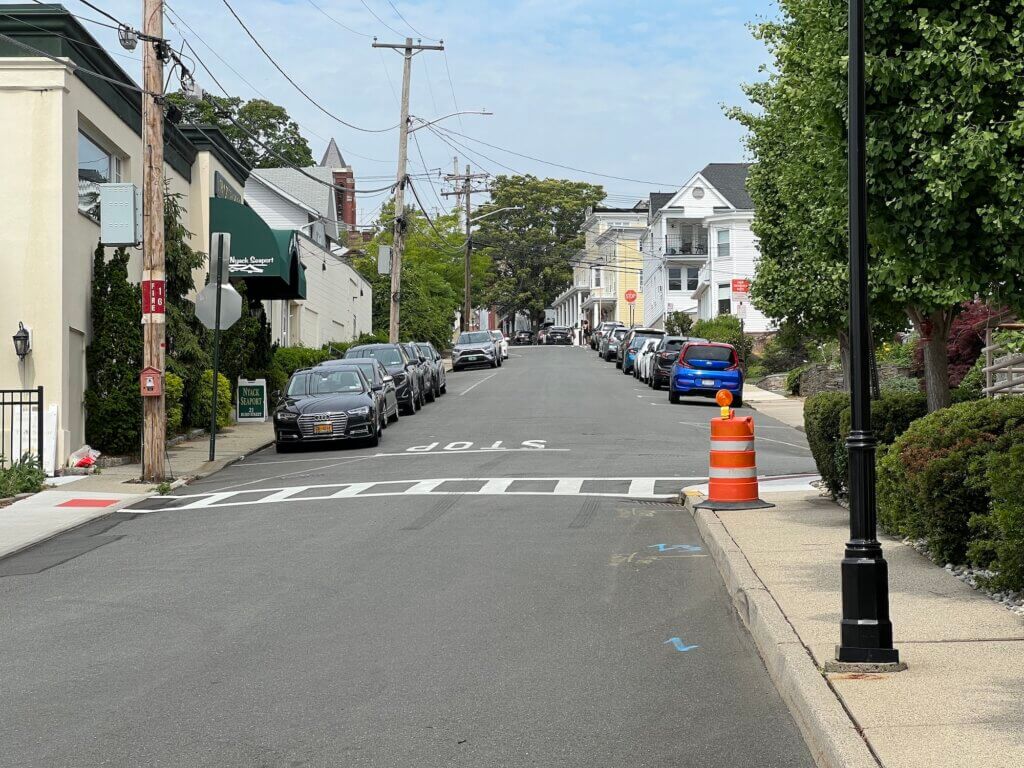
The square tower of the Dutch Reformed Church rises in the distance; the yellow building at right is the former Hotel St. George. Photograph by the author.
Burd Street remains one of the clearest links to early Nyack, preserving the legacy of Thomas Burd and the waterfront economy that helped transform a small river settlement into a thriving village.
Next up: “C” is for the Clarkstown Country Club
About the author
Mike Hays has lived in the Nyacks for 38 years. After a career as an executive at McGraw-Hill Education in New York City, he now focuses on researching, writing, and interpreting local history.
He serves as Treasurer and past President of the Historical Society of the Nyacks. He is also a Trustee of the Edward Hopper House Museum & Study Center and Historian for the Village of Upper Nyack. In these roles, he works with community partners to preserve historic resources and expand public understanding of the area’s past.
Since 2017, he has written the popular Nyack People & Places column for Nyack News & Views. The series chronicles the history, architecture, and personalities of the lower Hudson Valley.
Hays has also developed museum exhibitions, written interpretive materials, and led well-attended walking tours that bring Nyack’s history to life.
He is married to Bernie Richey. He enjoys cycling, history walks, and winters in Florida. You can follow him on Instagram at @UpperNyackMike.