A Sophisticated Store in a Muddy Village
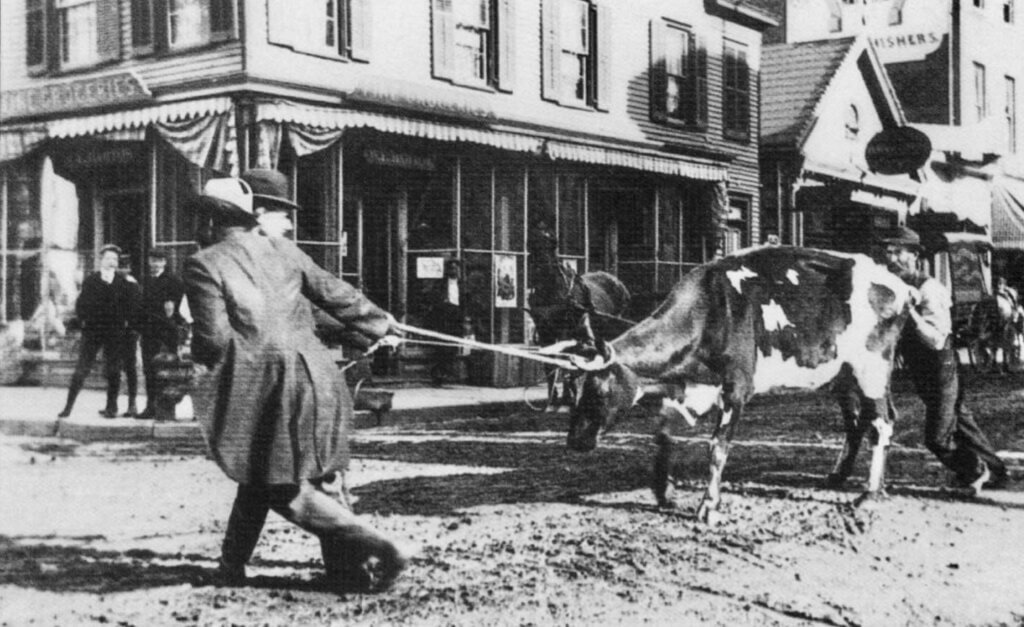
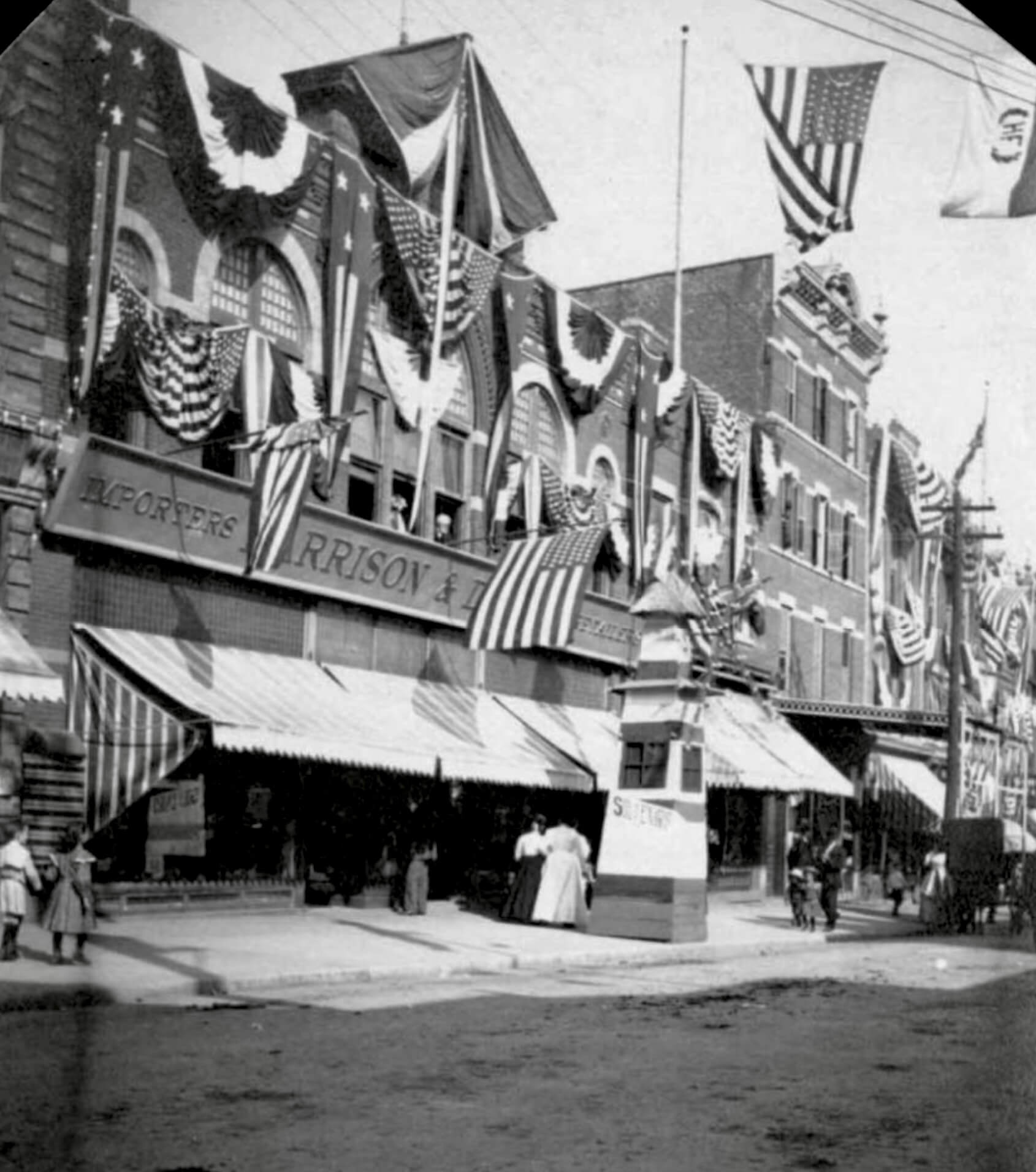
In the 1890s, boys still played ball in vacant lots along Main Street, cattle wandered nearby, and mud after heavy rain could rise nearly to the knee. Yet in the middle of this rough village stood Harrison & Dalley, an elegant department store with fashionable display windows, pneumatic cash tubes, imported furnishings, and the latest styles from New York City.
For more than four decades, Harrison & Dalley helped transform downtown Nyack from a river village into a modern shopping district. The store advertised itself as “A City Store in the Country,” and for many residents of Rockland County, that description rang true.
John W. Harrison and John W. Dalley arrived in Nyack during the late 1880s after emigrating from Rochester, Kent, in England. Lifelong friends and business partners, they had already worked in the dry goods trade before opening their first Nyack business in 1887. Two years later, they purchased Abram Merritt’s dry goods and carpet store at the southeast corner of Main Street and Broadway and renamed it the Boston Store.
At the time, the phrase “Boston Store” suggested refinement and fashion. Harrison and Dalley clearly understood their audience. Wealthy summer residents increasingly arrived in Nyack during the Gilded Age, while year-round villagers wanted access to the same goods and styles available in New York City.
Building Modern Main Street
Within a short time, the partners purchased part of the old Isaac P. Smith property on Main Street. Smith had operated one of Nyack’s early steamboat businesses with his brothers, and his large house still occupied the site. Rather than demolish it, workers moved the structure to the rear of the lot facing what became New Street, where it served as overflow storage.
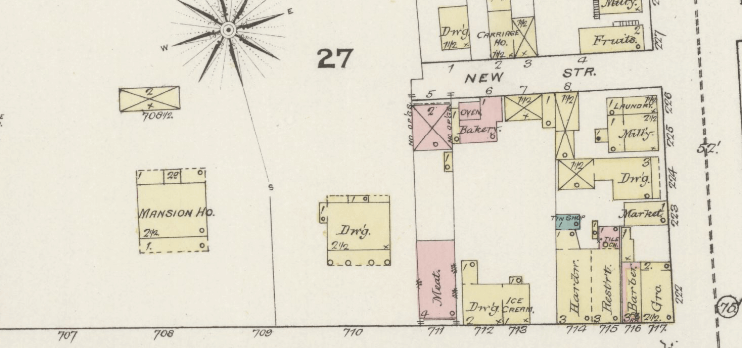
At the time, Main Street west of Broadway remained surprisingly undeveloped. Only a handful of brick commercial buildings stood nearby. Isaac Neisner, whose family clothing business dated to the 1890s, later recalled boys playing baseball in vacant lots nearby. During wet weather, Main Street became a muddy mess. Harrison & Dalley installed the first concrete sidewalk in downtown Nyack in 1903.
In many ways, modern downtown Nyack grew up around the department store.
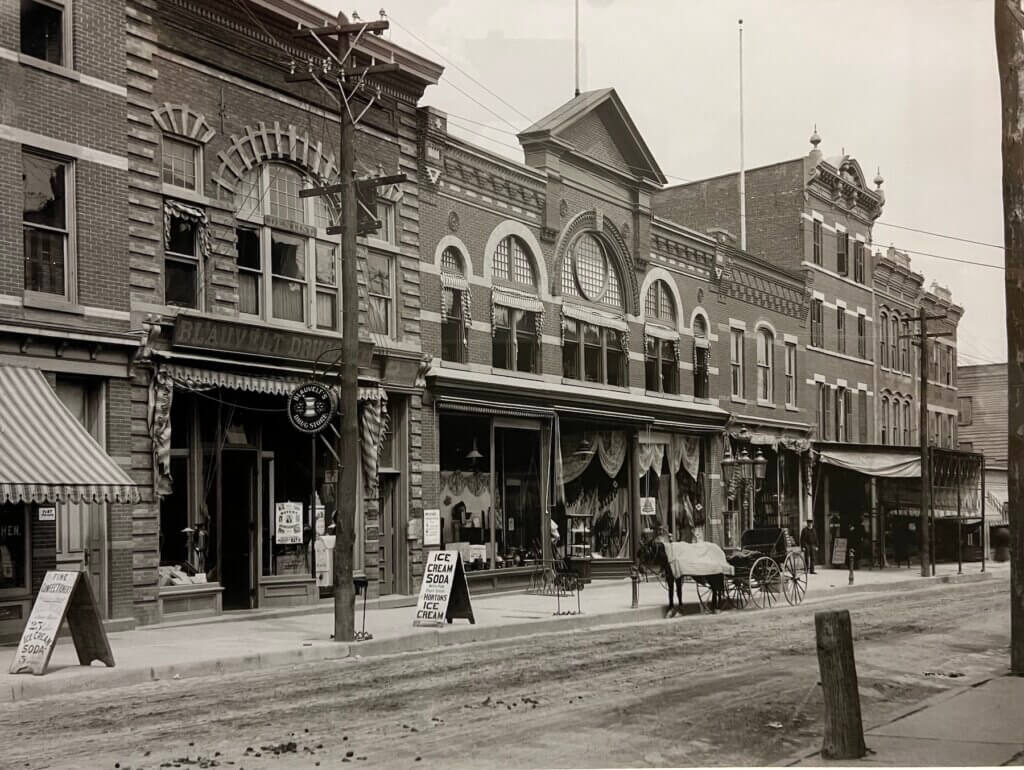
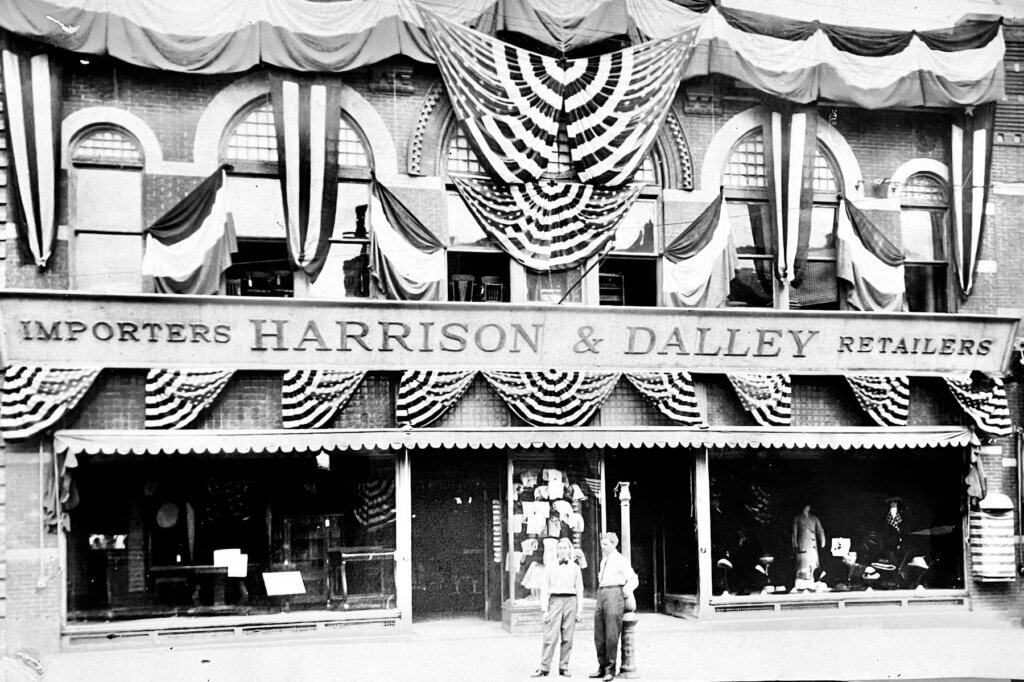
The celebrated local architecture firm Emery Brothers designed Harrison & Dalley’s new Main Street building, which opened in 1892. The new building looked far more urban and modern than most of downtown Nyack at the time. Twin entrance doors framed a central display case. Large storefront windows showcased merchandise to pedestrians. Above the second floor rose a triangular pediment topped by a flagpole. Decorative lunettes with circular panes crowned the upper windows. Striped awnings shaded the sunny south side of Main Street.
The store expanded steadily over the years, eventually stretching through the block toward New Street. A garage built by the company in 1912 still survives there today bearing the Harrison & Dalley name.
Inside Harrison & Dalley
Inside, the store offered many villagers their first true department store experience. Separate departments specialized in furniture, carpets, upholstery, clothing, millinery, jewelry, toys, perfumes, and household goods. Knowledgeable clerks staffed each section. Customers examined sample merchandise displayed on counters and in glass cases while clerks retrieved additional stock from cupboards and storerooms.
The store became especially famous for its atmosphere during holidays and seasonal openings.
An Easter display in 1903 transformed the building into a spring garden. According to the Rockland County Journal, “Never has the store been more beautifully decorated.” Nile green and white decorations filled the store. Morning glories and apple blossoms hung overhead. Mechanical songbirds filled the air with music. Customers received souvenirs shaped like Easter eggs while clerks served ice cream, cake, and coffee.
The millinery department drew particular attention. That season’s fashionable hats appeared large and flat, trimmed with small flowers and ribbons. One display window featured a child emerging from an Easter lily surrounded by doves and flowering apple trees.
“Sailing in a Silver Boat”
Yet perhaps no feature fascinated shoppers more than the pneumatic tube system.
The pneumatic tube system represented modern retail at its most magical. Sales clerks placed cash inside silver metal carriers that shot overhead through pneumatic tubes toward a central cashier on the upper floor. Moments later, the carrier returned with a receipt and change.
Children often stood transfixed watching the tubes race across the ceiling.
Florence Ripley Mastin of Piermont later immortalized the experience in her poem Old Nyack’s Department Store:
“The woman at the counter took the money
And sent it sailing in a silver boat
Along a humming wire…”
Upper Nyack resident Gene Brown remembered the same wonder during the 1930s. As a boy, he watched the tube disappear through a hole in the ceiling before returning moments later carrying silver and copper coins.


Department store pneumatic tube systems similar to the one used at Harrison & Dalley. Networks of pressurized tubes carried cash, receipts, and change between sales counters and a central cashier’s office. The systems became symbols of modern retail efficiency and fascinated generations of shoppers who watched the silver carriers race overhead through the ceiling. Courtesy of Wikimedia Commons.
For decades, Harrison & Dalley stood at the center of downtown life. Then, on the morning of October 13, 1915, disaster struck.
The Fire of 1915
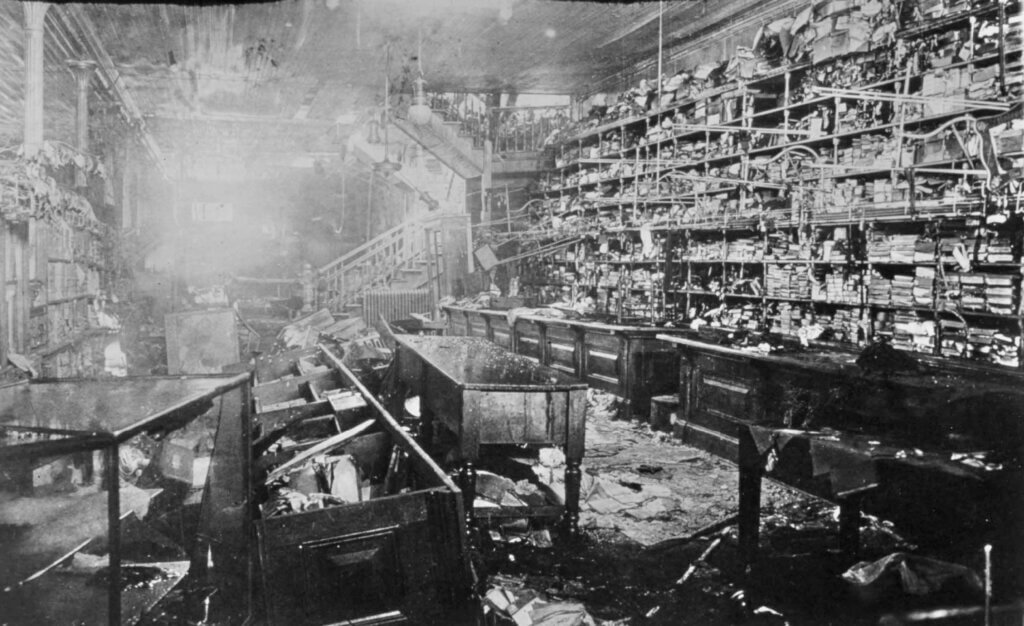
The fire started in the basement near crates and excelsior stored beside the elevator shaft. Employees initially attempted to extinguish the flames themselves rather than immediately summon firefighters. That delay proved costly. The fire spread quickly through the elevator shaft and central stairway, turning them into chimneys feeding flames upward into furniture, wicker, and rolls of linoleum.
By the time local fire companies arrived around 11 a.m., the blaze had already advanced through much of the building.
Hundreds of villagers crowded Main and New Streets to watch the battle unfold. Firefighters attacked the flames from both sides of the structure while ladders rose toward the roofline. Twenty streams of water poured into the building at once. Smoke rolled through downtown.
Then came the crash.
After burning through weakened floors, the store’s massive two-ton safe plunged downward into the basement with a roar heard across downtown. Around noon, the roof collapsed.

Saving Downtown
The fire burned so intensely that paint blistered on nearby buildings and fire equipment. Twelve firefighters lost consciousness from smoke and escaping gas. A falling brick knocked one fireman unconscious while another was blasted backward by a ruptured hose line.
Departments from Central Nyack, Suffern, Pearl River, Piermont, Spring Valley, Congers, and Haverstraw responded to prevent the flames from spreading across downtown. Their efforts succeeded. Despite severe smoke and water damage to neighboring businesses, the fire remained largely confined to Harrison & Dalley.
The original building, however, was destroyed.
Remarkably, the business itself survived.
John W. Dalley returned immediately to Nyack and reopened operations within days by renting temporary space throughout downtown. Furniture, rugs, dry goods, millinery, and clothing appeared in scattered storefronts along Main Street and South Broadway. By Christmas, Harrison & Dalley advertisements once again filled local newspapers.
From Harrison & Dalley to Woolworth‘s
The rebuilt Main Street store reopened in 1916, but the building looked very different. The ornate triangular pediment disappeared. The elegant lunettes vanished. The upper façade became simpler and more restrained, reflecting the changing architectural tastes of the early twentieth century.
In many ways, the rebuilding symbolized a broader transition in Nyack itself. The ornate confidence of the Gilded Age gave way to a more modern commercial world.
Harrison & Dalley continued operating until 1934. Soon afterward, F. W. Woolworth moved into the building, beginning another long chapter in downtown retail history. Woolworth remained there until 1993, long after department stores like Harrison & Dalley had disappeared from small-town America.
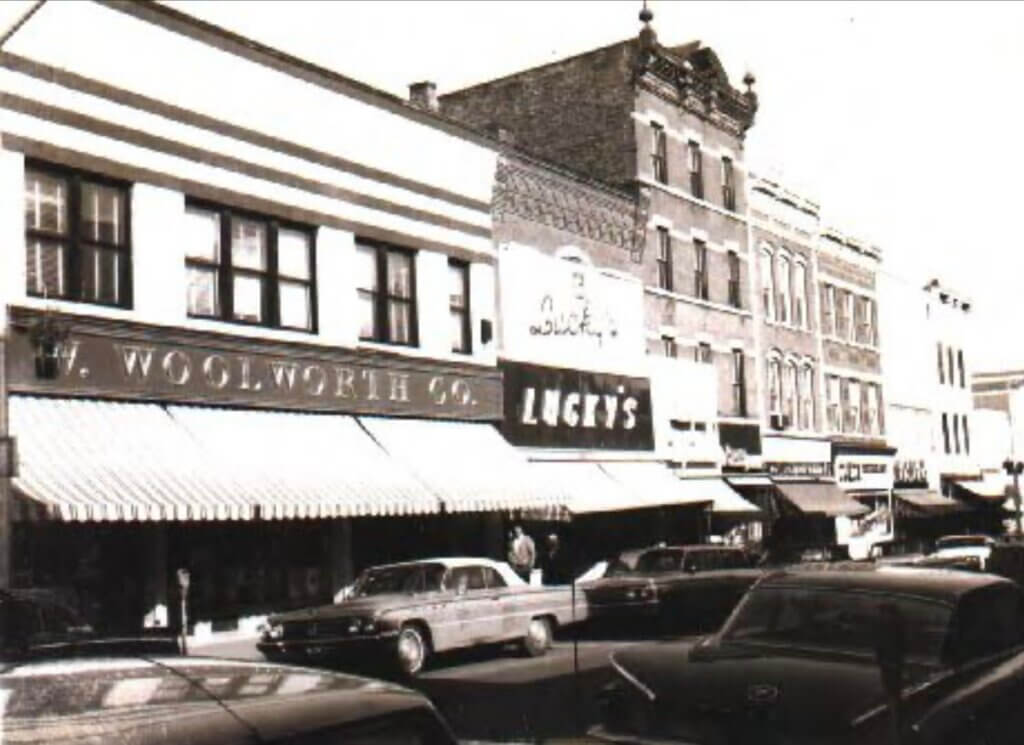
Today, shoppers still pass beneath the surviving Woolworth sign on Main Street with little indication of what once stood there. The pediment is gone. So are the pneumatic tubes, the elaborate holiday displays, and the humming sales floors filled with carpets, hats, and furniture.
Yet the building still anchors downtown Nyack, preserving traces of the moment when a muddy Hudson River village first imagined itself as something larger and more modern.

Note: An earlier two-part version with more details of the fire appeared in January 2023
About the author
Mike Hays has lived in the Nyacks for 38 years. After a career as an executive at McGraw-Hill Education in New York City, he now focuses on researching, writing, and interpreting local history.
He serves as Treasurer and past President of the Historical Society of the Nyacks. He is also a Trustee of the Edward Hopper House Museum & Study Center and Historian for the Village of Upper Nyack. In these roles, he works with community partners to preserve historic resources and expand public understanding of the area’s past.
Since 2017, he has written the popular Nyack People & Places column for Nyack News & Views. The series chronicles the history, architecture, and personalities of the lower Hudson Valley.
Hays has also developed museum exhibitions, written interpretive materials, and led well-attended walking tours that bring Nyack’s history to life.
He is married to Bernie Richey. He enjoys cycling, history walks, and winters in Florida. You can follow him on Instagram at @UpperNyackMike
Editor’s note: This article is sponsored by Sun River Health and Ellis Sotheby’s International Realty. Sun River Health is a network of 43 Federally Qualified Health Centers (FQHCs) providing primary, dental, pediatric, OB-GYN, and behavioral health care to over 245,000 patients annually. Ellis Sotheby’s International Realty is the lower Hudson Valley’s Leader in Luxury. Located in the charming Hudson River village of Nyack, approximately 22 miles from New York City. Our agents are passionate about listing and selling extraordinary properties in the Lower Hudson Valley, including Rockland and Orange Counties, New York.