

A Flash Sketch Mob will form at the Edward Hopper House on Saturday, October 10, creating dynamic and interpretive new views of Nyack.
Centered around stops on a walking tour of Hopper’s Nyack, artworks made en masse by artists of all skill levels will capture the streetscape, places, sights and people of our village.
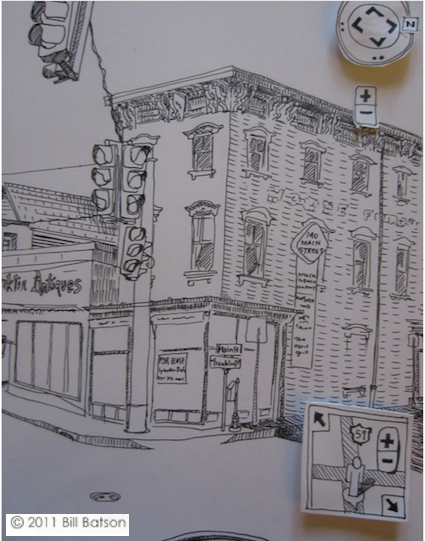
What’s a Flash Sketch Mob? This social practice art project came from a NyackNewsandViews.com column entitled “Nyack Sketch Log Versus Google Maps” published on October 11, 2011 and shown below.
The column argued that a handmade landscape of a place creates a superior record of life to that of Google maps, which are made by surveillance cars equipped with periscope cameras. I called for a “muscular humanity that will allow human values and frailties to persist in an increasing artificial world.”
I made the ambitious claim that I would, singlehandedly, create a one-square-mile- panoramic landscape portrait of Nyack. About a dozen solo plein-air efforts later, I realized I couldn’t do it alone and invited a community of creatives to help me get the job done — and the Flash Sketch Mob was born. (Spoiler alert: If one John Henry can’t beat the steam-powered drill – find ninety-nine more John Henrys!)


Since that column was posted, over 1,000 comrades in culture, of all skill levels, have participated in Flash Sketch Mobs, collectively chronicling Broadway in Nyack from Second Ave and Cider Hill, most of Main Street, Liberty Elementary and Blue Rock schools, portions of Garnerville Arts Center and Upper Nyack’s River Hook Preserve and the Nyack Farmers Market and the Rockland Center for the Arts.
As the project evolved, institutions like the Edward Hopper House and global Urban Sketcher movement have sought to elevate plein-air art-making into a powerful public art form that celebrates culture and community.


If you participate, you will learn the translation of this modified latin phrase that starts each mob of makers: Veni, Vidi, Sketchi!
October 11, 2011
Nyack Sketch Log Versus Google Maps by Bill Batson
Like John Henry, I am at war with a machine. My antagonist is not a steam powered drill, but Google Maps. What my nemesis accomplishes through satellite surveillance and cars equipped with periscope cameras, I endeavor to create with my humble sketch pad and pen. Just like the hero of legend Henry, I will never, ultimately, outlast the machine. What I hope to do is to complete a visual record of every inch, object, vista and structure in my village that will remind us that handmade, no matter how much slower, shakier or flawed, has a greater intrinsic value than the synthetic alternative.
These drawings are my training camp for this far more ambitious campaign. Eventually, I would like to expand Nyack Sketch Log to accommodate a universal streetscape depiction of the village. Presently, I am working my way up to the task. Like John Henry, who spent years slamming a steel hammer onto a steel spike, I am building momentum by dragging a black pen across white paper that I will need to rival the computer-generated version of reality. I am not yet a virtual cartographer. I still select my subjects randomly and out of sequence.
Eventually, I wish to surrender serendipity and assume the methodical attitude of the machine. I may have contempt for the impact of the machine on certain aspects of our culture, but I also respect the cold logic of these devices that are ultimately an invention and reflection of mankind. Unlike their creators, machines don’t tire like a frail body or lose focus like an undisciplined mind. The beauty of a computer or a camera is its universality. Machines won’t linger on objects that they like, avoid what they abhor or bounce around like a human mind rebelling against the monotony of discipline. Machines finish whatever they start, maintaining the highest standard of excellence.
But as the high fashion world knows all too well, imperfection is an essential part of human beauty. When my mother had a set of teeth made for her recently, the dentist warned that the final mold had to be imperfect. If a dental implant is composed of teeth that are too symmetrical, the human eye senses that they are false teeth. Subtle variations and asymmetry distinguish the creations of nature from the fabricated output of a machine.
As unyielding and unerring reproducers, machines make duplicates, never originals. Every structure that I record, manually, through my sketch log was constructed by human hands. Handcraftsmanship imparts a human spirit into an object. The absence of the human hand is what makes Google Maps a relative to the steam powered drill of John Henry legend, and henceforth, my adversary. The Google Map will always be superior to my super-sized sketch log as a navigation tool. But as an archive of our collective time on the planet, I believe the artistic record reigns supreme.
We have reached the tipping point in our relationship with the machine. During the summer you can see people use mechanical equipment to groom their yards and gardens, hogging energy that is not renewable and ignoring an excellent opportunity to engage in some cardio. If you drew a bar graph describing the shortening of the attention span of modern man, how steep a line would you have to draw to connect the hand written letter to Twitter?
In a culture where machines do the physical work, will people become soft? In an era when machines perform all the mental work, will people become vapid? Could we reach a point in our society where we become as dependent on our machines as a critically ill patient is on life support? What would happen if our plug gets pulled? Will the dynamic eventually shift making the machine the operator and the human the tool?
A phenomenon I observed while traveling overseas illustrates the limits of mechanical reproduction. When you attempt to use a camera to take a picture of a person in some parts of the world, you risk an indignant assault. Some cultures view the mechanical lens as at best an intrusive instrument, at worse a soul thieving contraption. But when you approach the very same party with a sketch pad, the results are radically different.


I know that without a computer and an Internet connection I could not transmit this screed. Would John Henry have turned down a ride on a locomotive on his way to his fateful duel? The point of this exercise is not to win outright or without contradiction. I simply wish to demonstrate a muscular humanity that will allow human values and frailties to persist in an increasing artificial world, whether through legend or artifact which in this case will be a hand drawn map.
Artist and activist Bill Batson lives in Nyack, NY. “Nyack Sketch Log Versus Google Maps” Copyright 2011, Bill Batson.