Nyack History At to Z
Nyack’s First Prominent Summer Resident
For decades, one of Upper Nyack’s most famous houses was said to have been built by a French pirate. The story included imported bricks, smuggling, and a secret tunnel to the Hudson River. Almost none of it was true.
The real story began around 1840, when North Broadway was still lined largely with farms and the grand summer estates of the Gilded Age were decades away. Hugh Maxwell, a successful New York City lawyer and political figure, acquired an 80-acre farm and built what was probably the largest house in Nyack at the time.
Maxwell became the first person of regional or national prominence to make Nyack his summer home. Others would follow. In time, their estates would transform North Broadway and Upper Nyack. Yet strangely, Maxwell himself was largely forgotten. The pirate wasn’t.

A New Yorker Comes to Nyack
Born in Scotland, Maxwell immigrated with his family to New York City in 1790. Before graduating at the top of his class at Columbia in 1811, he became involved in a free-speech protest that resulted in his arrest for inciting a riot. The prosecutor was future New York governor DeWitt Clinton. Maxwell lost the case and paid a $200 fine.

Maxwell went on to become a successful and sometimes formidable attorney. During the War of 1812, Secretary of War James Monroe appointed him Assistant Judge Advocate of the U.S. military. From 1819 to 1829, Maxwell served as District Attorney for the City of New York, where he prosecuted prominent defendants, including politically connected Tammany Hall figures. One acquitted defendant was angry enough to challenge him to a duel, although the duel never took place.
Maxwell also became an influential Whig, the major early nineteenth-century rival of the Democrats. His political connections eventually brought one of the most important federal appointments in New York. President Zachary Taylor named him Collector of the Port of New York, a prestigious Federal position overseeing the customs revenues generated by one of the nation’s busiest ports.
This was the man who chose Nyack for his country home.
An Estate on North Broadway
Maxwell purchased an 80-acre farm once owned by Benjamin Knapp. The property followed the pattern of Upper Nyack’s old farms, running in a long strip from the Hudson River west beyond today’s Midland Avenue. Knapp had acquired the land before the Revolutionary War from the Kuyper family, Upper Nyack’s earliest European settlers.

Around 1840, Maxwell built a three-story brick mansion in the federal style facing North Broadway. A broad veranda faced the road, with a semicircular drive. This was no ornamental country place alone. Fifty acres remained under cultivation, and six people worked the farm and maintained the house.
Maxwell did more than retreat to Nyack for the summer. Over the years, he became an active participant in local affairs serving as president of the Rockland Bible Society, speaking at the 1851 cornerstone ceremony for the Rockland Female Institute, and later, taking part in the dedication of a memorial to Colonel Edward Pye, who died during the Civil War. His local involvement also extended to Stony Point, where he supported the installation of a gas light for the lighthouse lens and spoke at an anniversary observance of the Revolutionary War battle.
Maxwell also entertained friends at his summer home. Marian Gouverneur later remembered childhood visits by her family to the Maxwells in Nyack. A local newspaper recalled Maxwell’s many summers in Upper Nyack and the “dignified presence, the silvery hair and the kindly smile” familiar to residents. Even at 85, he rode his horse into downtown Nyack every day during the summer.
After Maxwell
Maxwell died in 1871 and was buried in Oak Hill Cemetery, but settling his estate proved almost as complicated as some of the cases he had prosecuted. His $150,000 estate was divided among four children and two grandchildren. Heirs and an executor died, a lawsuit followed, and the estate remained unsettled for more than thirty years. A court ordered its final partition in 1902.
The Nyack Country Club
In 1891, while the Maxwell estate was still unsettled, his heirs leased the house and grounds to the newly formed Nyack Country Club. Maxwell’s private summer estate became one of Nyack’s principal social centers.
The club enlarged the mansion with a new wing for dancing, dining, and theatrical performances. Tennis courts appeared along North Broadway and hosted sanctioned tournaments and leading players of the day. Behind them stretched a nine-hole golf course, an archery range, stables, and a bridle path along North Midland Avenue.
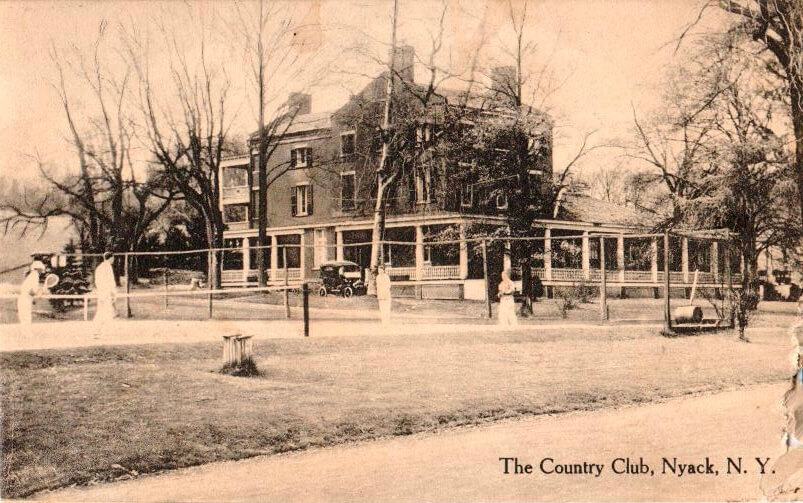
After the estate was finally partitioned in 1902, Van Wyck Rossiter purchased much of the property for $20,000 and continued leasing the house and grounds to the club.
The Magnificent OOM Arrives
In 1919, Pierre Bernard, the flamboyant yoga teacher known as the Magnificent Oom, acquired much of the former Maxwell estate after the Nyack Country Club departed. His followers first called their new home the Braeburn Country Club and named the mansion the Brick House. Later, Bernard called his holdings the Clarkstown Country Club.
Yoga was still exotic enough to shock some villagers. Women in athletic clothes and bloomers performed asanas on the lawns of the former Maxwell estate. Morton Lexow, Clarence Lexow’s brother and then Rockland County District Attorney, called for an investigation, declaring that Nyack “was not the place for a man like Bernard.” The sensational New York press that had followed Bernard to Nyack soon joined in.
During one police raid, investigators reportedly discovered an underground passage leading beneath North Broadway toward the river. Newspapers speculated that it might be Bernard’s escape route—or even a place for imprisoning young women. The raid uncovered no wrongdoing. Police Chief Bill Wanamaker summed it up simply: “they didn’t get anything on him, Bernard’s alright.”
The Pirate Who Wasn’t There
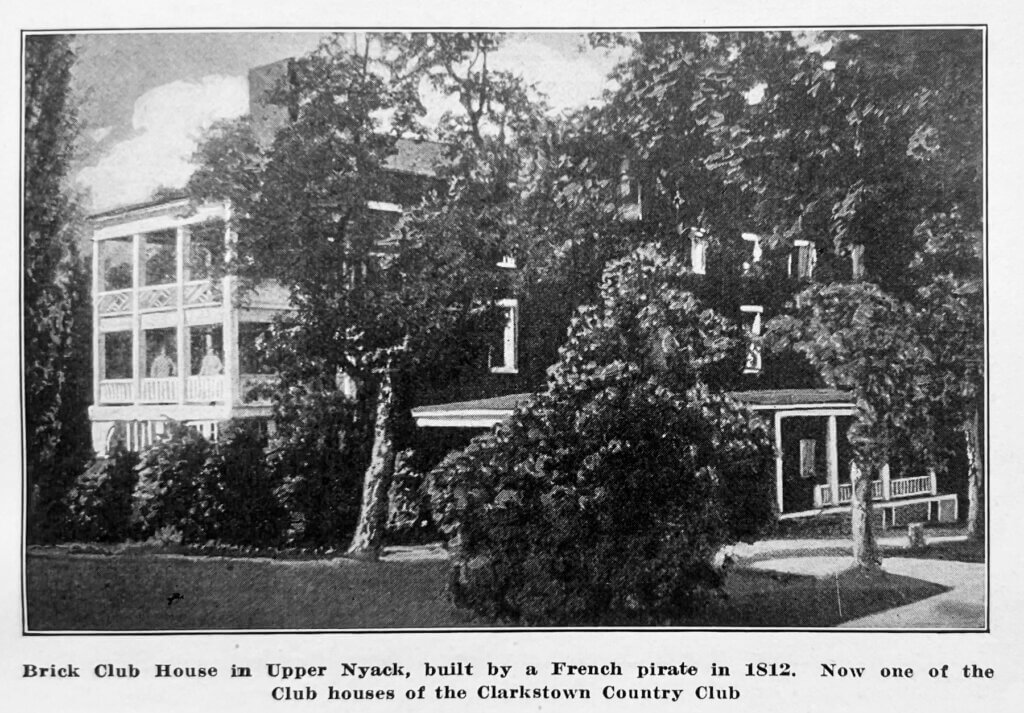
By the 1920s, the legend made its way into published accounts. The 1927 Rockland County Redbook confidently repeated the story:
“The house was built about 1812 by a French pirate and smuggler and a tunnel was discovered leading to the water, giving color to the story. Rumor has it the bricks came from France.”
1927 Rockland County Redbook
There was just one problem. The house had been built around 1840, not during the War of 1812, and the owner was not a mysterious French pirate. He was Hugh Maxwell.
Later investigation offered a much less romantic explanation. The “tunnel” appears to have been a drainage channel carrying water beneath the road toward the Hudson. The French pirate, imported bricks, smuggling passage, and hidden contraband belonged to folklore rather than the documented history of the house.
The Man Behind the Myth
By 1950, the old Maxwell estate was run down. The Nyack School District acquired the Broadway portion of the property, the mansion was demolished, and Upper Nyack Elementary School eventually rose on its site.

Today, nothing on North Broadway announces the enormous country estate that once occupied the property. Nor is it immediately apparent that one of New York City’s prominent nineteenth-century public figures spent his summers there.
Yet few properties in Nyack have known such a varied succession of occupants and visitors. Maxwell’s family and guests gave way to country club members and tennis players, Pierre Bernard and his followers, and eventually generations of Upper Nyack schoolchildren.
That may be the greatest irony of the Pirate House legend. Nyack remembered an imaginary French pirate while largely forgetting the man who actually built the house. Around 1840, when Upper Nyack was still largely a community of farms, Maxwell chose it for his summer county estate. Others followed , and North Broadway was never quite the same.
Just Published
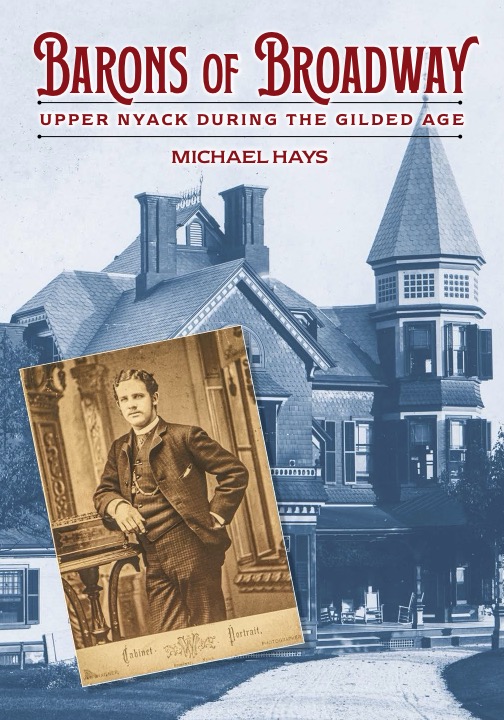
Barons of Broadway: Upper Nyack During the Gilded Age
Available at Pickwick Books, Historical Society of the Nyacks, and Amazon
About the author
Mike Hays has lived in the Nyacks for 38 years. After a career as an executive at McGraw-Hill Education in New York City, he now focuses on researching, writing, and interpreting local history.
He serves as Treasurer and past President of the Historical Society of the Nyacks. He is also a Trustee of the Edward Hopper House Museum & Study Center and Historian for the Village of Upper Nyack. In these roles, he works with community partners to preserve historic resources and expand public understanding of the area’s past.
Since 2017, he has written the popular Nyack People & Places column for Nyack News & Views. The series chronicles the history, architecture, and personalities of the lower Hudson Valley.
Hays has also developed museum exhibitions, written interpretive materials, and led well-attended walking tours that bring Nyack’s history to life.
He is married to Bernie Richey. He enjoys cycling, history walks, and winters in Florida. You can follow him on Instagram at @UpperNyackMike.
Editor’s note: This article is sponsored by Sun River Health and Ellis Sotheby’s International Realty. Sun River Health is a network of 43 Federally Qualified Health Centers (FQHCs) providing primary, dental, pediatric, OB-GYN, and behavioral health care to over 245,000 patients annually. Ellis Sotheby’s International Realty is the lower Hudson Valley’s Leader in Luxury. Located in the charming Hudson River village of Nyack, approximately 22 miles from New York City. Our agents are passionate about listing and selling extraordinary properties in the Lower Hudson Valley, including Rockland and Orange Counties, New York.