Nyack History A to Z
The Railroad That Made Nyack a Commuter Village
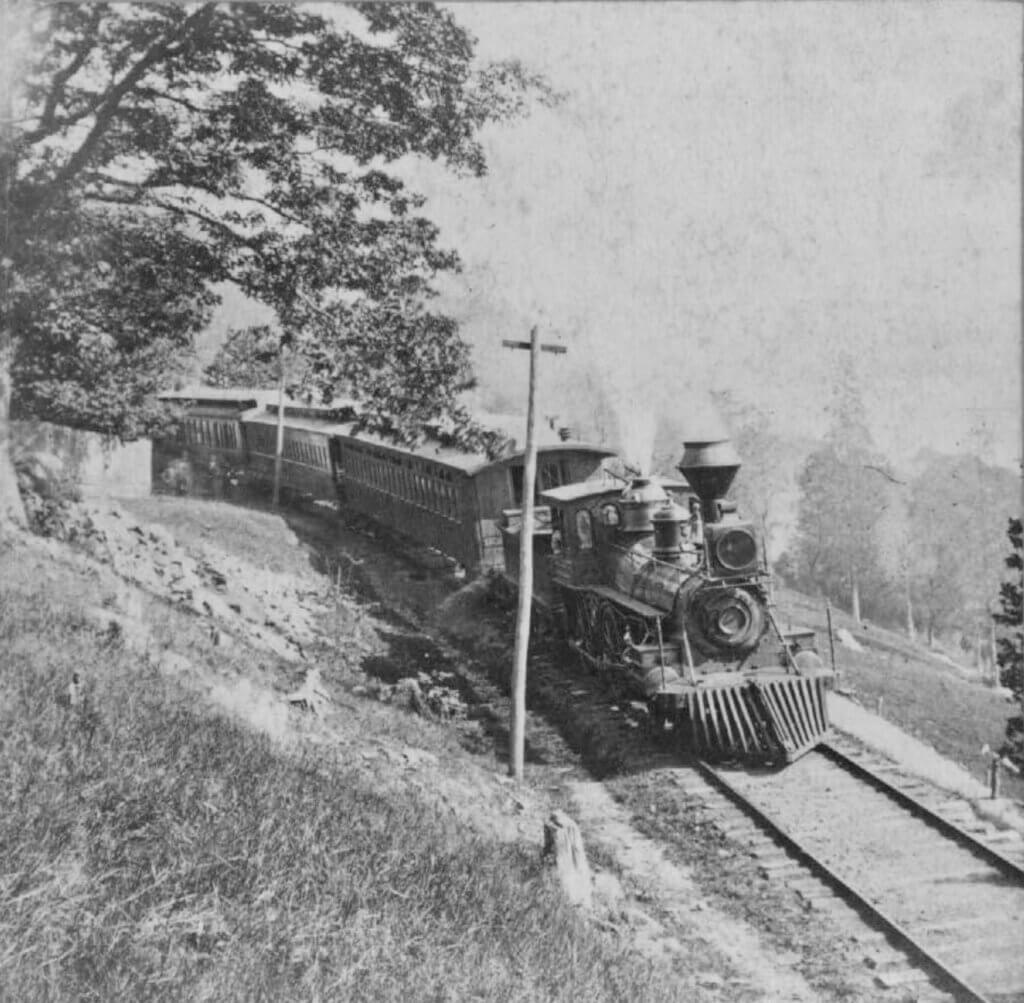
The train turns south toward Grand View and Piermont at the start of its run to Jersey City. Courtesy of the Nyack Library.
A century ago, during rush hour, the “Flyer”, also known as the “Banker’s Special”, served Nyack’s wealthiest commuters. Operated on the Northern Railroad, it offered a luxurious chair car and attentive porter service. The train carried passengers from Nyack to Jersey City in about 55 minutes. From there, ferries connected riders to Wall Street and Lower Manhattan.
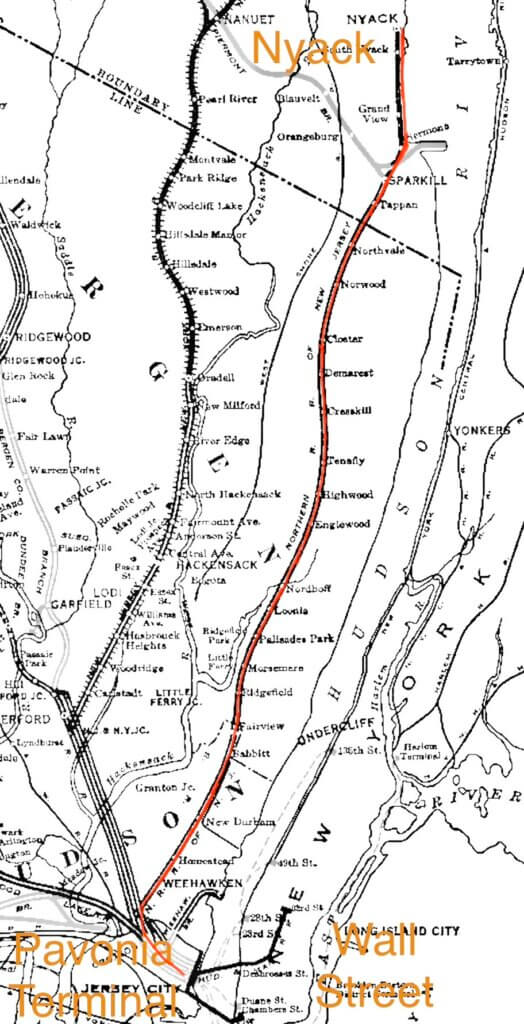
The Daily Commute from Nyack to Wall Street.
The Flyer followed the Northern Railroad route highlighted on this period railroad map. Afters stops at South Nyack, Grand View, Piermont, and Sparkill, it ran express to the Pavonia Terminal in Jersey City. There, commuters boarded the Chambers Street Ferry for the ten- to 15-minute crossing to Lower Manhattan.
Although the Flyer did not run directly into New York City, it provided speed, comfort, and status. A typical trip from Nyack to Wall Street took about 70 minutes. For its riders, the Flyer was more than transportation. It was a daily ritual of privilege.
The railroad offered many other options as well. Schedules listed roughly 20 trains per day in each direction. Semi-express trains ran during peak hours. A “shopper’s special” delivered passengers to Manhattan by 9:45 a.m., just as stores opened. Passenger service from Nyack ended in 1965, closing a long chapter in village life. The story of the Flyer mirrors the rise and fall of rail travel in Nyack.
Erie Railroad: A Gateway to the Hudson River Valley
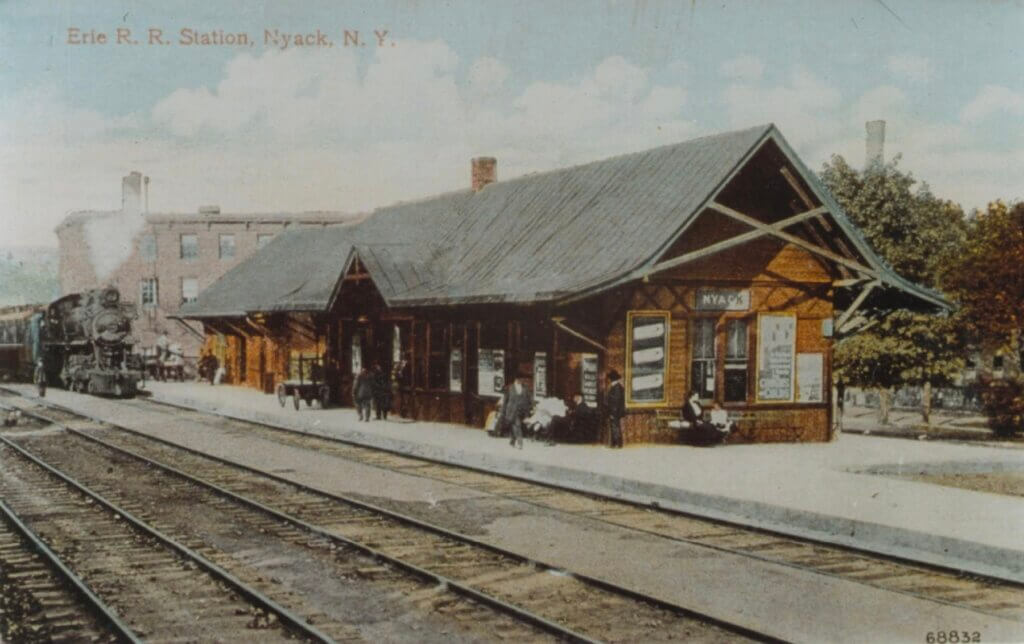
The passenger station. stands in the foreground, with the freight depot behind it. At left, the locomotive has been turned on the nearby turntable for the return trip. Courtesy of the Nyack Library.
Rail service in the Hudson River Valley began with Eleazar Lord, president of the Erie Railroad. The new railroad aimed to connect New York City with Lake Erie. It offered a faster alternative to the recently opened Erie Canal.
The Erie Railroad’s 1832 charter prohibited trains from crossing state lines. As a result, the line ended at a mile-long pier in Piermont. Steamboats completed the journey to New York City. Vessels such as the New Haven and the Iron Witch carried passengers across the Hudson.
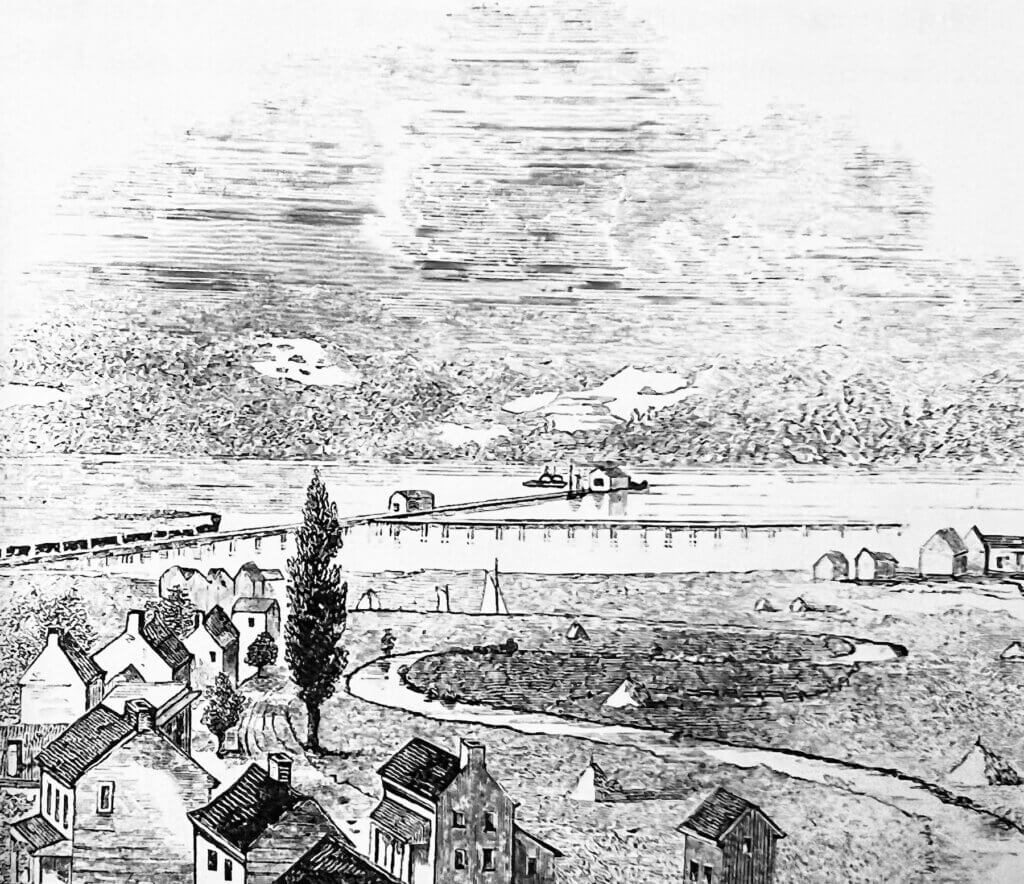
Illustration showing the original Erie Railroad terminus, where passengers transferred to steamboats bound for New York City. From Lossing, The Hudson, From Wilderness to Sea, 1859.
The railroad succeeded almost immediately. In 1851, President Millard Fillmore and Secretary of State Daniel Webster attended the opening of the first segment from Piermont to Goshen. Piermont, once known simply as “the Landing,” began to thrive. Nearby towns such as Blauvelt, Nanuet, Spring Valley, and Monsey became easier to reach.
The Northern Railroad: Expanding Rail Connections
In 1852, the charter restriction blocking a New Jersey connection was lifted. The Erie Railroad bypassed Piermont and built a line to Jersey City via Paterson. This shift threatened Piermont’s future as a rail hub.
Nyack residents responded quickly. Azariah Ross, David D. Smith, and Eleazar Lord organized a committee to promote a new river-route railroad. The proposed line would run from Jersey City to Nyack and north through Haverstraw to Albany. It became known as the West Shore Railroad.
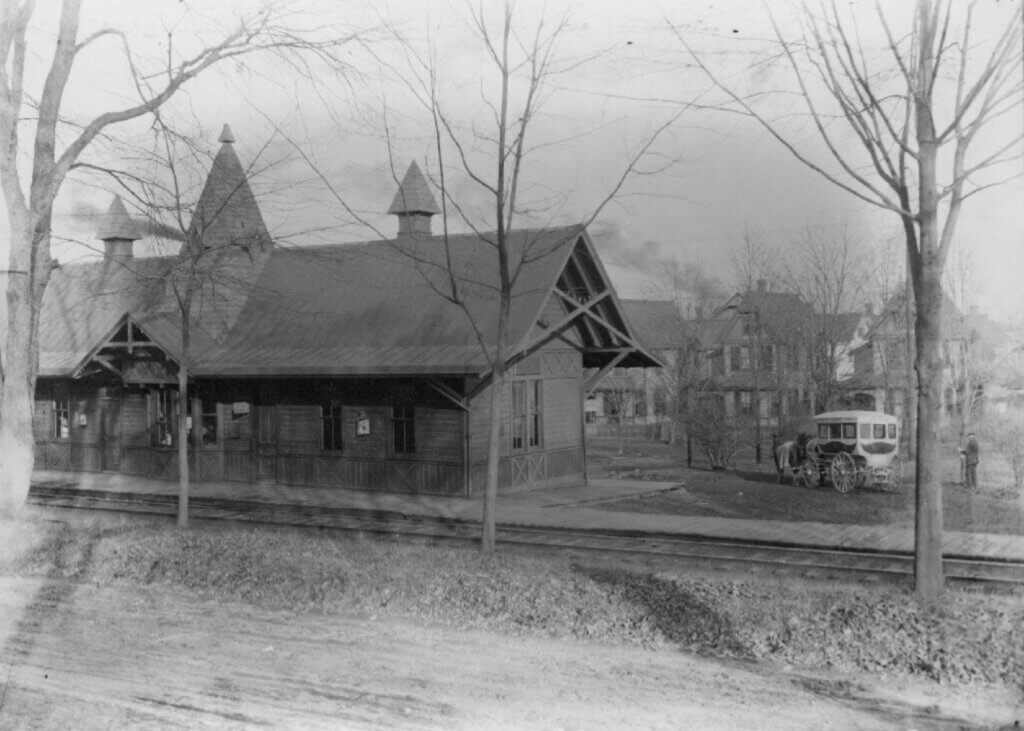
Horse-drawn transportation waits at the depot, with cottages along Depot Place visible in the background. Courtesy of the Nyack Library.
Nyack ultimately lost influence over the project. The railroad moved forward without the village’s direct involvement and adopted the name Northern Railroad. The line connected Jersey City with Upper Piermont, later called Sparkill. There, it linked with the Erie Railroad and provided access to Suffern. Today, the former Erie right-of-way from Palisades to Blauvelt survives as the Joseph Clarke Rail Trail
The Opening of the Northern Railroad
On May 28, 1859, Piermont hosted a grand celebration to mark the opening of the Northern Railroad. A nine-car train departed for Jersey City in the morning. Three flat cars carried local fire companies and their engines, all richly decorated.
The train returned the same day with 18 cars. Passengers were welcomed with oysters, cold meats, sandwiches, and champagne. A full carload of champagne had been shipped in from Jersey City for the occasion.
In its early years, three trains ran daily in each direction between Sparkill and New York City. One was the “milk train,” also called the mail train or “strawberry train” during harvest season. Rockland County farms shipped nearly two million baskets of strawberries each year by rail.
Before the Rails Reached Nyack
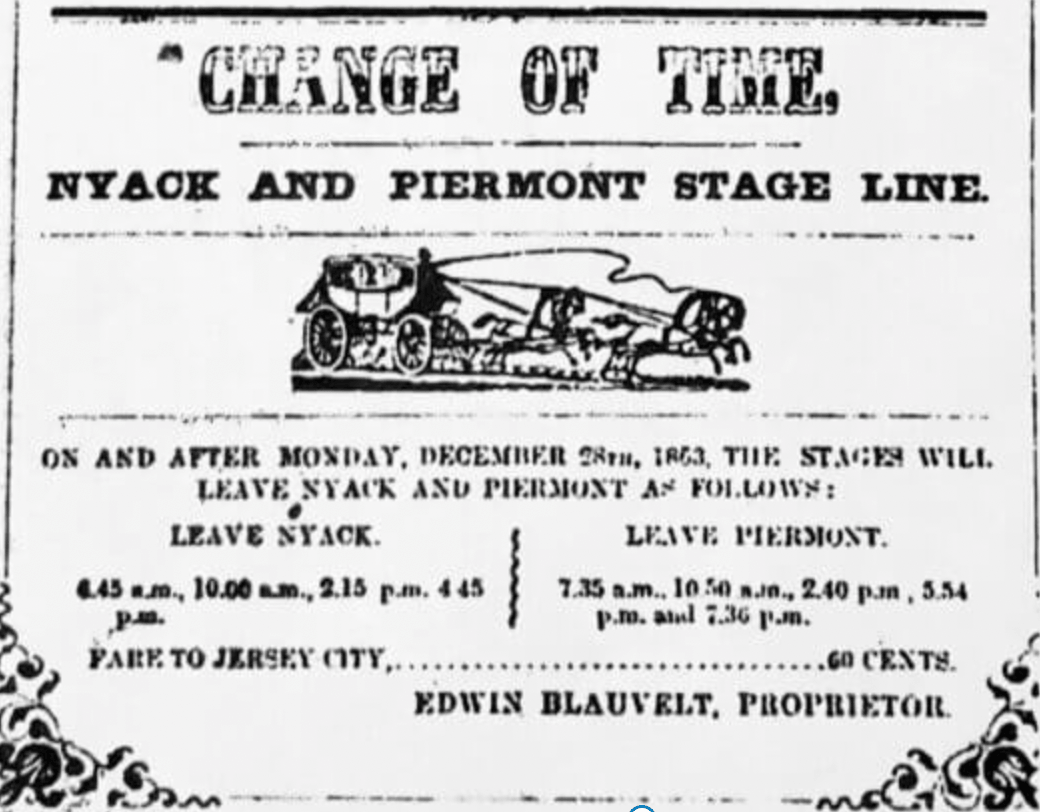
Nyack and Piermont Stage Line advertisement, 1863. Before the Northern Railroad reached Nyack, horse-drawn stages carried passengers south to connect with the Erie Railroad at Piermont. The line made four daily trips and advertised through passage to Jersey City for 60 cents. Edwin Blauvelt was the proprietor.
Before the Northern Railroad reached Nyack in 1870, travelers heading for New York first rode south by horse-drawn stage to connect with the Erie Railroad at Piermont. Locals nicknamed the cumbersome coach the “pickle boat.”
Designed to seat six passengers, the coach often carried as many as ten. Drivers allowed about 45 minutes for the journey and timed their trips to meet scheduled trains. Railroad conductors occasionally held a departure when the stage arrived late.
The ride along River Road could be pleasant in fair weather, but winter brought frozen ruts and spring rains turned the road into deep mud. The final miles to the railroad were often the slowest part of the journey.
Everything changed on May 21, 1870, when the Northern Railroad extended its tracks into Nyack. Passengers could finally board the train in the village itself, eliminating the stagecoach connection and beginning a new era of rail travel.
The Northern Railroad Spur to Nyack
Pressure soon mounted to bring the railroad directly into Nyack. Plans shifted away from the river route to a higher inland alignment. The railroad offered $40,000 if the community could raise $60,000. Residents collected only $28,000. Despite the shortfall, the railroad agreed to fund the remainder.
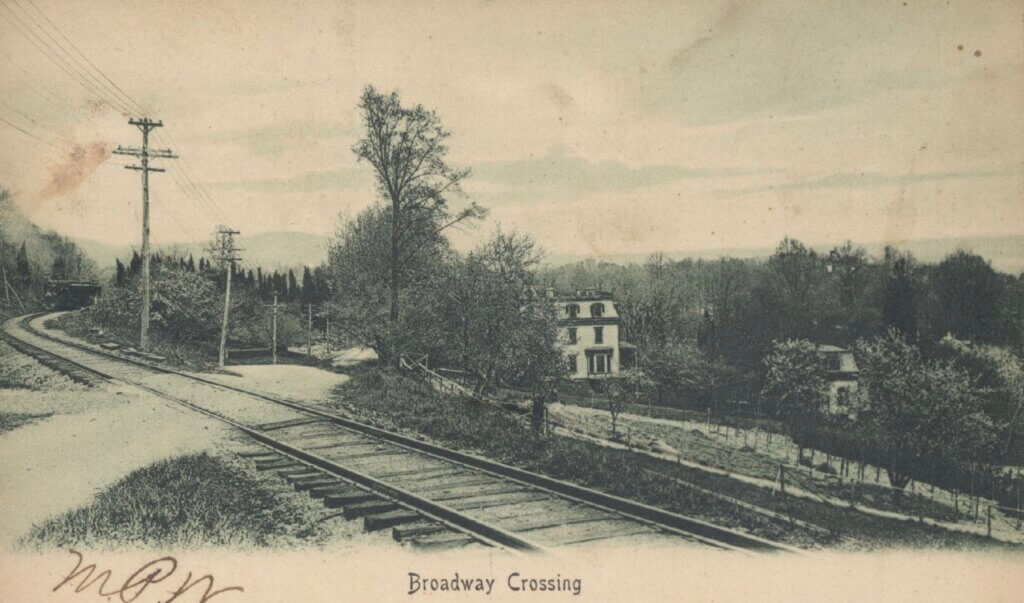
The Northern Railroad line cut directly through Nyack as it approached the village station. Courtesy of the Nyack Library.
The railroad purchased land in Nyack from Tunis Depew and William Voorhis. Depew received $3,300 for land through Depew’s Grove and for a station site at Cedar Hill Avenue. Today, the Franklin Street tennis courts occupy the location. Anticipation ran high throughout the village.
“Our lovely little town will be awakened from its Rip Van Winkle state.”
— Rockland County Journal
On May 21, 1870, the first steam locomotive approached Nyack on a foggy, humid morning. A cannon fired as passengers disembarked near a flagpole. Visitors explored the village by carriage and boat. That evening, guests dined at the St. Nicholas Hotel.
The following day, the train returned to Jersey City amid cannon fire, ringing church bells, and waving handkerchiefs. Ferry passage into New York was free for the inaugural passengers.
Immediate Impact on Nyack
The railroad transformed Nyack almost overnight. Optimism surged, and growth followed quickly. In 1870, Louis Hoffer built a new hotel near the terminal. A few years later, he added the Nyack Opera House.
The 150-room Prospect House opened in South Nyack as a summer hotel. Families stayed for the season while husbands commuted daily. John Onderdonk erected a four-story commercial building on Main Street, later known as Onderdonk Row. Another four-story commercial block rose at South Broadway and Burd Street.
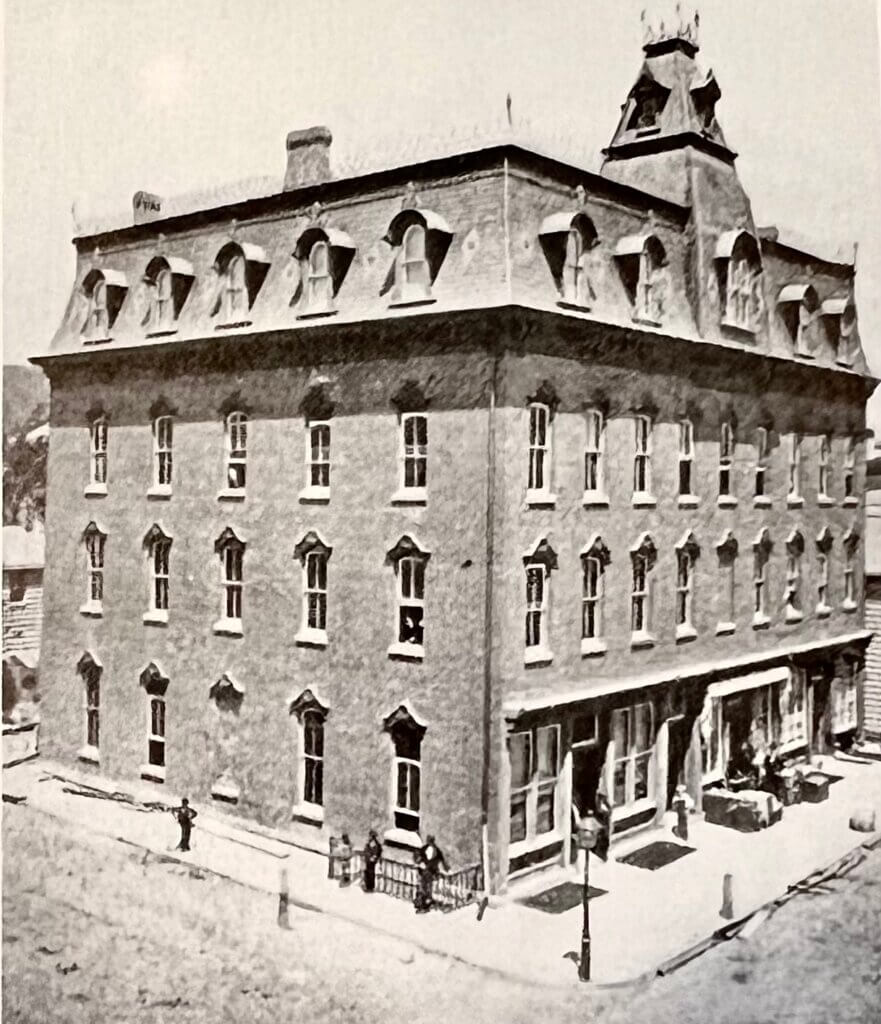
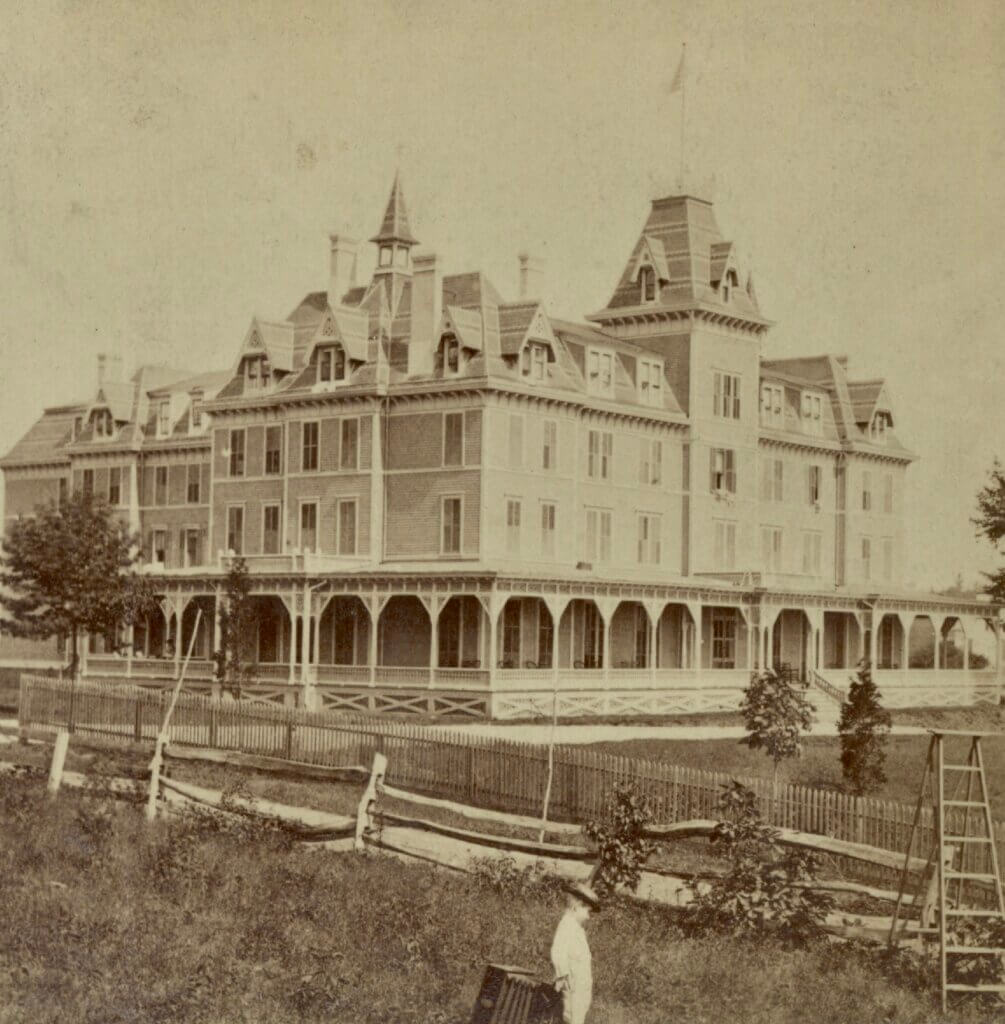
Commercial Building and Prospect House.
Two large buildings constructed soon after rail service reached Nyack, reflecting the village’s rapid growth. Photos from Old Nyack and the Nyack Library.
Broadway itself was extended south beyond the quarry hole near Hudson Avenue. New house lots appeared in South Nyack and along Castle Heights Avenue. Rail service reshaped the village.
The Flyer
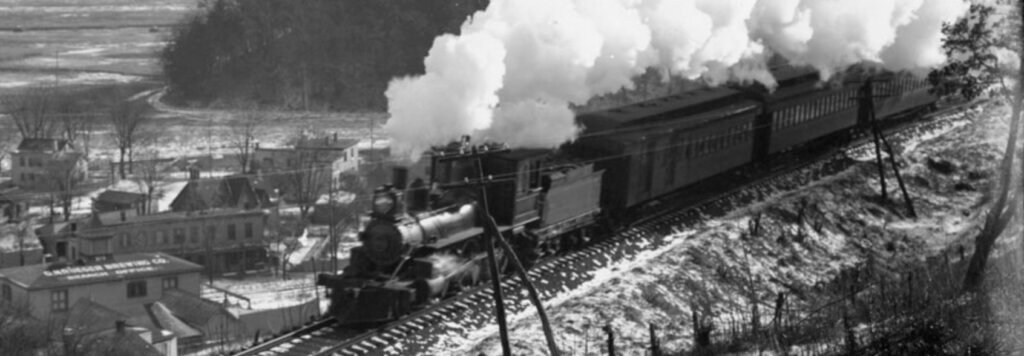
The commuter train curves north toward Nyack on the Northern Railroad line. Courtesy of the Piermont Historical Society.
Beginning around 1900, the Flyer became Nyack’s premier commuter train. It departed around 8 a.m. and reached Jersey City in about 50 minutes. A ten-minute ferry ride carried passengers to Chambers Street. The evening return left Jersey City at 5 p.m. and arrived in Nyack just before 6.
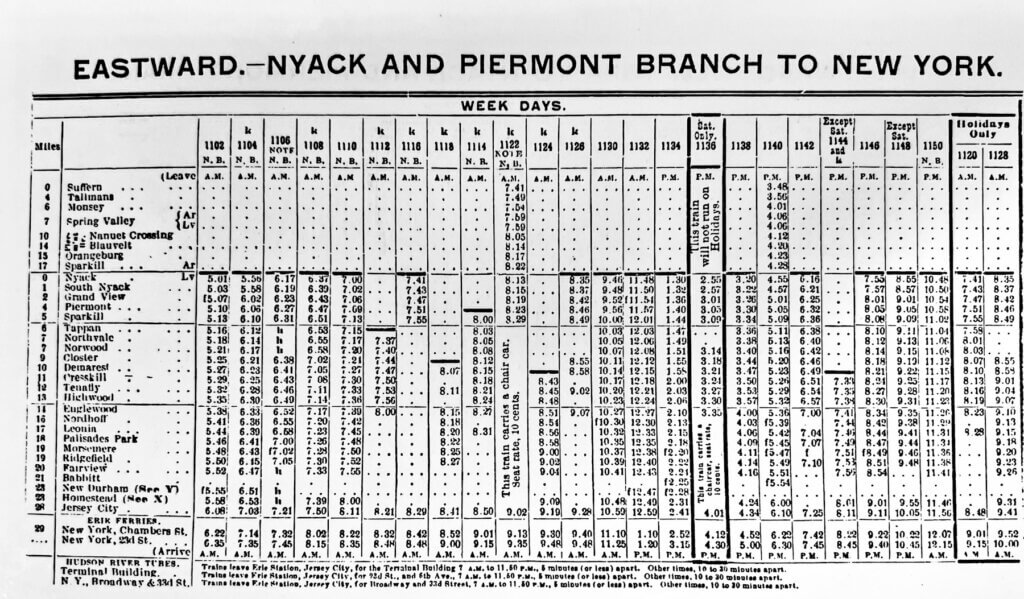
Timetables show frequent service, including express, semi-express, and late-night trains.
For many years, a second semi-express Flyer ran at 7:30 a.m. and 5:30 p.m. The “Shopper” departed at 8:30 a.m. and reached Jersey City by 9:45 a.m. Late-night trains allowed theatergoers to return home near midnight.
The Flyer’s chair car set it apart. Seats swiveled, porters attended passengers, and antimacassars protected the upholstery. In the smoker, thick with cigar and pipe smoke, men played cards on the ride home.
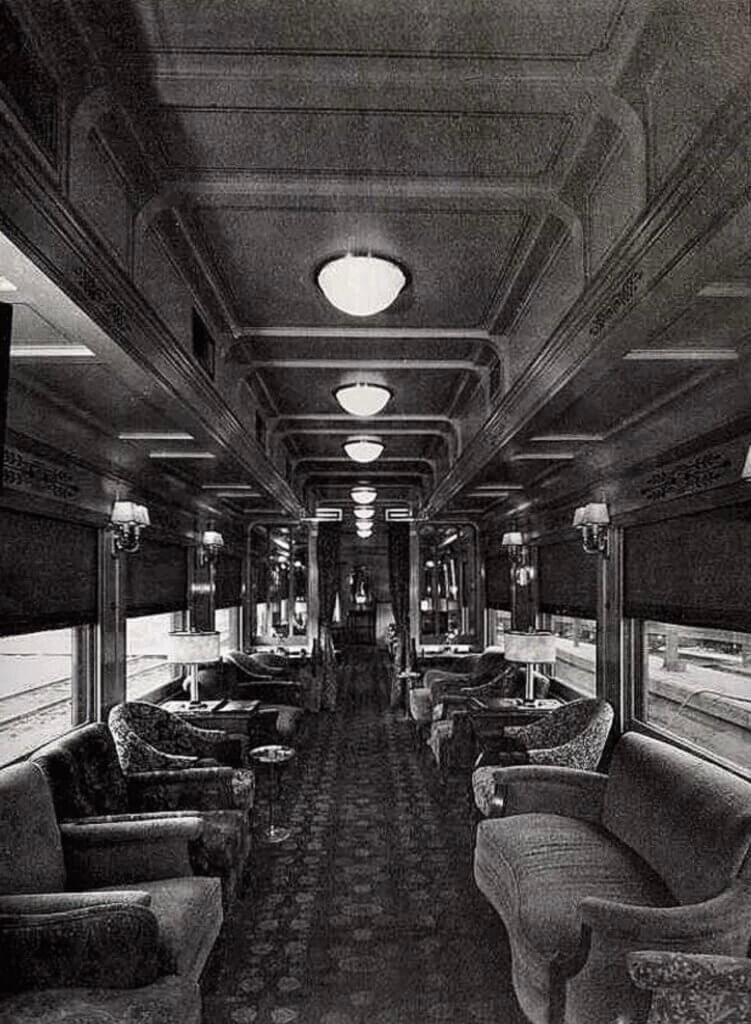
Interiors conditions on early commuter trains.
Chair cars offered upgraded seating and porter service, while open windows provided ventilation before air conditioning became common.
Early heating relied on wood-burning furnaces in each car. Smoke and soot drifted inside when windows opened. Later improvements brought steam heat and louvered windows. Air conditioning did not appear until the 1930s.
The Decline and Fall of the Northern
The Great Depression sharply reduced ridership. After the 1929 crash, many commuters lost their jobs. Businesses moved uptown, making downtown ferry connections less convenient. Service to the 23rd Street ferry ended as passenger numbers declined.
Automobiles soon replaced rail travel for many wealthy commuters. Improved roads and the opening of the George Washington Bridge in 1934 made driving faster. By the end, only three slow local trains remained.
Highways delivered the final blow. The Palisades Interstate Parkway and the Tappan Zee Bridge sealed the railroad’s fate. On December 14, 1965, the last train arrived in Nyack carrying no commuters. Only 12 rail enthusiasts rode that final run.
The tracks were removed, and the station was demolished. The property later became village-owned land. Today, tennis courts occupy the site where Nyack’s commuters once boarded the Flyer, newspapers in hand, beginning their daily journey to New York City and Wall Street.
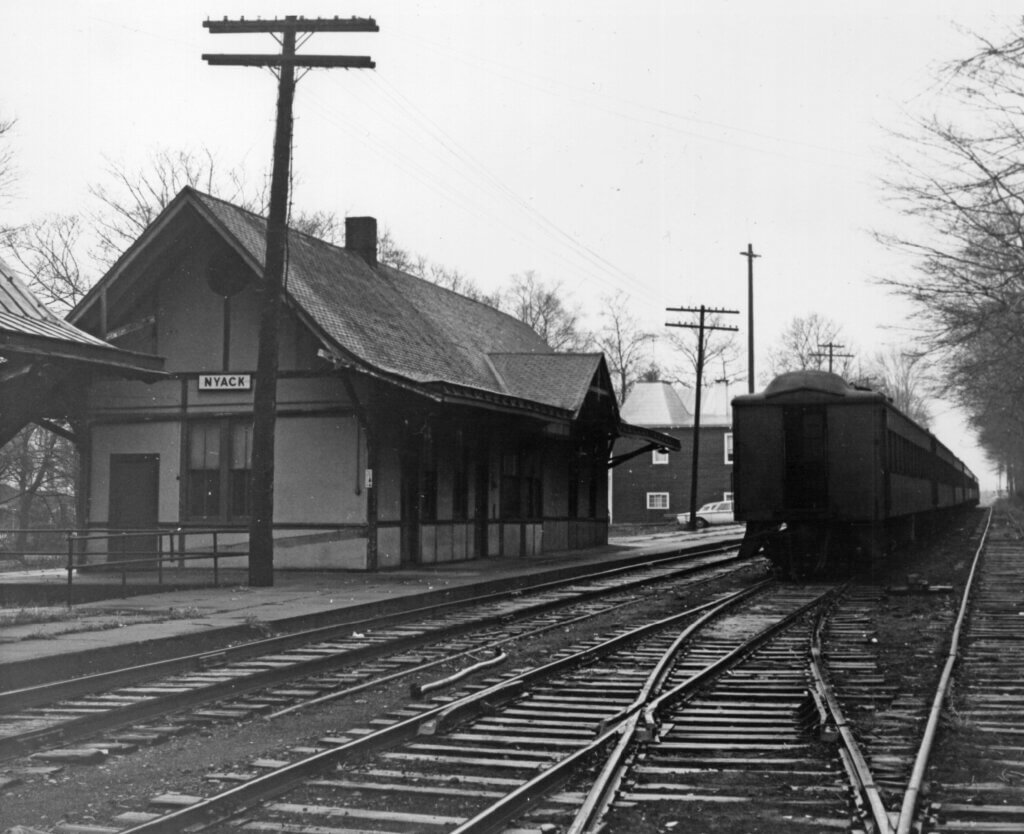
One of the final trains awaits southbound passengers. Courtesy of the Nyack Library.
About the author
Mike Hays has lived in the Nyacks for 38 years. After a career as an executive at McGraw-Hill Education in New York City, he now focuses on researching, writing, and interpreting local history.
He serves as Treasurer and past President of the Historical Society of the Nyacks. He is also a Trustee of the Edward Hopper House Museum & Study Center and Historian for the Village of Upper Nyack. In these roles, he works with community partners to preserve historic resources and expand public understanding of the area’s past.
Since 2017, he has written the popular Nyack People & Places column for Nyack News & Views. The series chronicles the history, architecture, and personalities of the lower Hudson Valley.
Hays has also developed museum exhibitions, written interpretive materials, and led well-attended walking tours that bring Nyack’s history to life.
He is married to Bernie Richey. He enjoys cycling, history walks, and winters in Florida. You can follow him on Instagram at @UpperNyackMike.