The largest event in Nyack’s history.”
Rockland County Journal, July 8, 1876
Cannons boomed. Train whistles shrieked. Church and school bells rang across the village. Roman candles burst overhead in red and green arcs. On Hook Mountain and West Hook, enormous bonfires roared into the night sky.
For a few dazzling hours on July 3, 1876, Nyack seemed transformed.
There was no electricity. No illuminated signs. No streetlights. Yet thousands of candles, lanterns, fireworks, and bonfires turned the village into a ribbon of light stretching from Upper Nyack to South Nyack.
The celebration marked the nation’s one hundredth birthday. It also announced something new about Nyack itself.
By 1876, the village stood on the threshold of the Gilded Age. Steamboats and railroads connected it to New York City. Summer visitors filled its hotels. Wealthy families were beginning to purchase former farms along the Hudson for country estates. New business blocks were rising downtown.
The Centennial celebration was more than a patriotic observance. It was Nyack’s coming-out party.
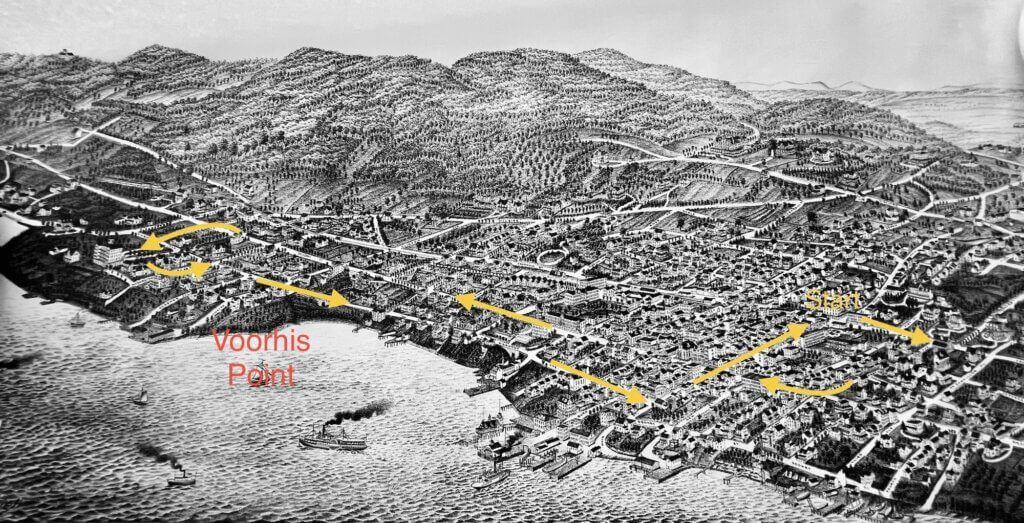
The route of the July 3, 1876 Centennial parade overlaid on L. R. Burleigh’s 1884 bird’s-eye view of Nyack. The procession began and ended at Franklin and Main Streets, traveled north to First Avenue, south through the village to Cornelison in South Nyack, passed through the grounds of the Tappan Zee House and Glen Byron, and returned by Piermont Avenue and Main Street. The route covered nearly the entire village and showcased many of Nyack’s most prominent homes, businesses, and hotels.
The Night Before
Preparations began days in advance. Local merchants reportedly sold out of flags and Chinese lanterns. Visitors arrived by steamboat, carriage, and railroad. By evening on July 3, the streets were packed. The parade assembled near Franklin and Main Streets and stepped off at nine o’clock.
Leading the procession were marshals, cavalry, the Nyack Brass Band, local fire companies, the Tarrytown Brass Band, and the Mazeppa Hose Company carriage carrying young Lillie Towne dressed as the Goddess of Liberty.
The route took marchers north on Franklin Street to First Avenue, south along Broadway to Cornelison Avenue in South Nyack, through the grounds of the Tappan Zee House and Glen Byron Avenue, then east to Piermont Avenue before returning by Main Street to Franklin Street.
The parade became a moving tour of the village.
A Village on Display
The Rockland County Journal devoted remarkable attention to the decorations along the route. Reading the account today is like taking a walking tour through Nyack in 1876.
At the starting point, William Randolph’s general store at Franklin and Main displayed flags and lanterns. Nearby, the homes of David J. Blauvelt and General James H. Blauvelt at First Avenue and Broadway glowed with lanterns and candles.
Further south, the Sturtevant Piano Factory joined the festivities with rows of lanterns, a reminder that manufacturing was becoming an increasingly important part of the village economy.
The intersection of Main Street and Broadway received the grandest treatment. Abram Merritt’s dry goods store displayed patriotic bunting. Nearby businesses illuminated their windows with candles.
The recently completed Commercial Building dominated the scene.
Hotels, Mansions, and Summer Visitors
South of downtown, the decorations became even more elaborate.
At Broadway and Clinton Avenue, the homes of John Polhemus and A. M. Wilcox were connected by strings of lights stretched across the street. On the Wilcox porch, his daughter appeared as the Goddess of Liberty illuminated by a red glow. Spectators reportedly declared them “the finest decorations we have seen tonight.”
The village hotels joined the spectacle as well. The Clarendon Hotel shone with lanterns. Evergreen and the Tappan Zee House glowed above the river. Along Piermont Avenue and Main Street, the homes of Tunis DePew and James P. Smith were draped in bunting, flags, and lights. The Journal described Smith’s residence as presenting “a beautiful and thoroughly American sight.”
What emerges from the newspaper account is not simply patriotism but prosperity. Nyack was displaying its confidence and ambition to residents and visitors alike.
Along the Parade Route
The Rockland County Journal described dozens of decorated homes, hotels, stores, and public buildings. These surviving illustrations provide a glimpse of the village that residents and visitors saw during the Centennial celebration.
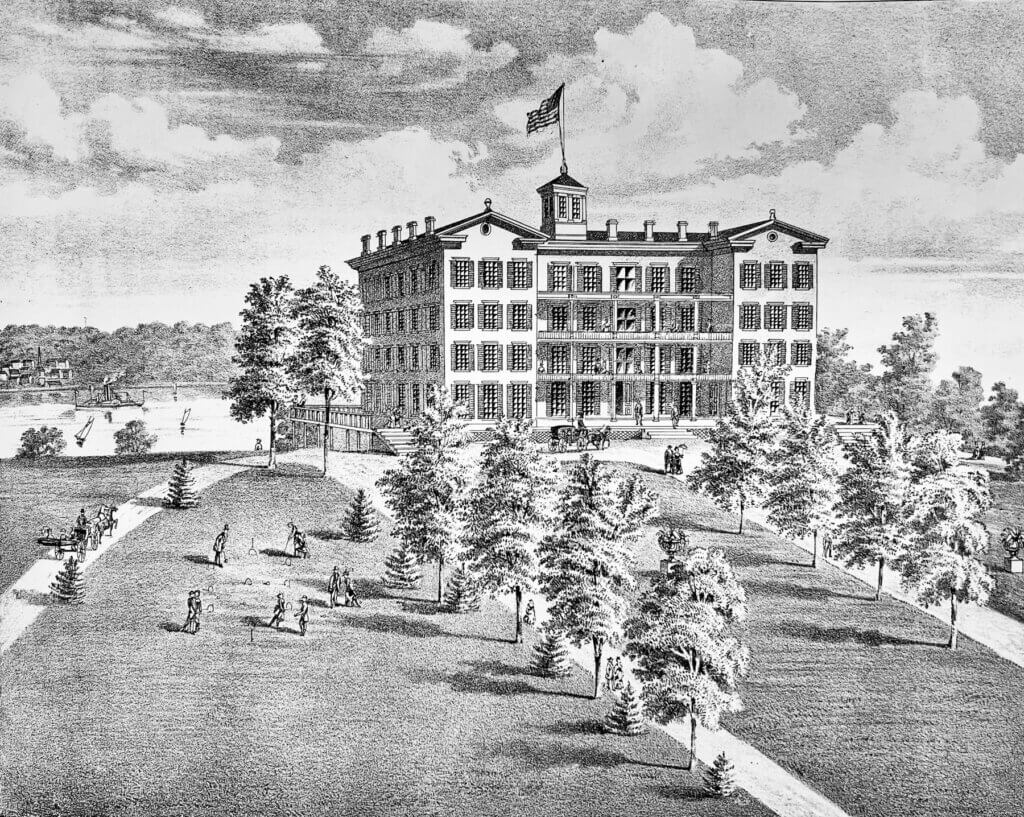
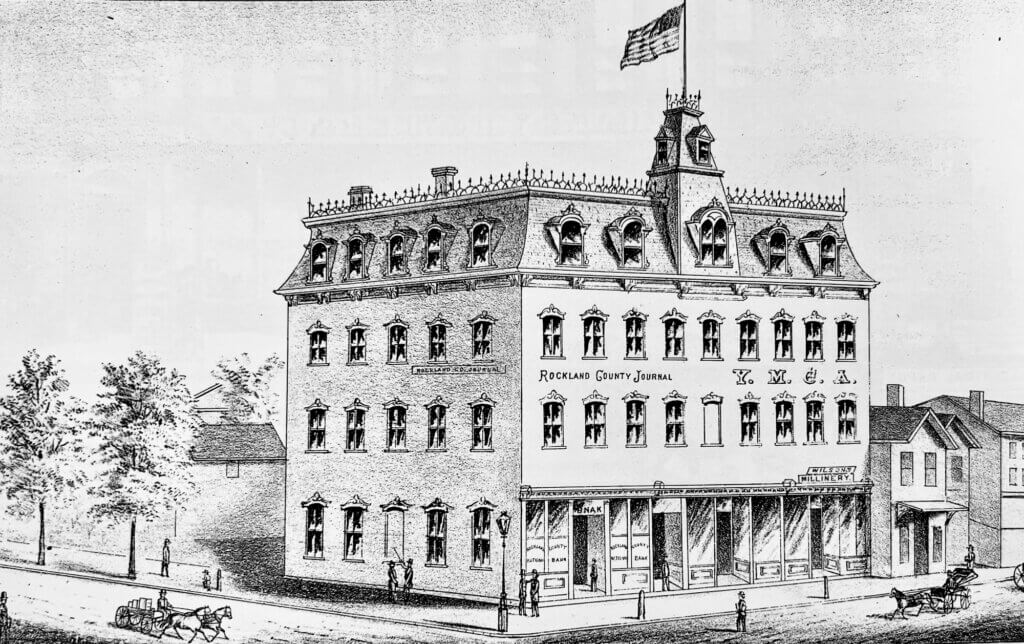
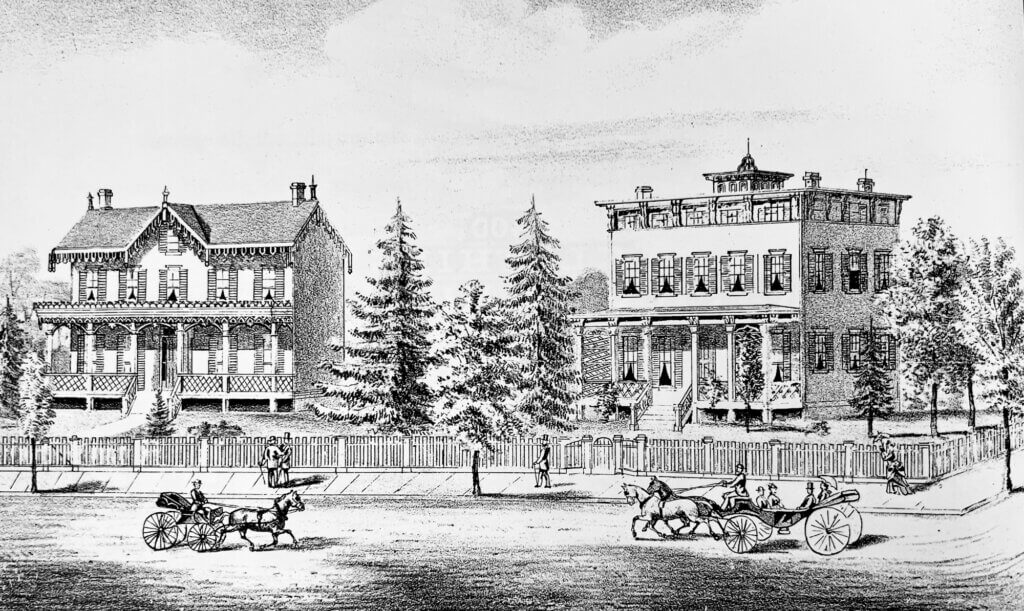
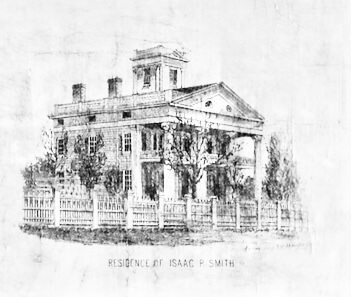


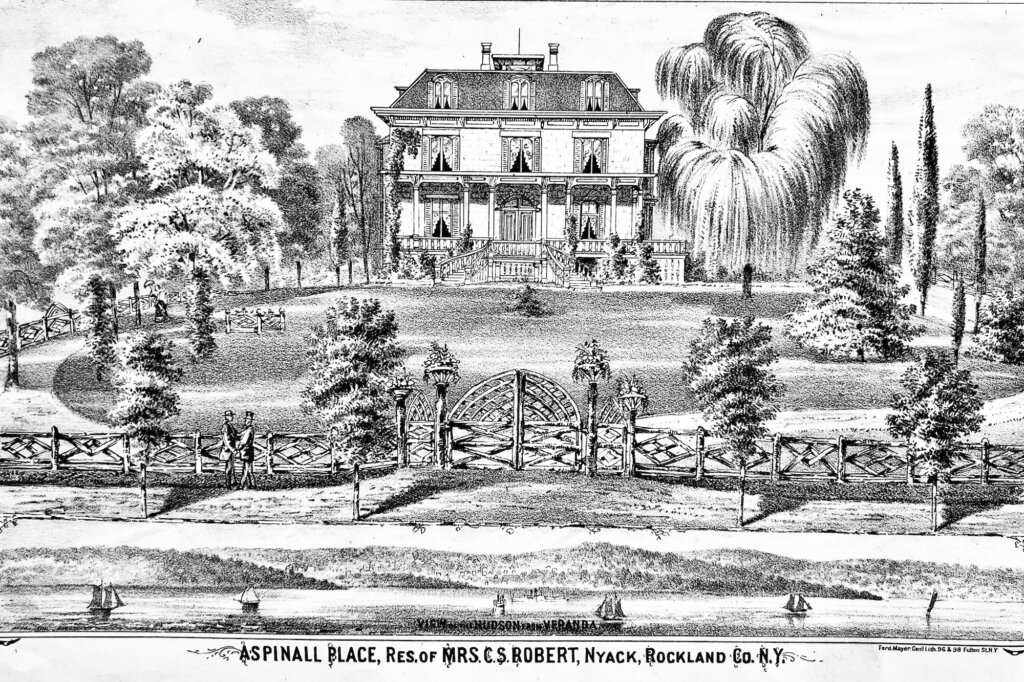
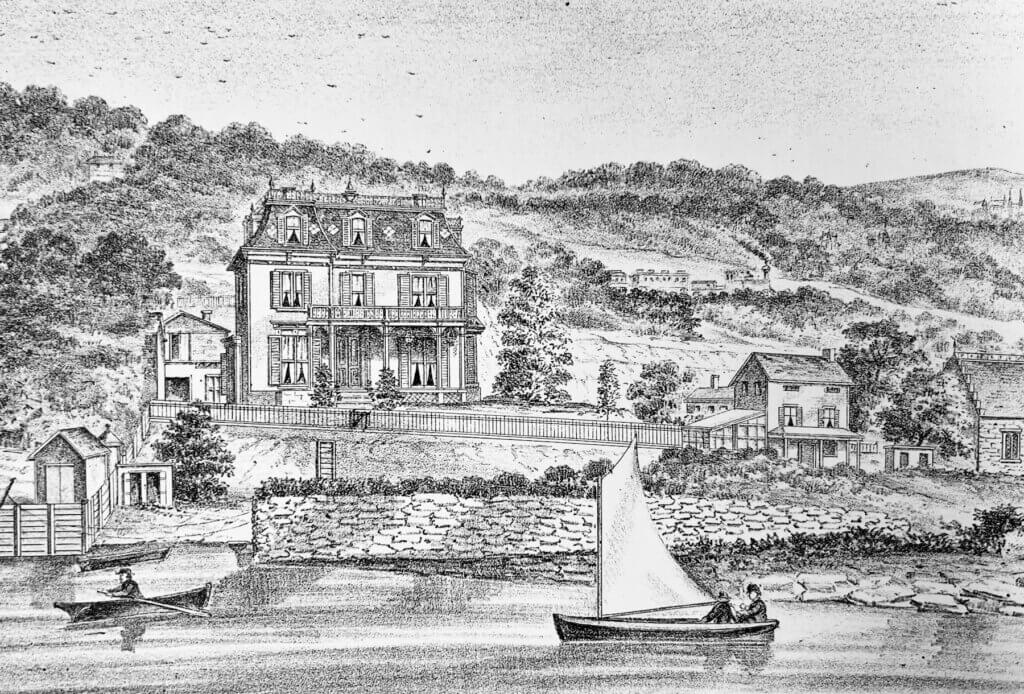
Gallery: Along the Parade Route.
This gallery brings together six lithographs from the Combination Atlas Map of Rockland County (F. A. Davis & Co., 1876) and two illustrations from the 1859 map of Nyack. Together they depict many of the homes, hotels, businesses, and public buildings described by the Rockland County Journal, providing a rare contemporary glimpse of the village that residents and visitors experienced during the Centennial celebration.
Midnight on the Mountain
As midnight approached, the celebration reached its climax. Roman candles and skyrockets streaked across the sky. Crowds answered with cheers and huzzahs. Then the mountaintop fires were lit.
Huge bonfires on Hook Mountain and West Hook blazed above the Hudson, visible for miles. To many residents, the sight must have recalled the Revolutionary War beacon fires once used to carry warnings across the Hudson Valley
The Fourth at Voorhis Point
The next morning began more quietly.
At sunrise, bells rang and cannons sounded, but many residents were recovering from the festivities of the night before. Soon the soda fountains and ice cream parlors filled with visitors seeking relief from the July heat.
By midmorning, crowds gathered at Voorhis Point in South Nyack for the formal observance. A platform beneath large shade trees overlooked the Hudson. The Nyack Brass Band performed patriotic music. Reverend Voorhis offered the invocation. A choir sang “America” and the band played “Hail Columbia.”
P. A. Hawes delivered a dramatic reading of the Declaration of Independence.
The principal address came from William Shepherd, a leading advocate for public education. The Journal praised his ability to discuss national issues without descending into partisan politics. His remarks were later printed and distributed.
The ceremony concluded with a Centennial Hymn sung to the music of Verdi’s “Anvil Chorus” from IlTrovatore, conducted by Nyack composer Grenville Wilson.
As the formal program ended and the crowd dispersed beneath the trees at Voorhis Point, Nyack’s Centennial celebration drew to a close. The village that gathered there in 1876 stood on the edge of extraordinary change. Within eleven years, electric lights would replace lanterns, grand estates would rise along the river, and Nyack would become one of the Hudson Valley’s best-known resort communities.
Looking Forward
The Centennial celebrated the nation’s first century, but it also captured a turning point in Nyack’s own history.
The village that gathered beneath lanterns and fireworks in 1876 was no longer the small river community of earlier generations. Hotels welcomed visitors from New York City. Business blocks rose downtown. Elegant homes lined the main streets. New fortunes were beginning to reshape the landscape. Within a generation, many of the farms that still bordered the village would become the estates of the Gilded Age families whose names remain familiar today.
The fireworks faded. The lanterns were extinguished. The crowds returned home.But for two remarkable days in July 1876, Nyack celebrated its past while confidently stepping into its future.
About the author
Mike Hays has lived in the Nyacks for 38 years. After a career as an executive at McGraw-Hill Education in New York City, he now focuses on researching, writing, and interpreting local history.
He serves as Treasurer and past President of the Historical Society of the Nyacks. He is also a Trustee of the Edward Hopper House Museum & Study Center and Historian for the Village of Upper Nyack. In these roles, he works with community partners to preserve historic resources and expand public understanding of the area’s past.
Since 2017, he has written the popular Nyack People & Places column for Nyack News & Views. The series chronicles the history, architecture, and personalities of the lower Hudson Valley.
Hays has also developed museum exhibitions, written interpretive materials, and led well-attended walking tours that bring Nyack’s history to life.
He is married to Bernie Richey. He enjoys cycling, history walks, and winters in Florida. You can follow him on Instagram at @UpperNyackMike.