Nyack History A to Z
The Empire Hook & Ladder Company Number One holds a significant place in Nyack’s history as one of its earliest fire companies. Established in 1863, this esteemed company is housed in a picturesque Queen Anne Style firehouse on North Broadway in Upper Nyack. The historic firehouse itself is recognized on the National Register of Historic Places. For many years, Upper Nyack Village Hall, now its next-door neighbor, occupied the second floor of this remarkable building.
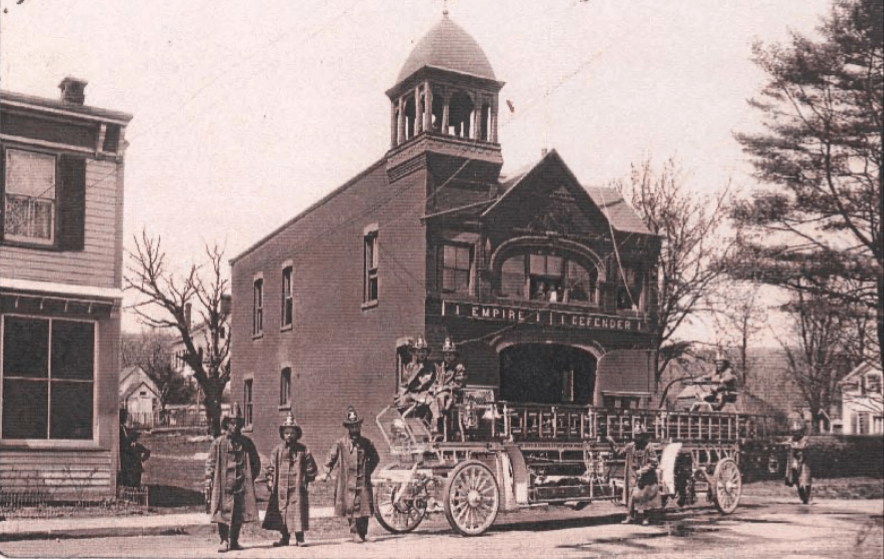
Members pose with their ladder truck in front of the newly completed Queen Anne–style station. Courtesy of the Nyack Library.
Founding
In 1863, Upper Nyack residents formed the Empire Hook & Ladder Company at a local store following a destructive fire. The new company purchased its first hook and ladder truck from a New Jersey fire company for $250. A steamboat delivered the apparatus, and Empire pressed it into service almost immediately to fight a nearby blaze.
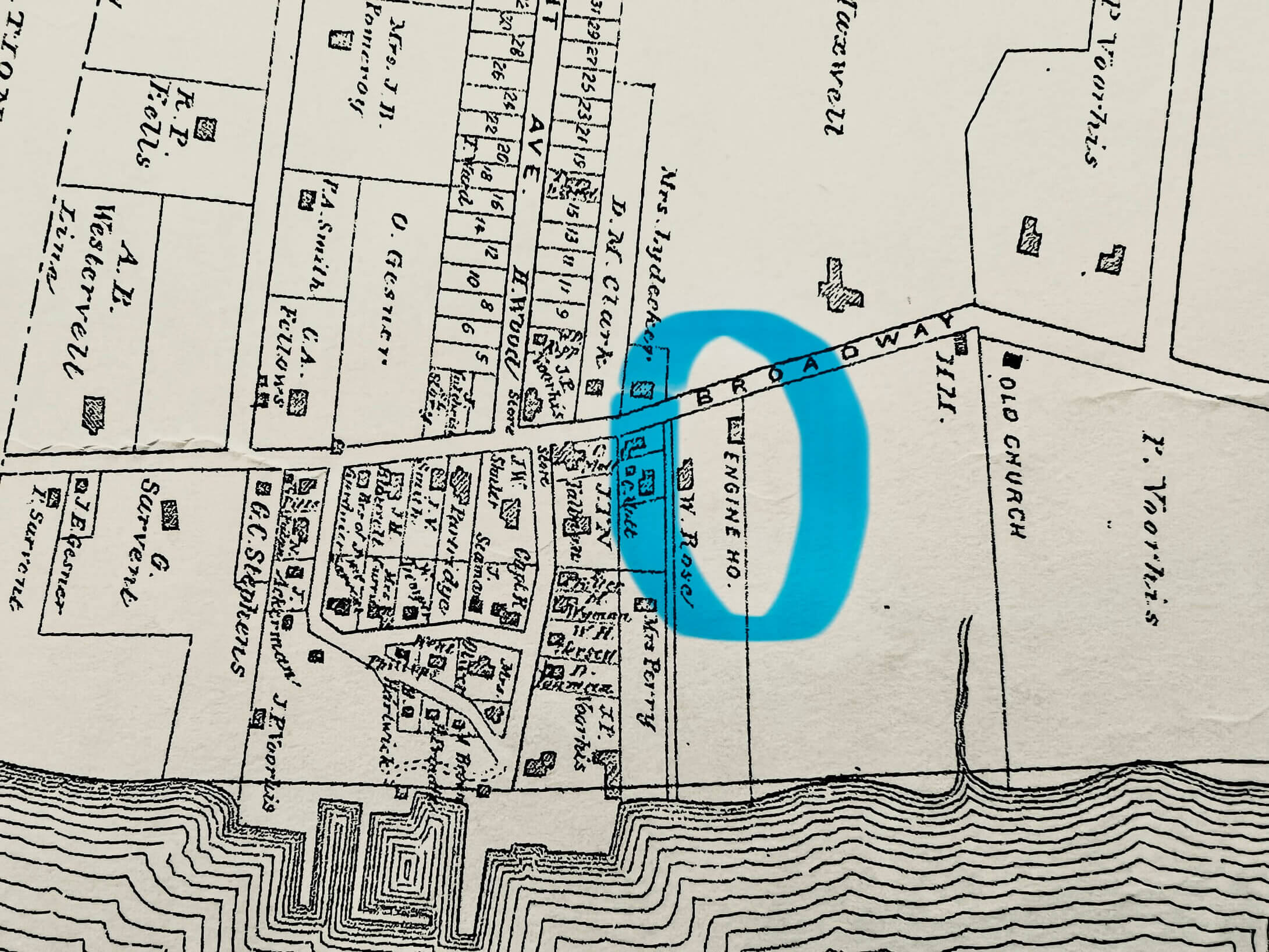
Detail showing the original firehouse site near Perry Lane, across from today’s location. Courtesy of the Historical Society of the Nyacks.
Empire’s first firehouse stood on property owned by James Rose, an early foreman, near Perry Lane and across from the company’s present location. In 1883, the company ordered a new ladder truck and constructed a modest firehouse at a cost of $242.82. Disaster struck soon after. A fire that began around 3:00 a.m. on a Sunday morning in 1885 destroyed the building, the new truck, and much of the company’s equipment. Although rumors of arson circulated, investigators never proved them.
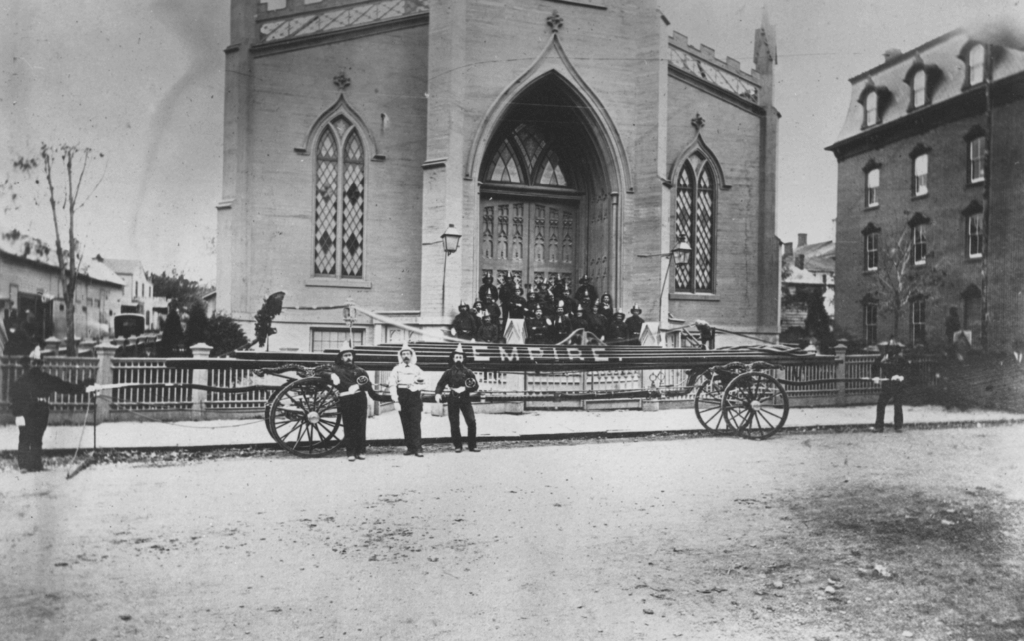
The company’s apparatus stands before the Reformed Church during Nyack’s early firefighting era. Courtesy of the Nyack Library.
A Tale of Two Empires
After the loss of the firehouse, two groups operated under the Empire name for nearly six years. William Colsey led a faction based in the Village of Nyack, while G. A. Polhemus headed the Upper Nyack contingent. Legal disputes followed, focusing on insurance claims, land leases, and ownership of equipment.
In 1886, the Nyack faction purchased a new ladder truck and housed it at Mazeppa Engine Company in downtown Nyack. The conflict ended in 1891, when the Nyack group relinquished the Empire name and property rights. That company later reorganized as Chelsea Hook & Ladder Company. The settlement allowed Upper Nyack’s Empire company to move forward without internal division.
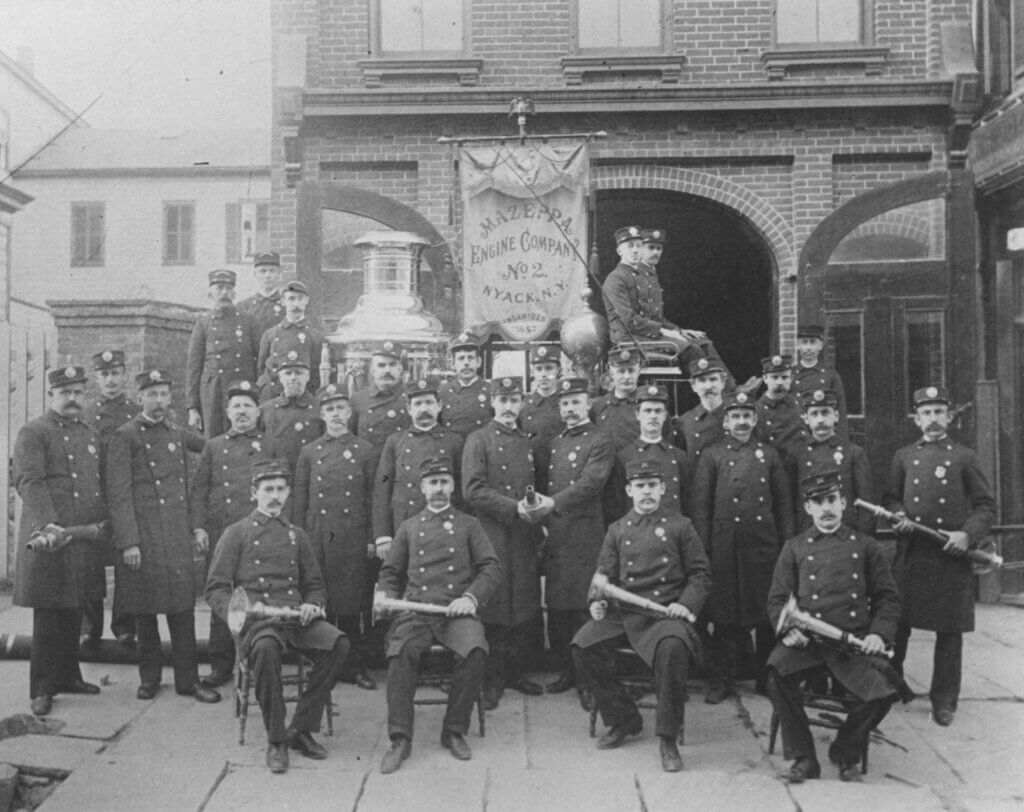
Firefighters gather on Main Street just east of Broadway beside their steamer, dressed in knee-length, double-breasted uniforms that reflect the era’s formal fire service traditions. Courtesy of the Nyack Library.
New Firehouse
During the dispute between the two Empire factions, Upper Nyack resident John W. Shuler donated $3,000 to fund a permanent firehouse. Shuler accumulated his wealth supplying prospectors during the Colorado gold rush and died in 1887, the same year construction finished.
Architect Horace Greeley Knapp designed the new Queen Anne style firehouse, and builders James Seaman, Martin Demarest, and John Pitt completed the structure in 1887. The opening drew community celebration, including a dinner held on the second floor. Empire also received a new ladder truck from the D. A. Woodhouse Manufacturing Company. Equipped with a 60-foot extension ladder, the apparatus remained in service for 24 years.
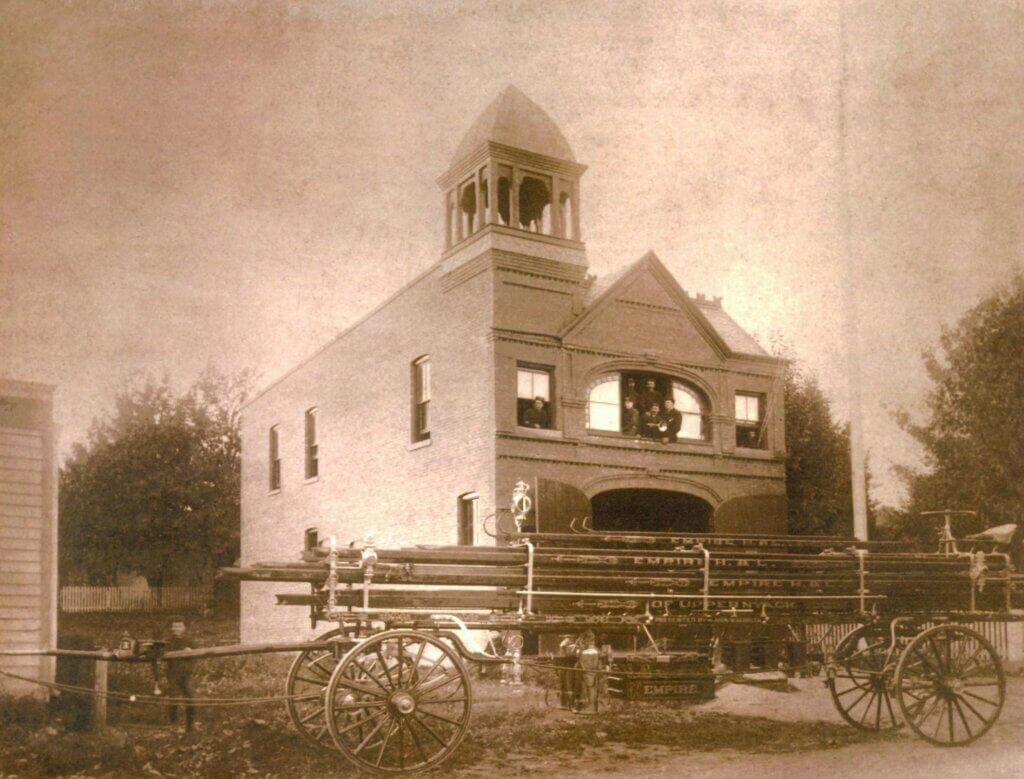
Onlookers crowd the second-floor windows as a young boy clings to the wagon tongue below. Courtesy of the Nyack Library.
A Lightning Strike and a New Company
In the summer of 1895, lightning ignited a barn on Arthur Tucker’s Underclyffe estate near North Midland Avenue, close to his greenhouses. Empire and Chelsea responded. Empire, without a steam pumper, relied on an older hand engine pulled by Tucker’s horses, and the equipment proved inadequate.
Mazeppa’s steamer never reached the scene. The company could not find a team of horses, and firefighters struggled to move the heavy apparatus along muddy roads. Fire Chief Haines recalled the engine, and the barn burned.
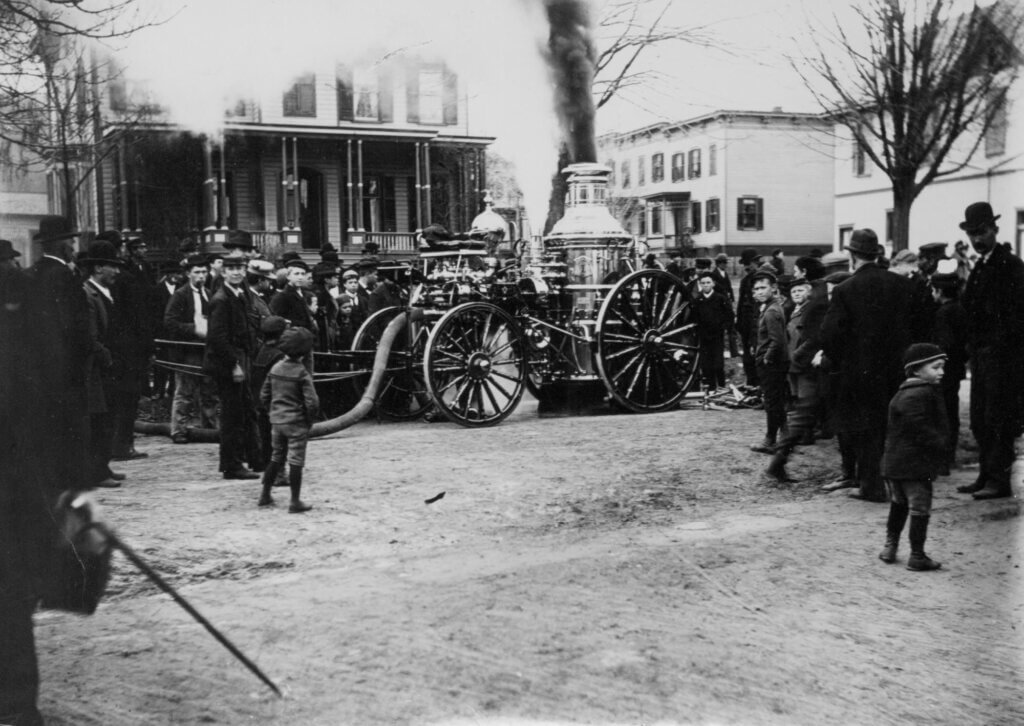
The house behind belonged to shipbuilder James Voris; row houses at right housed dock workers. Courtesy of the Nyack Library.
Tucker, then president of the Village of Upper Nyack, filed a complaint against Chief Haines. The village held a hearing at the Mazeppa firehouse with representatives from several companies present. Haines testified that even if the steamer had arrived, the crews could not have saved the barn. The jury ruled that his judgment error was unintentional and issued a suspended sentence.
The episode exposed a larger problem: Upper Nyack needed reliable steam firefighting capacity. In 1903, local leaders organized Defender Engine Company Number One under R. Dickinson Jewett and purchased a Silsby steam pumper. Defender operated from Empire’s firehouse, and the two companies worked side by side for years. Although Empire and Defender later functioned as a unified service, Defender continued as an identified company into at least 1919 and earned a reputation across the Nyack fire service.
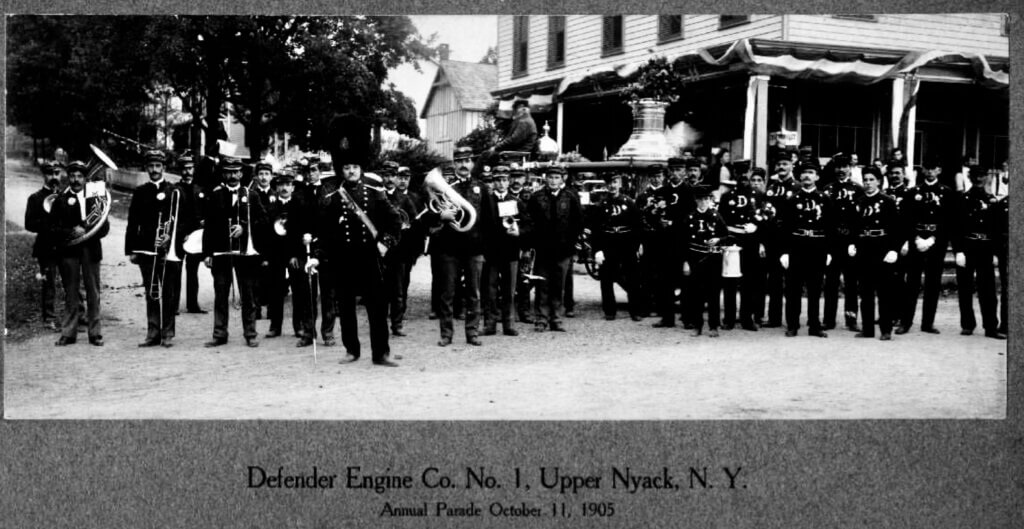
Firefighters gather at North Broadway and School Street beside Otto Hahn’s saloon , later Upper Nyack Village Hall. Courtesy of the Nyack Library.
Goosetown Against The World
In 1909, Empire Hook and Ladder Company found itself in a dispute with the Hudson-Fulton Parade Committee commemorating the 300th anniversary of the “discovery” of Hudson River and the 100thanniversary of Fulton’s successful steamboat journey on the Hudson. Empire claimed the right to use money it collected to feed guests after the parade, but the committee argued they had first rights to the money for their own purposes. Consequently, Empire was denied participation in the parade.
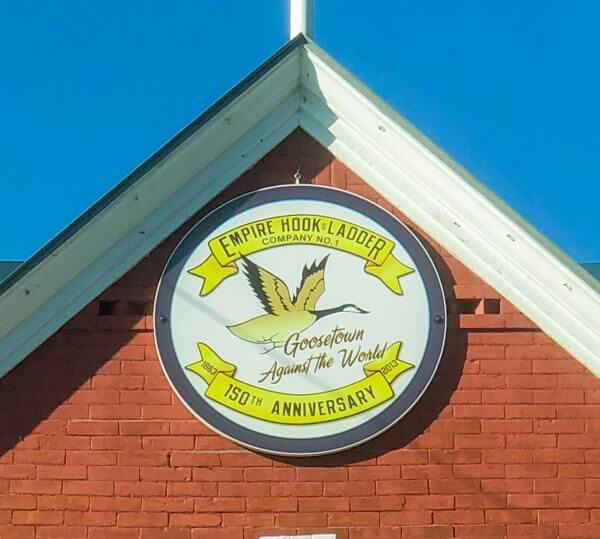
Mounted on the firehouse eave, the slogan commemorates Empire’s defiant 1909 parade protest. Photograph by the author.
In a display of solidarity, Jackson Hose Company invited Empire to march with them. Empire marched in the first division, led by a jackass covered with a red blanket bearing the slogan, “Goosetown Against the World”. This memorable slogan has survived to this day, although the origin of the term “Goosetown” and its association is beyond the scope of this article.
A New Truck and a Sleigh
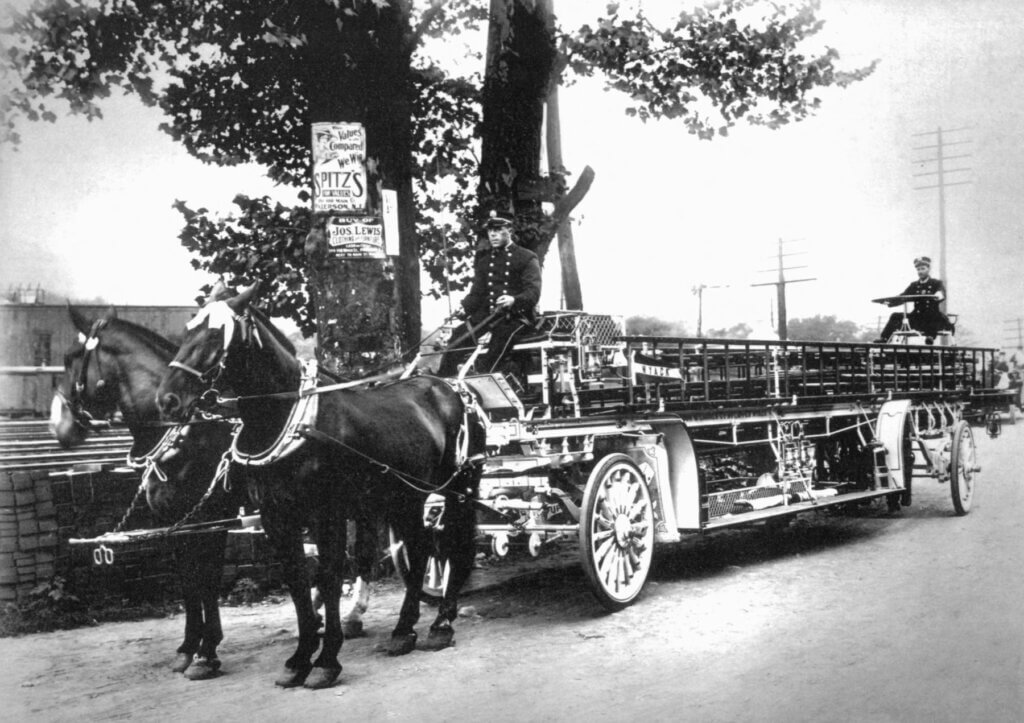
In 1911, Empire acquired an all-white horse-drawn ladder truck equipped with a 65-foot extension ladder. During winter fires, firefighters often loaded ladders and equipment onto a large sleigh. After a storm dropped nearly 20 inches of snow, Empire’s sleigh proved essential when fire broke out at the former Rutherford College building on Sickles Avenue just west of Route 9W.
Motorized Trucks
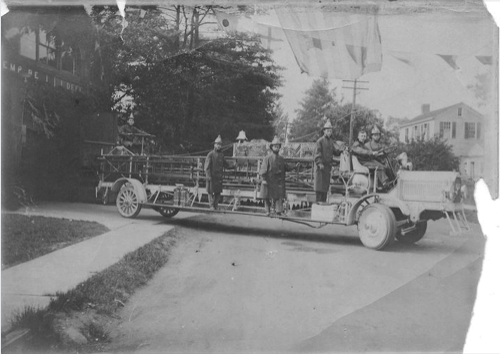
Empire entered the motorized era in 1916 with its first powered ladder truck, which remained in service until 1930. Over the following decades, the company operated several Seagrave ladder trucks. In the 1970s, crews lowered the firehouse floor to provide sufficient clearance for newer apparatus. Watching drivers guide the large 2011 Seagrave into the narrow historic building remains a familiar sight.
9/11 Remembrance
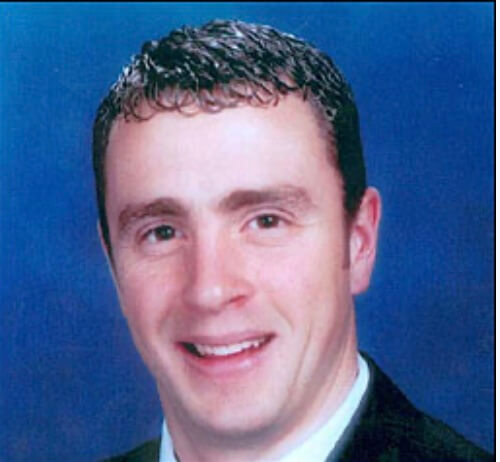
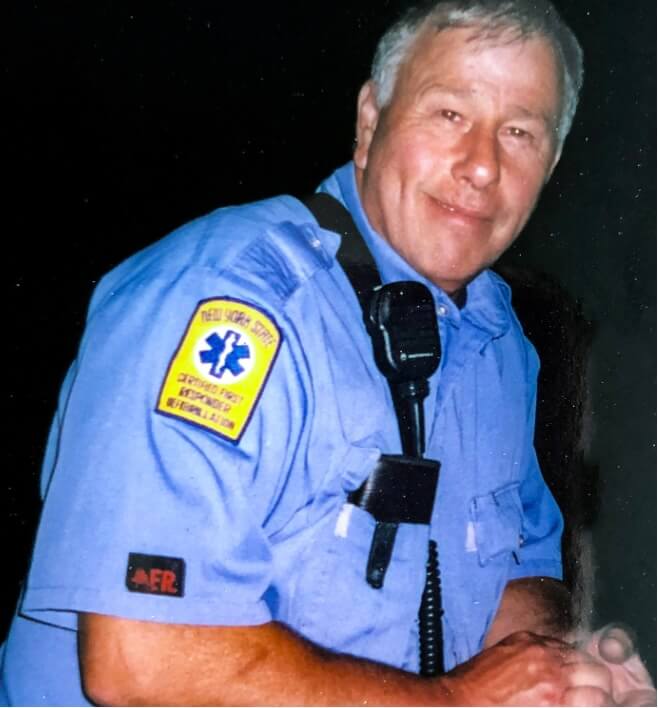
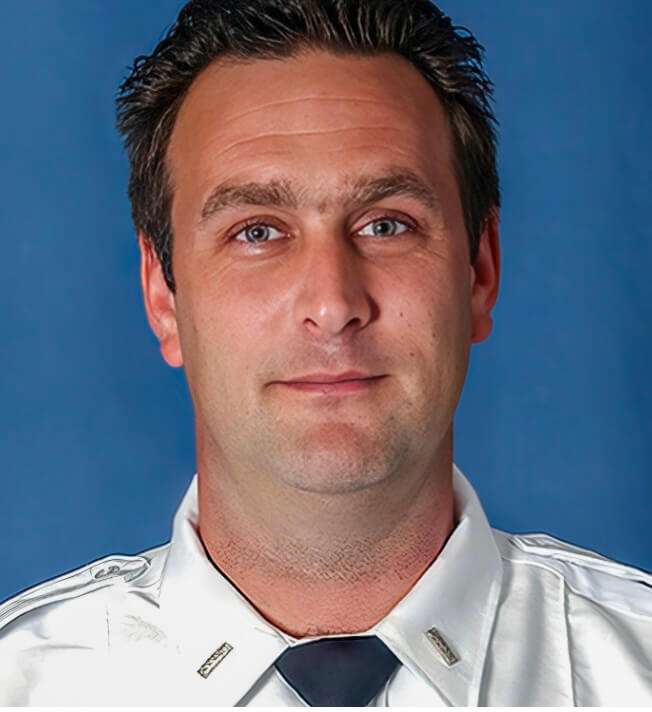
Welles Crowther, remembered as the “man in the red bandana” for his actions during the collapse of the South Tower of the World Trade Center, belonged to Empire Hook & Ladder, as did his father. Crowther died in the attacks. Harry Wanamaker Jr., from a multigenerational Empire family, assisted at Ground Zero and later died from a 9/11-related cancer in 2019. Joseph Stach Jr., a former FDNY firefighter and Empire member, succumbed to a related cancer in 2017.
Enduring Service
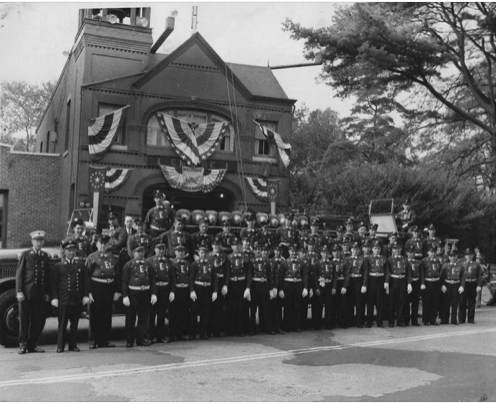
Since its founding in 1863, Empire Hook & Ladder Company Number One has adapted to fire, division, reform, and technological change. The company weathered internal disputes, rebuilt after loss, incorporated steam and motorized equipment, and responded to moments of local and national crisis. Through these transitions, Empire remained rooted in Upper Nyack, operating from its North Broadway firehouse and serving alongside sister companies as part of a unified fire service. More than a historic institution, Empire continues as an active link between the Nyacks’ past and present.
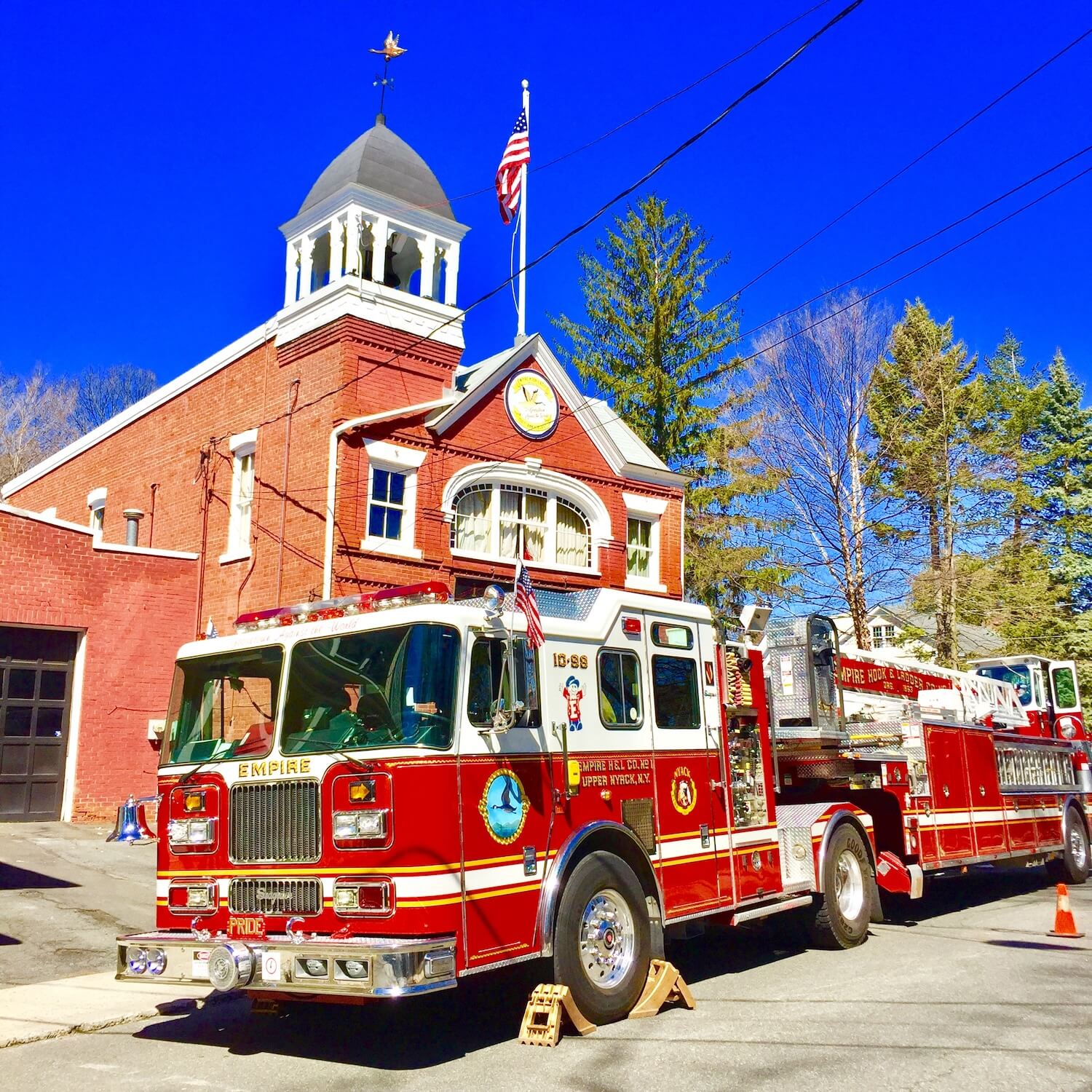
The historic station remains in active service at the heart of Upper Nyack. Photograph by the author.
About the author
Mike Hays has lived in the Nyacks for 38 years. After a career as an executive at McGraw-Hill Education in New York City, he now focuses on researching, writing, and interpreting local history.
He serves as Treasurer and past President of the Historical Society of the Nyacks. He is also a Trustee of the Edward Hopper House Museum & Study Center and Historian for the Village of Upper Nyack. In these roles, he works with community partners to preserve historic resources and expand public understanding of the area’s past.
Since 2017, he has written the popular Nyack People & Places column for Nyack News & Views. The series chronicles the history, architecture, and personalities of the lower Hudson Valley.
Hays has also developed museum exhibitions, written interpretive materials, and led well-attended walking tours that bring Nyack’s history to life.
He is married to Bernie Richey. He enjoys cycling, history walks, and winters in Florida. You can follow him on Instagram at @UpperNyackMike.