Nyack History A to Z
A Ball on South Mountain
On the evening of July 19, 1873, the newly opened Palmer House, later known as the Prospect House, celebrated its first season with a grand ball. At precisely 8:15, Schilling’s Orchestral Band of New York City struck up Les Lanciers, a quadrille, and formally dressed couples took to the gaslit ballroom.
Matthew Baird, a wealthy Philadelphia railroad magnate, brought his family to Nyack aboard a private steamboat. His wife wore black silk and what a local newspaper described as “magnificent diamonds.” His daughters Flora and Dolly appeared in white dresses and diamonds.
The newspaper lingered over the scene. Its account catalogued the evening dress of some forty women—black silk, blue silk, pink satin, white grenadine, lace, flowers, and, again and again, diamonds. The attention given to what the women wore tells us something about the social world Mrs. Palmer hoped to create on South Mountain. This was more than the opening of a new hotel. It was the debut of a fashionable summer resort. Dancing continued late into the night.
It is a Nyack that is difficult to imagine today.
During the Gilded Age, prosperous families from New York, Philadelphia, and elsewhere came to spend weeks or entire summers in the village. They sought fresh air, river breezes, recreation, and escape from the heat, crowds, and recurring diseases of the city. Nyack was also close enough to New York that businessmen could return to the city when necessary while their families remained for the summer.
No hotel represented that world better than Prospect House.
A Hotel on South Mountain
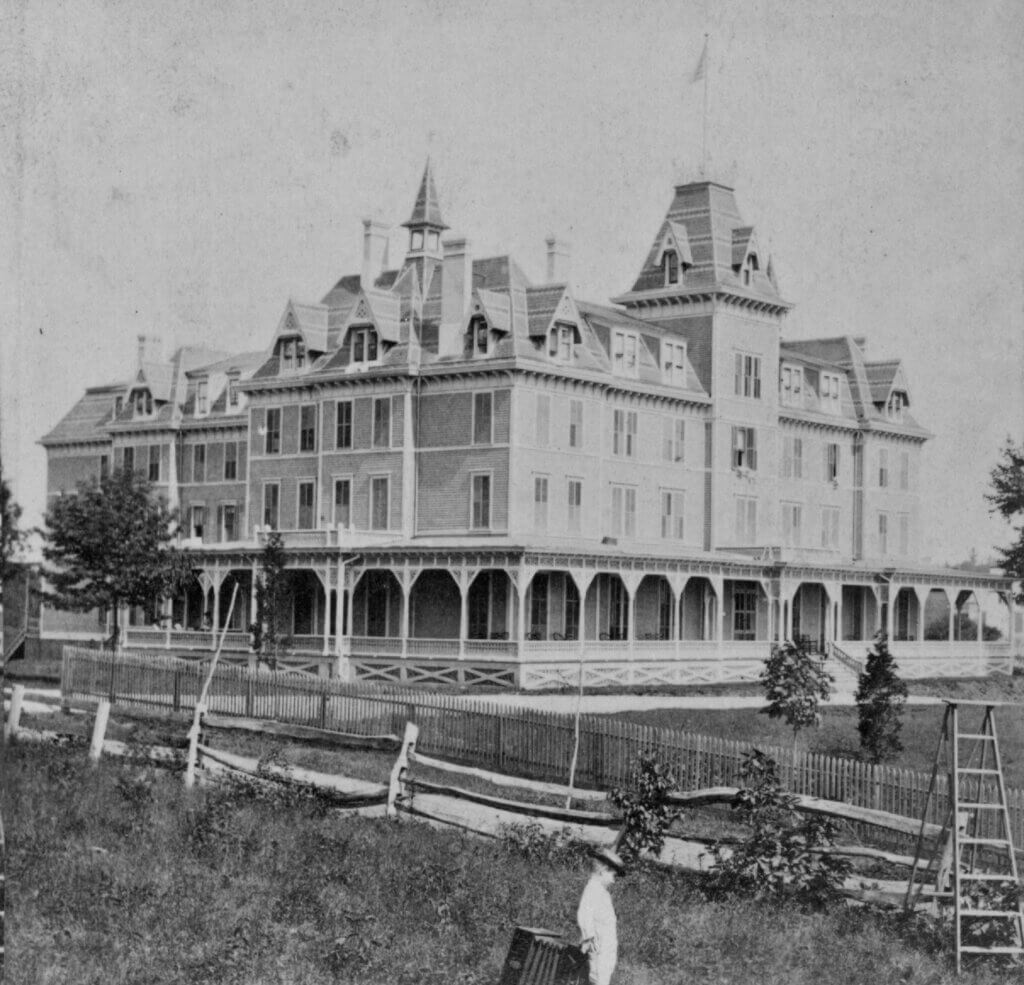
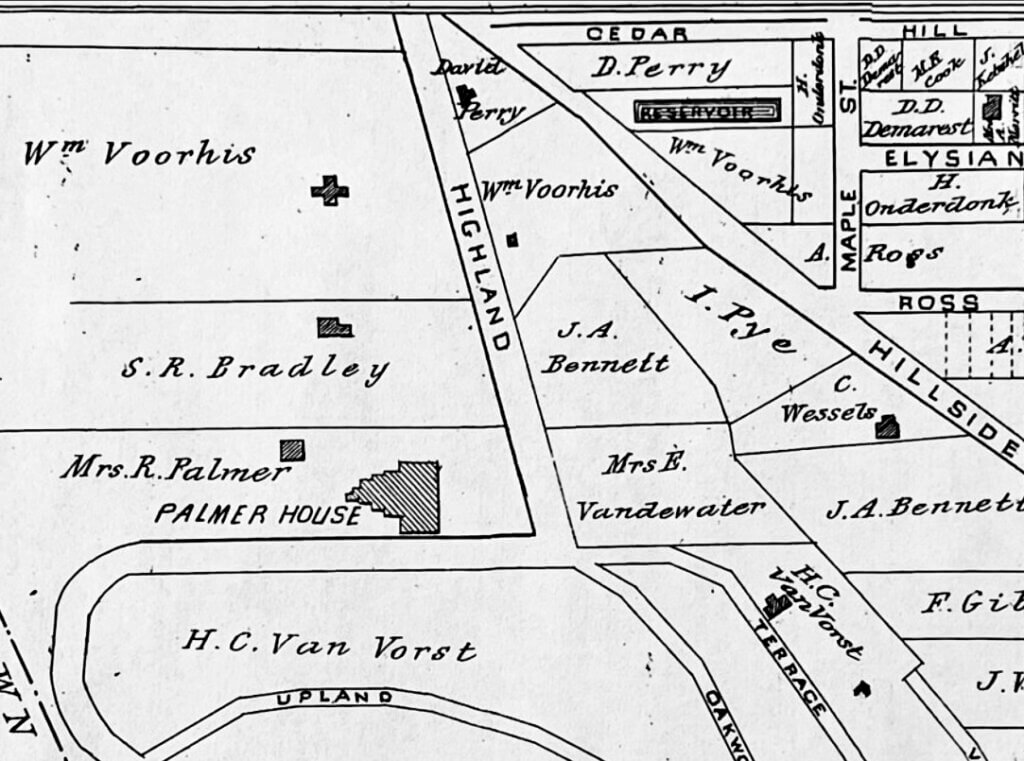
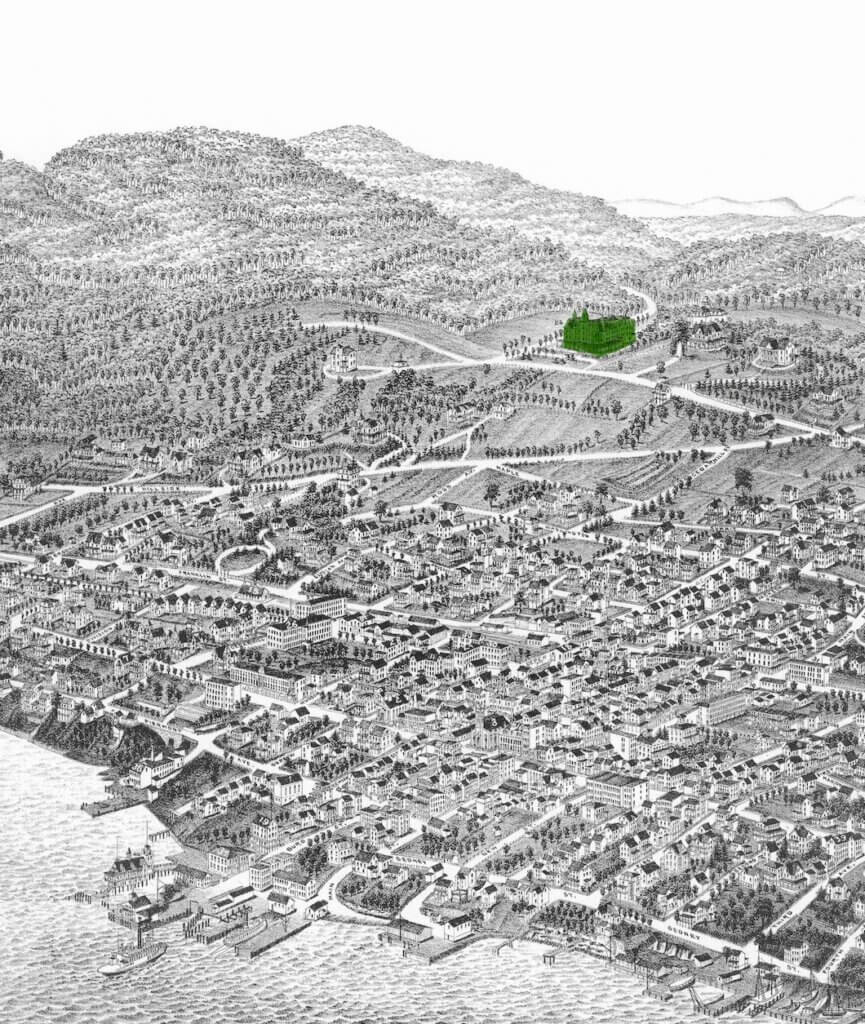
The hotel began as the Palmer House. Construction started late in 1872 on an open hillside near the crest of South Mountain, some 400 to 500 feet above the Hudson. The new hotel opened for transient and seasonal guests on June 18, 1873.
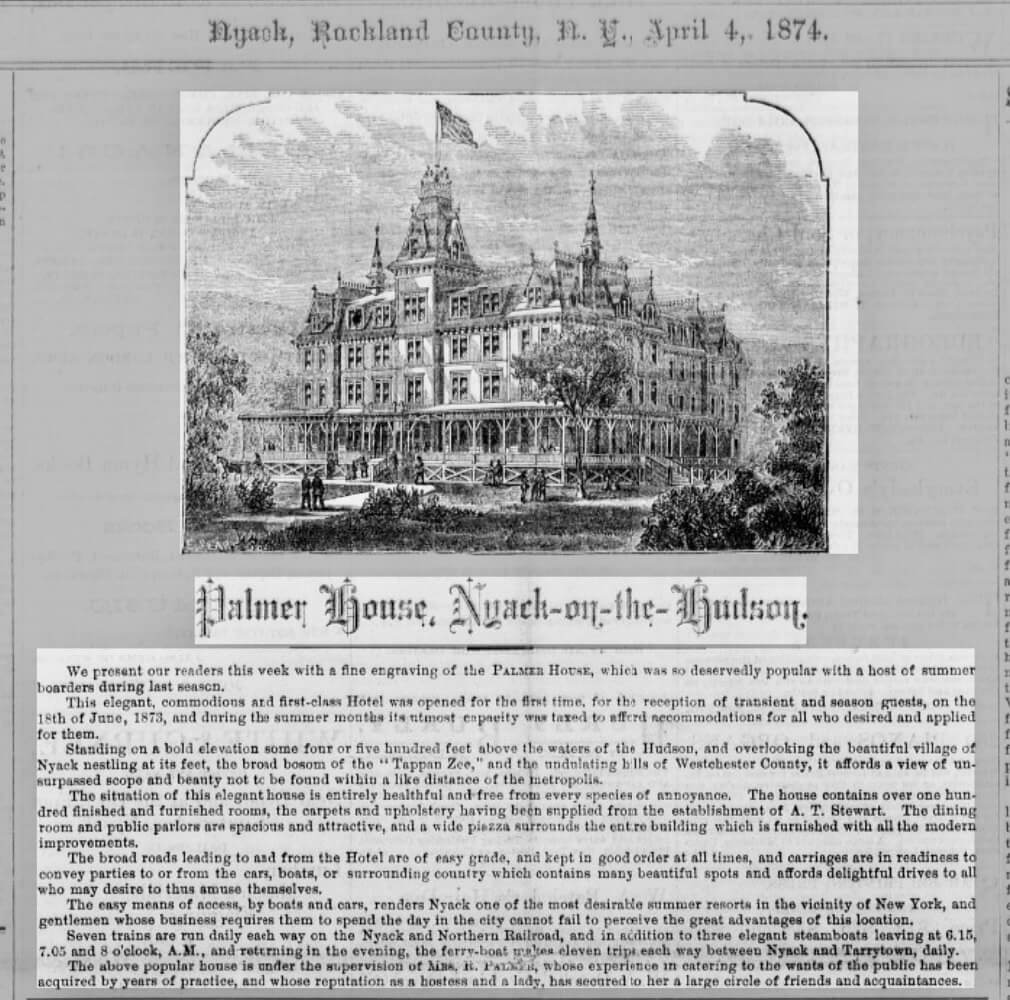
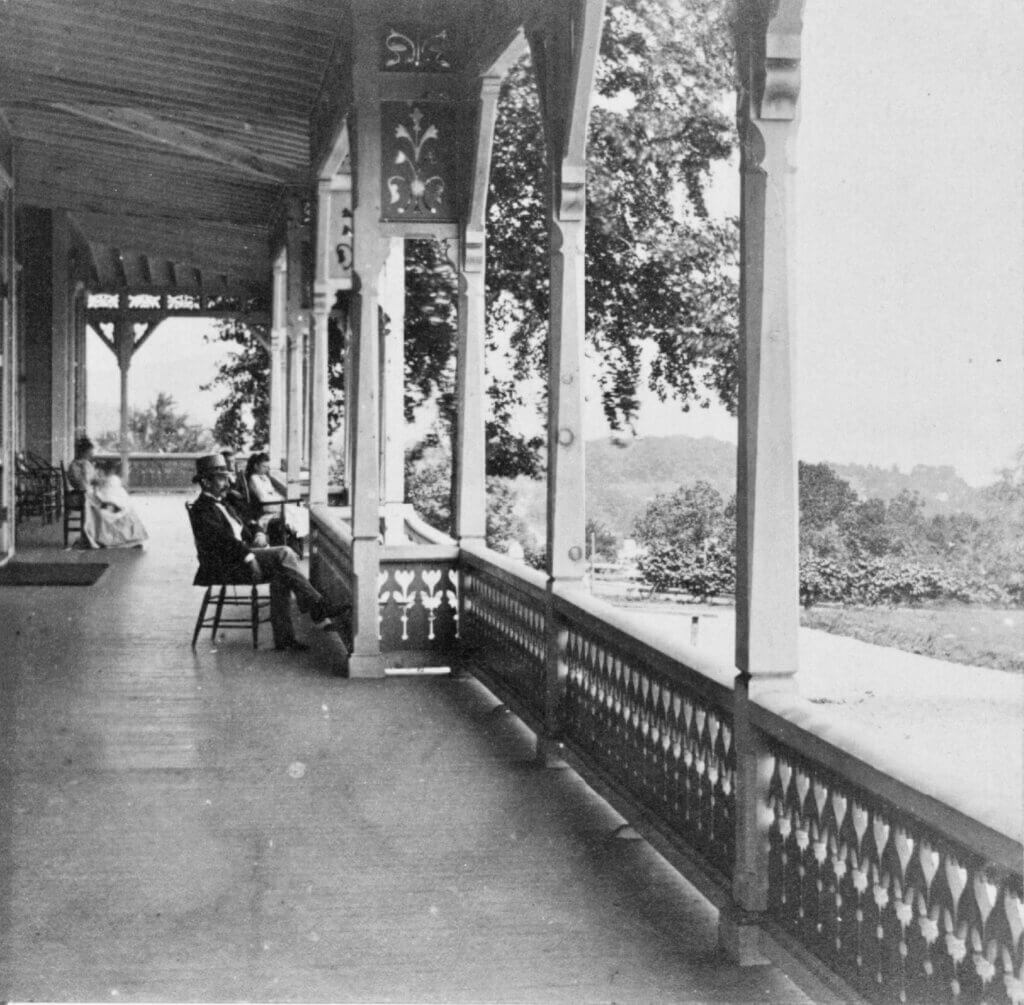
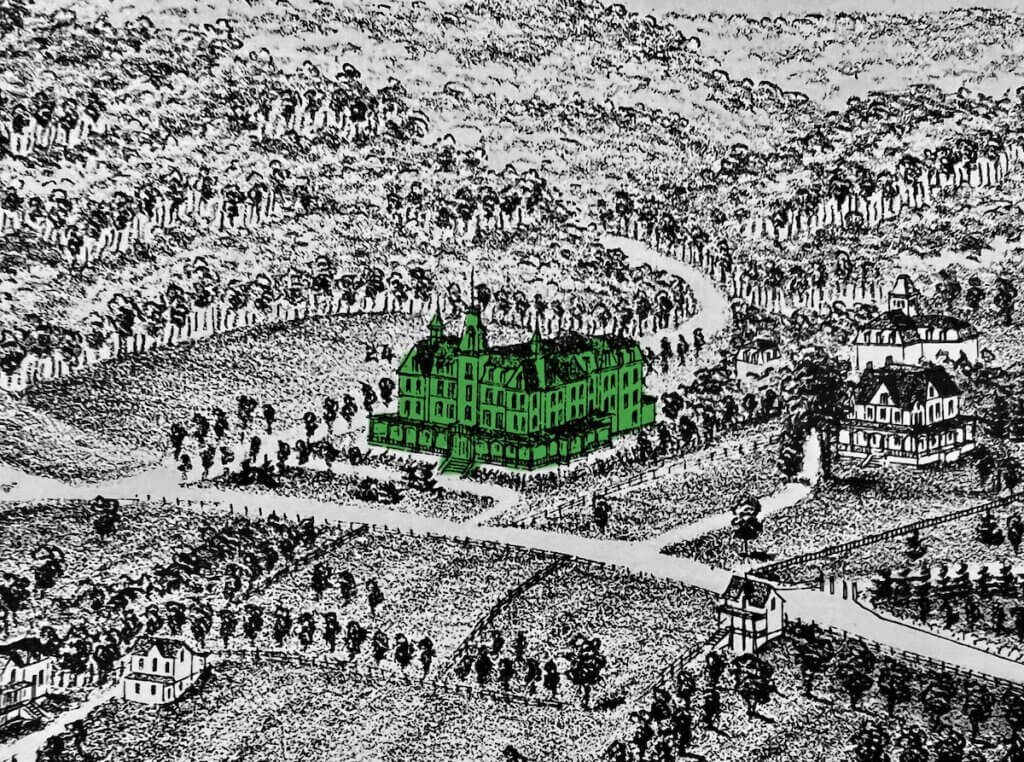
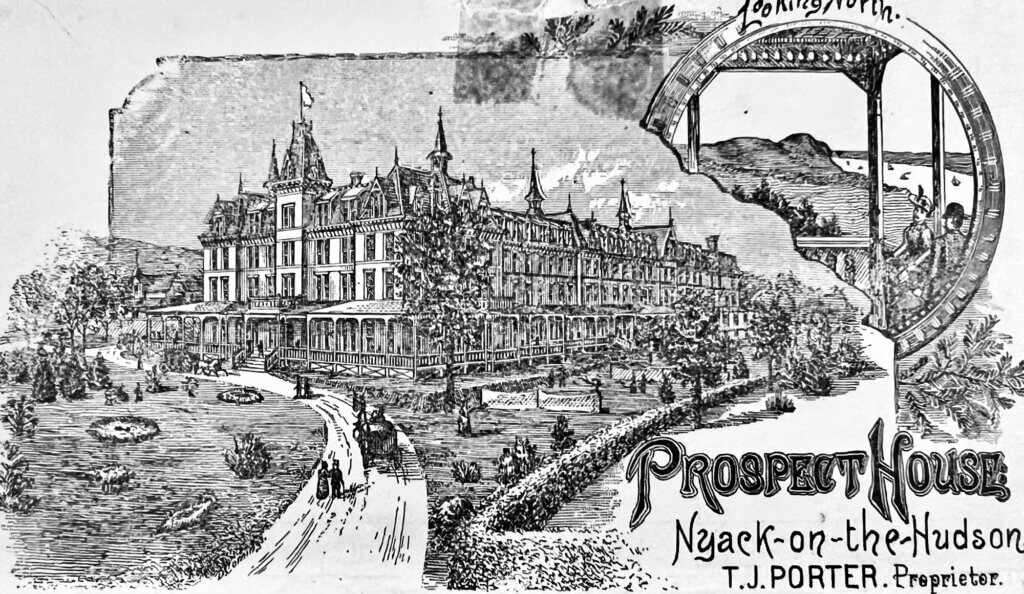
The four-story Second Empire building presented a striking profile above South Nyack, with mansard roofs, dormers, towers, and a broad covered piazza. An early advertisement said the hotel contained more than one hundred finished and furnished rooms, spacious dining and public rooms, and a wide piazza surrounding the building.
Its elevated setting was one of its principal attractions. A contemporary newspaper described a panorama extending across the entire Tappan Zee. Hook Mountain rose to the north, with Rockland Lake behind it. Across the river were Teller’s Point (known today as Croton Point) and the entrance to Haverstraw Bay, while Sing Sing, Sleepy Hollow, Washington Irving’s Sunnyside, and Piermont could be picked out in the distance.
It was the landscape that Palmer House would sell as much as its rooms.
Mrs. Palmer and Matthew Baird
The name over the door belonged to Rebecca Palmer, an experienced hotelkeeper. Born in Ireland around 1831, Palmer was widowed while still relatively young and supported herself and her family through the lodging and hotel business. By 1868 she was advertising rooms for rent in New York City. She later operated the Cornwall Mountain House in 1871–72 and Larchmont Manor in Westchester County in 1872.
Palmer House was therefore not her first venture. But its creation involved another important figure: Philadelphia railroad magnate Matthew Baird.
Palmer acquired the South Mountain property in the fall of 1872 and conveyed it to Baird the following February. A contemporary Nyack newspaper credited Baird with erecting the hotel. It reported that his family had been accustomed to spending summers in Nyack and had become so attached to the area that he decided to build on the hillside.
Yet Palmer was much more than the woman whose name appeared on the hotel. In 1875, a local newspaper reported that she had “the sole management of the affairs of the hotel,” praising her long experience, good judgment, and keen observation. Another account called her “one of the most accomplished hotel keepers to be found anywhere.”
The surviving records do not explain exactly how Palmer and Baird structured their business relationship. A curious newspaper item from 1873 reported a rumor that Palmer had sold “her interest in the new hotel” for $20,000. The newspaper soon corrected itself, saying the report was erroneous.
Baird’s conspicuous presence at the opening festivities makes sense in light of his connection to the hotel. He brought his family from Philadelphia aboard a private steamboat for the July ball. His wife and daughters, dressed in silk and diamonds, were among the evening’s most carefully described guests.
A Summer Household Moves to Nyack
Palmer House quickly found its clientele. During its first summer, a newspaper reported that Palmer House and the nearby Tappan Zee House were so “overrun with visitors” that beds were being made in parlors and private residences were taking in the overflow.
Hotel-arrival lists reveal what a summer migration could involve. Couples arrived with children, nurses, maids, servants, and even coachmen and horses. One family brought three children and two nurses; another arrived with two children and two nurses. Most guests came from New York, although the registers also recorded visitors from Philadelphia, Brooklyn, Pennsylvania, and more distant places.
For some families, spending the summer in Nyack meant moving a substantial portion of the household with them.
Palmer paid attention to the fashionable setting awaiting them. Carpets for the parlors and principal rooms were made abroad to her order and described by the local newspaper as “magnificent.”
The hotel was not isolated from the village socially. Nyack residents regularly joined summer guests at its hops and dances. One newspaper praised the “remarkable degree of sociability” at Palmer House, observing that newcomers quickly became acquainted.
Getting There
Although Palmer House stood high above the village, it was closely connected to the transportation network that made Nyack accessible to summer visitors. An early advertisement described the roads leading to the hotel as an “easy grade” and promised that carriages would be ready to carry guests to and from trains, steamboats, or excursions into the surrounding countryside.
Seven trains ran daily in each direction on the Nyack & Northern Railroad. Three steamboats left New York each morning, while the ferry made eleven trips each way between Nyack and Tarrytown. Visitors could leave the city and within hours find themselves high above the Hudson.
The hotel also required infrastructure on what had recently been an open hillside. In 1875, village officials approved a petition to lay a sewer from Palmer House toward the river. As the resort grew, its connections to the village below grew with it.
Becoming Prospect House
In 1878, Thomas Jefferson Porter leased Palmer House for three years and soon renamed it Prospect House. Porter was already an experienced hotelkeeper. As a young man he had interests in hotels at Saratoga Springs and later spent several winters managing the Royal Victoria Hotel in Nassau, the Bahamas.
Porter gradually transformed Prospect House into a much larger resort. A later account recalled that he purchased the hotel property and additional adjoining land, enlarged the hotel when it could no longer accommodate the demand, and built four cottages on the grounds. Contemporary evidence documents a major expansion in 1885: the kitchen was moved back 102 feet and a four-story addition filled the intervening space, adding about seventy sleeping rooms. The enlarged dining room measured 100 by 45 feet, while the piazza extended nearly 500 feet around the building.
Porter also had a personal connection that would eventually bring one of the country’s best-known visitors to South Mountain. While managing the Royal Victoria, he became acquainted with the Cleveland family through Grover Cleveland’s brother. A later account described Porter and Cleveland as personal friends for twenty-five years. Cleveland visited Prospect House twice between his two presidential terms.
A Village Above the Village
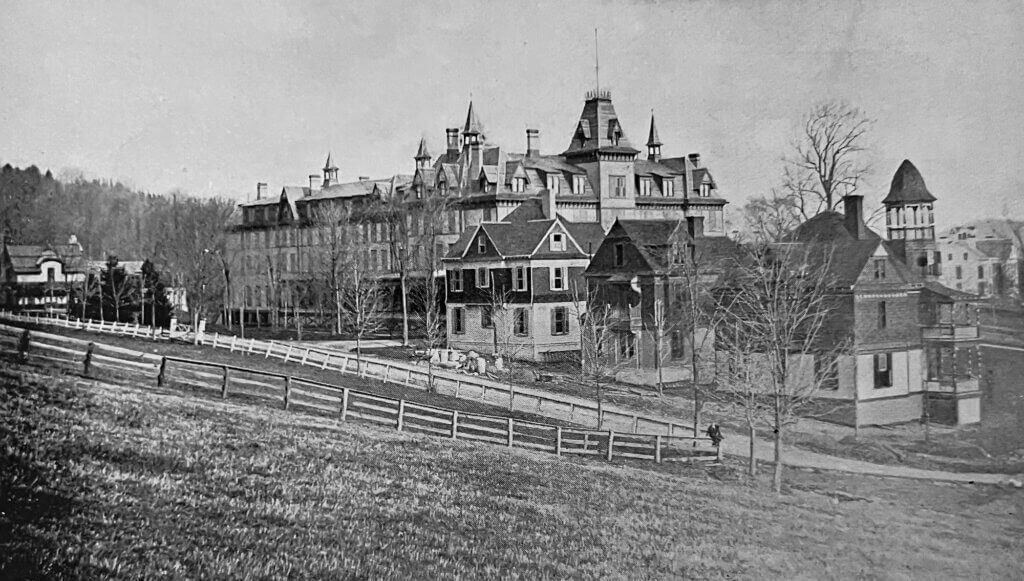
By 1896, Prospect House had become a small resort complex. The Sanborn map listed the hotel for an occupancy of 400 people. Its enormous piazza wrapped around the main building and continued around the elongated rear addition.
Nearby buildings supplied many of the services required by a resort of that size. A separate building contained a bowling alley, billiard room, and barber shop. Behind the hotel stood a separate laundry and servants’ quarters. The grounds also included a large carriage house. Large cottages stood near the Highland Avenue corner.
The Sanborn map also reveals some of the infrastructure hidden behind summer resort life. Gas came from the village, steam heated the first floor, and a large water tank stood in the attic. A sewer connection had already been approved in the Palmer House years.
Prospect House thus combined its relatively isolated mountain setting with many of the conveniences and services expected by its guests. A family could spend much of a summer on South Mountain surrounded by the amenities of a small seasonal community.

Summer on the Mountain
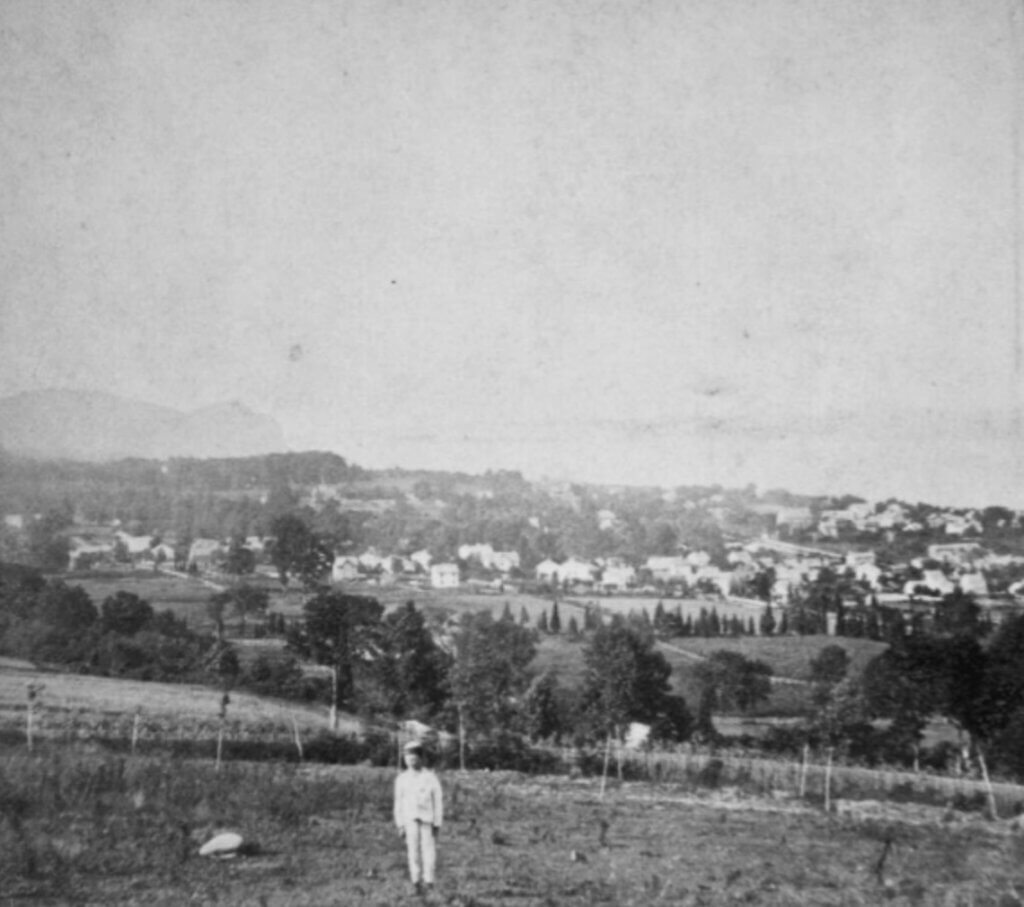
A reporter arriving in 1879 followed directions up Main Street, turned south near the ice houses, and eventually reached Prospect House. Sitting in one of the hotel’s “easy chairs,” the writer looked out across Nyack. The village lay below “looking cool and placid,” with the bright waters of the Hudson beyond and Hook Mountain rising in the distance.
The People behind the Summer
The world enjoyed by Prospect House guests depended on a large staff working behind the scenes. Many of the waiters, porters, bellmen, and other employees were African American.
They also developed a social world of their own. Hotel employees formed a baseball team, while Fourth of July celebrations included contests for staff members as well as entertainment for guests and villagers. Events included a 200-yard dash, a greased-pole contest, a three-legged race, tug-of-war, and pie eating. George Avery, a longtime Prospect House waiter, won one of the foot races.
In 1891, twelve couples participated in a cakewalk at the Nyack Opera House. J. F. Parono and Mamie Brown won the competition. Prospect House guests joined the dancing afterward, followed by a midnight meal. The festivities continued until 5:30 in the morning.
The surviving newspaper accounts usually tell us far more about the people who vacationed at Prospect House than those who made their vacations possible. These occasional glimpses of the staff reveal another community within the resort.
Five Thousand Clams
Outdoor entertainments could be conducted on an equally extravagant scale. In 1888, George Bardin prepared a Prospect House clambake that required 5,000 clams, 1,000 Saddle Rock oysters, 100 lobsters, 100 pounds of sea bass, 100 pounds of spring chicken, 100 ears of corn, and a barrel and a half of potatoes.
The enormous quantities tell us something about the scale Prospect House had reached. This was no longer simply the hundred-room hotel Rebecca Palmer had managed in the 1870s.
Grover Cleveland at Prospect House
Among Prospect House’s most famous visitors was former president Grover Cleveland, who came to the resort twice in 1889. On July 10, Cleveland arrived from New York with Porter on the Northern Railroad “flyer” shortly before six in the evening. He stayed in one of the cottages on the Prospect House grounds.
After arriving, Cleveland took a carriage ride toward Hook Mountain and back. “I had no idea there was such a beautiful region here,” he told a reporter, adding that he was “perfectly charmed with the scenery.” After dinner, Cleveland settled into an easy chair on the veranda overlooking the Hudson and smoked cigars. Word of his presence spread. Supporters gathered on the lawn, a cornet band played “Hail to the Chief,” and Cleveland came out to shake hands, although he declined to make a speech. He left the following morning.
Cleveland returned on September 21, this time with his wife, Frances Folsom Cleveland. A clambake was spread on the grassy west lawn, where a long table had been set beneath the trees. Cleveland sat at its head, with Porter and George Bardin, Nyack’s Hotel St. George owner, among those seated nearby. At least forty-two other guests joined them, while waiters in full dress served the meal on the hotel’s best tableware.
There were jokes but no speeches. A newspaper reported that Cleveland “did his full share in eating and joking.” When a passing shower interrupted the gathering, the party retreated to the nearby carriage house. The rain soon passed, and a rainbow appeared over the Hudson
After Porter
Thomas Jefferson Porter died in 1895, ending nearly two decades of his association with Prospect House. His estate retained the property and leased the hotel to a succession of managers. That arrangement continued until 1898.
By then W. P. F. Meserve was preparing Prospect House for another summer season. Before the hotel could officially open, disaster struck.
Fire on South Mountain
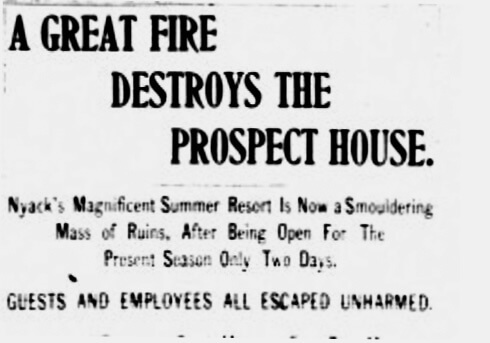
At about 1:45 on the morning of June 2, 1898, smoke was discovered inside the enormous wooden hotel. Meserve and several employees traced a fire to the space between the floors above the office. They cut through the floor and thought they had nearly extinguished it. Then flames appeared again about twenty feet away.
Meserve believed the fire had started in a kitchen flue and had been traveling unseen through the building. Once it broke through the exterior, it spread rapidly from one part of the hotel to another. Firelight could be seen for miles along the Hudson.
Nyack firefighters faced another problem. Prospect House stood high on South Mountain, where, according to a contemporary newspaper, “the water pressure was not very great.” Wells and cisterns were pumped dry, and additional water had to be taken from a hydrant at Hillside and Cedar Hill Avenues. Firefighters could not save the main hotel, but by drenching the surrounding buildings they saved the cottages and outbuildings.
Six guests, the Meserve family, and about twenty employees were inside. Among the guests were Winston Churchill, the American novelist and one of the nation’s best-selling authors, and his wife. Everyone escaped unharmed, although many fled only partly dressed. Employees housed on the upper floor lost much of their clothing and personal belongings.
By morning, Prospect House was a smoldering ruin.
The Summer Crowds Disappear
What remained of Prospect House was dispersed that fall.
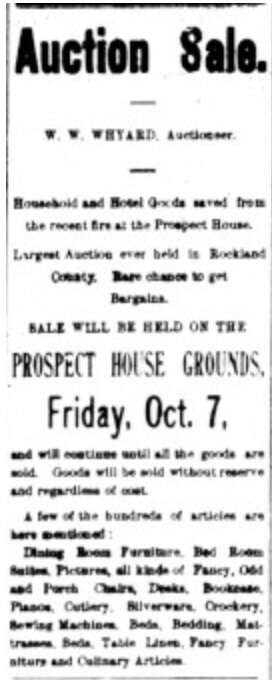
On October 7, auctioneer W. V. Whyard conducted what was advertised as the “largest auction ever held in Rockland County.” Dining-room furniture, bedroom suites, mattresses, chairs, desks, bookcases, pianos, cutlery, silverware, bedding, and linens went under the hammer.
The furnishings that had served generations of summer visitors were scattered piece by piece.
After Prospect House
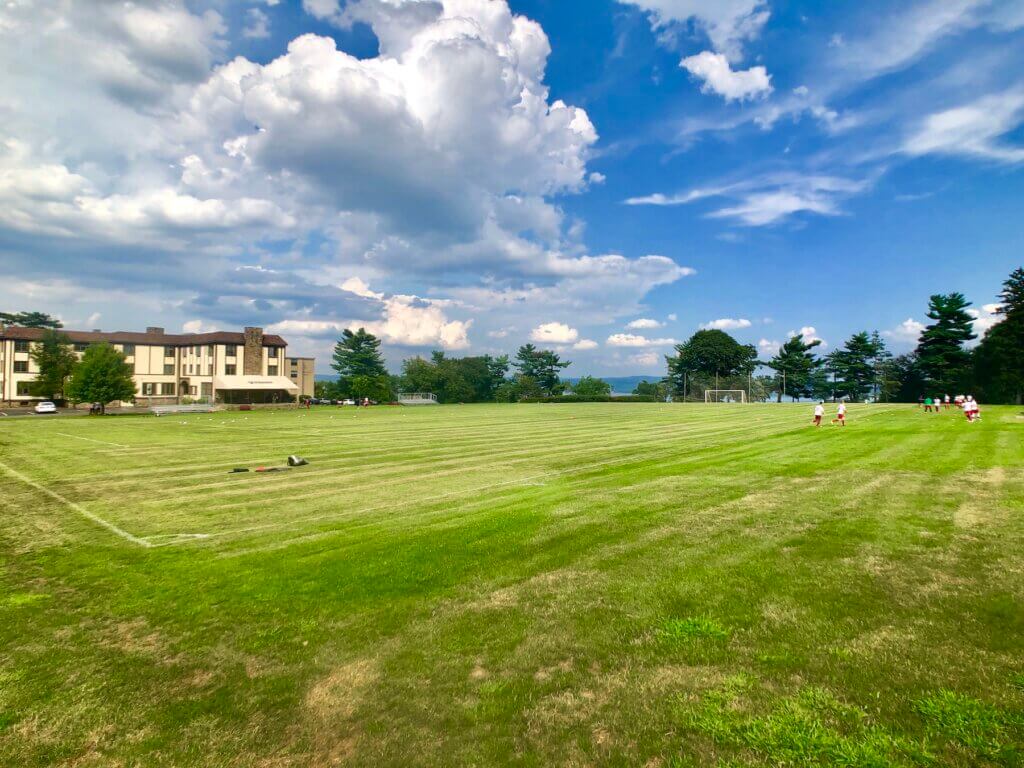
Prospect House was never rebuilt. The property later became part of the Clarkstown Country Club and eventually Nyack College (now known as Alliance College). For many years, athletic fields occupied much of the former hotel grounds. The former hotel grounds remain largely open under the current ownership of the Yeshivath Viznitz D’khal Torath Chaim.
Little remains on South Mountain to suggest the scale of the resort that once stood there. For a generation, Palmer House and Prospect House offered summer visitors what had drawn them to Nyack in the first place: fresh air, river views, recreation, society, and escape from the city, all within easy reach of New York.
The fire ended Prospect House, but not South Mountain’s long history of attracting newcomers. What disappeared was a particular kind of Nyack summer—the Gilded Age resort world of grand hotels, long verandas, summer cottages, dances, and clambakes.
Just Published
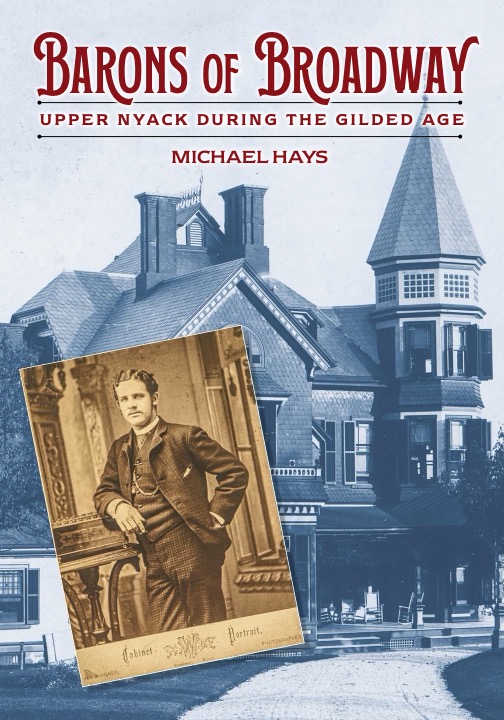
Barons of Broadway: Upper Nyack During the Gilded Age
Available at Pickwick Books, Historical Society of the Nyacks, and Amazon
About the author
Mike Hays has lived in the Nyacks for 38 years. After a career as an executive at McGraw-Hill Education in New York City, he now focuses on researching, writing, and interpreting local history.
He serves as Treasurer and past President of the Historical Society of the Nyacks. He is also a Trustee of the Edward Hopper House Museum & Study Center and Historian for the Village of Upper Nyack. In these roles, he works with community partners to preserve historic resources and expand public understanding of the area’s past.
Since 2017, he has written the popular Nyack People & Places column for Nyack News & Views. The series chronicles the history, architecture, and personalities of the lower Hudson Valley.
Hays has also developed museum exhibitions, written interpretive materials, and led well-attended walking tours that bring Nyack’s history to life.
He is married to Bernie Richey. He enjoys cycling, history walks, and winters in Florida. You can follow him on Instagram at @UpperNyackMike.
Editor’s note: This article is sponsored by Sun River Health and Ellis Sotheby’s International Realty. Sun River Health is a network of 43 Federally Qualified Health Centers (FQHCs) providing primary, dental, pediatric, OB-GYN, and behavioral health care to over 245,000 patients annually. Ellis Sotheby’s International Realty is the lower Hudson Valley’s Leader in Luxury. Located in the charming Hudson River village of Nyack, approximately 22 miles from New York City. Our agents are passionate about listing and selling extraordinary properties in the Lower Hudson Valley, including Rockland and Orange Counties, New York.