Nyack History At to Z
For nearly a century, boarding the Nyack ferry meant stepping directly into the life of the Hudson River. Commuters and tourists stood beside carriage drivers, shopkeepers, politicians, wealthy estate owners, and eventually motorists as the boat pulled away from the Burd Street dock. Passengers could watch Nyack recede against the hills, feel the wind across the Tappan Zee, or simply ride across and back for the pleasure of being on the river.
The ferry was transportation, but it was also one of Nyack’s great public spaces. It connected the village with the eastern shore, brought shoppers and visitors into downtown, and helped make Nyack a destination. Twelve round trips a day made the river part of everyday village life.
Today, almost nothing remains to show where the ferry once landed.
Early Hudson River Ferries
Bridges now make crossing the Hudson routine. Before them, getting across a broad stretch of river like the Tappan Zee meant going by boat.
Indigenous people crossed the Hudson in sturdy dugout canoes long before European settlement. By the Revolutionary War, established ferries at Dobbs Ferry and King’s Ferry carried travelers, horses, wagons, and troops across the river. In 1775, Molly Sneden, a Loyalist who operated the ferry at Sneden’s Landing, carried Martha Washington across the river in a “chariot drawn by four horses, driven by enslaved coachmen and postillions in scarlet and white livery” on a journey to join her husband in Cambridge, Massachusetts.
First Nyack Ferry
R. W. L. Gedney, an early real estate developer of Nyack’s downtown shoreline, received a 15-year license for a Nyack-to-Tarrytown ferry in 1840. Gedney’s dependence on sailboats proved unreliable because of the tricky tides and winds of the Tappan Zee. He concluded that a profitable ferry would require steam power.
Large Hudson River steamboats also connected Nyack with New York City and towns farther upriver. The Chrystenah, built in Nyack, was among the best known. For a time, large steamboats even met the Nyack ferry in mid-river to transfer passengers bound for either Nyack or Tarrytown.
Abram Smith, one of the Smith brothers who controlled much of Nyack’s steamboat business, purchased a small side-wheel steamer named the Daniel Drew for the Nyack-to-Tarrytown ferry in 1853. He replaced it the following year with the larger J. J. Herrick. Abram sold the ferry business to D. D. and Tunis Smith in 1862. The ferryboat subsequently went by several names, including Union during the Civil War and finally Bergen, the name most associated with it.
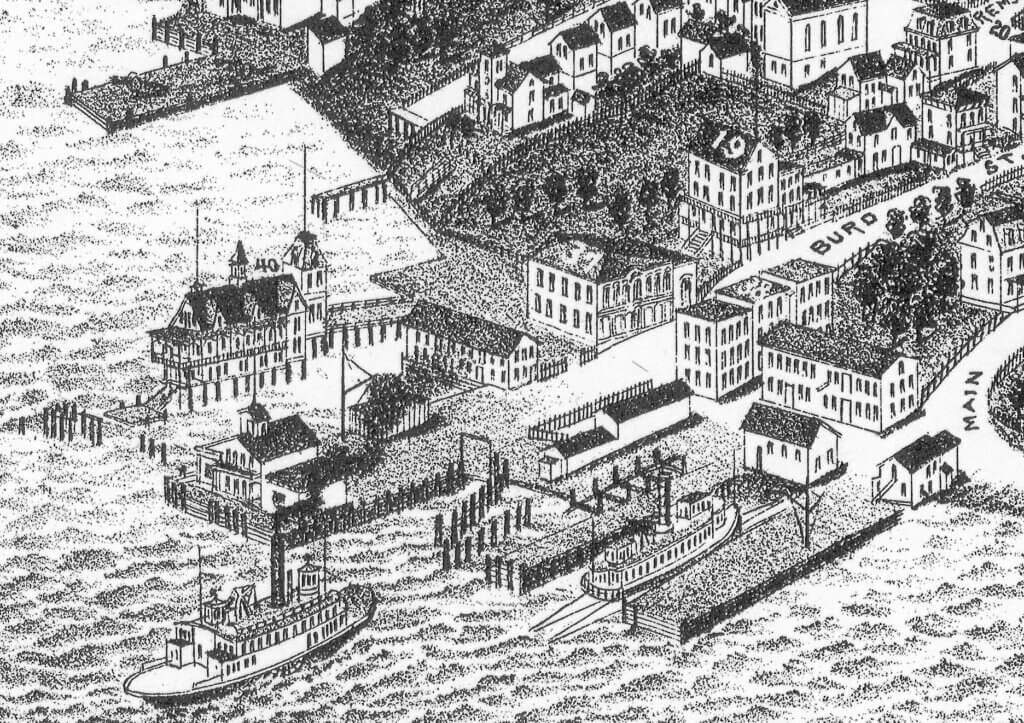
To accommodate the service, the Smith brothers built a new dock at the foot of Burd Street and erected a two-story ferry terminal topped by a cupola.
The Tappan Zee
In 1874, the Smith brothers built a new and larger ferry in Nyack called the Tappan Zee. The side-wheel steamer carried as many as 600 passengers a day. The Smith brothers even offered free ferry service to people from Tarrytown who crossed the river to shop at their dry goods store on Burd Street, then the largest store in Rockland County.
The financial crisis of the late 1870s brought ruin to the Smith brothers, who lost their steamboat company, hotel, dry goods business, and bank. The Tappan Zee nevertheless continued operating under new ownership.
Its career ended dramatically in 1887 when the ferry caught fire at night while docked in Nyack. Two crew members escaped. To prevent the flames from spreading to the waterfront, the burning ferry was cut loose from its moorings. It drifted south before sinking near Commodore Voorhis’s house in South Nyack.
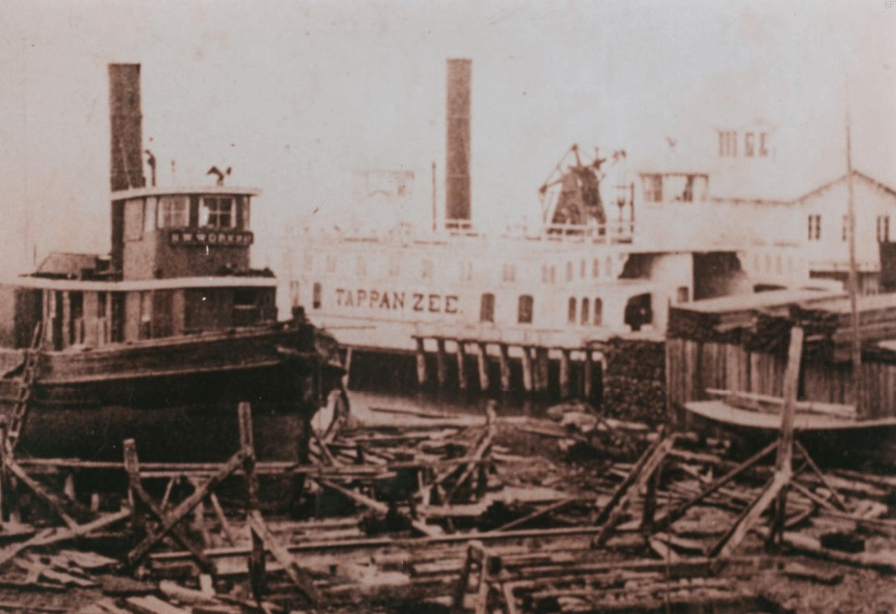
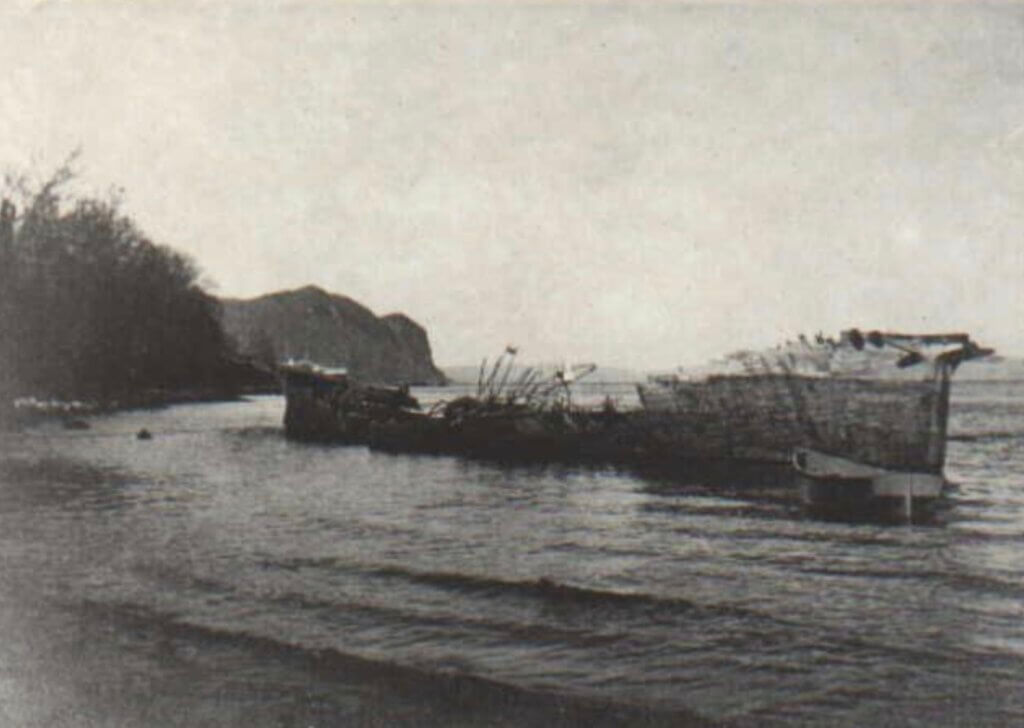
TheTappan Zee, before and after. The ferry at the Nyack landing and its burned hull after the 1887 fire. Cut loose to protect the waterfront, the blazing vessel drifted south before sinking off South Nyack. Courtesy of the Nyack Library.
The Rockland
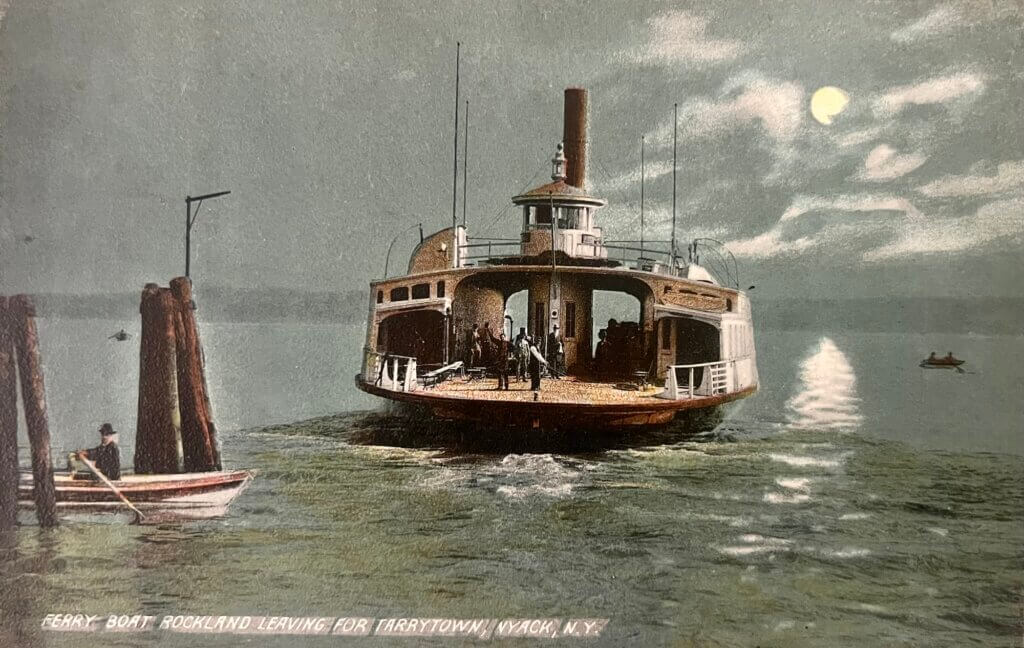
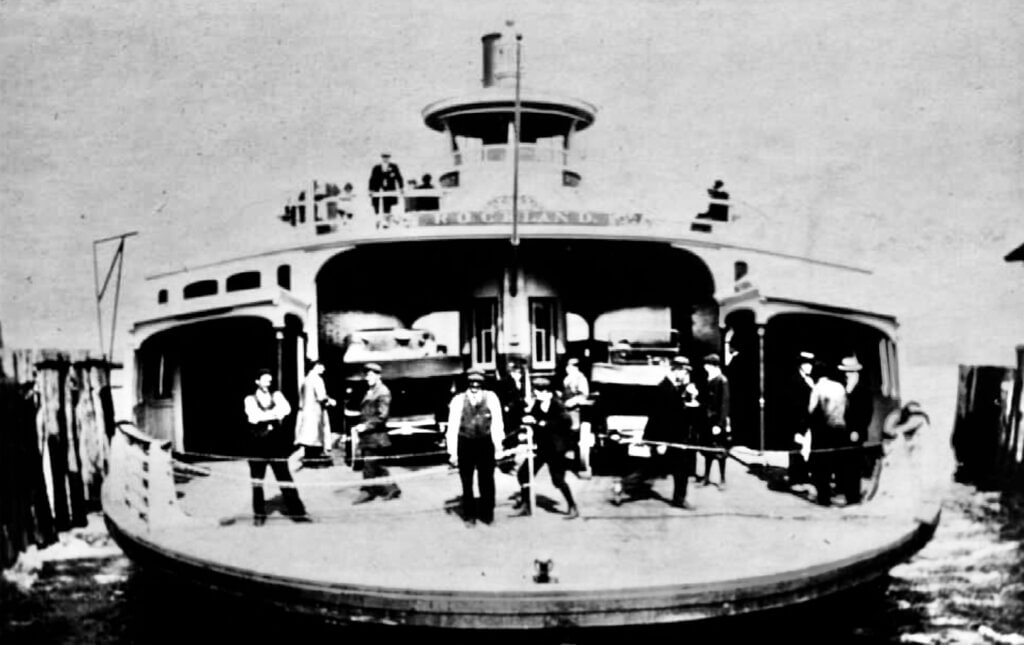
The Rockland, replacement for the Tappan Zee, was steam powered but used a propeller rather than side wheels. Built locally and painted white, it became one of the better-known ferries on the Hudson. It carried about 100 passengers along with carriages, livestock, and eventually automobiles.
Accommodations were simple, appropriate for the short trip between Nyack and Tarrytown. Carriages and automobiles occupied two central lanes on the main deck. Enclosed waiting rooms had benches beside large windows and a stove for cold-weather crossings, while passengers could also remain outside on the open deck. A pointed bow faced the river, while vehicles loaded and unloaded through the broad, squared-off end at the ferry slip.
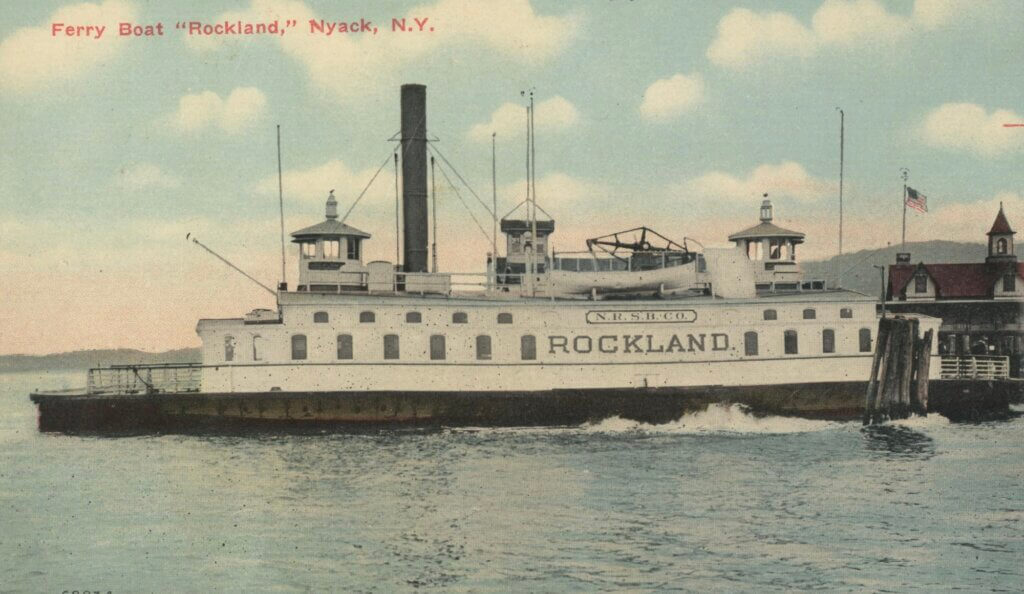
The ferry was also a social space where people from very different worlds found themselves aboard the same boat. Captain John Lyon’s passengers included baseball stars Babe Ruth and Eddie Collins, members of the Rockefeller and Gould families, and prominent local residents such as Judge Arthur S. Tompkins and Dr. Leitner.
Chance encounters could have consequences. In the 1920s, Frank Crumbie recalled meeting Edwin Gould, son of railroad magnate Jay Gould, for the first time aboard the ferry. Crumbie solicited a contribution toward Nyack’s new YMCA and, according to his account, secured Gould’s donation during the crossing.
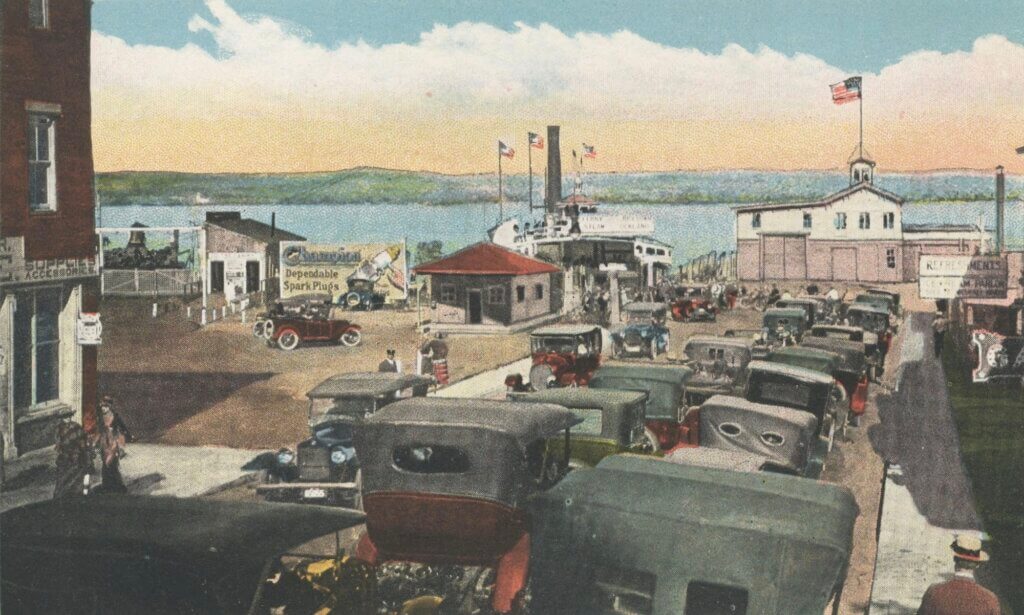
The Rockland ran from 7 a.m. to 7 p.m. As automobile traffic increased into the 1920s, cars sometimes lined Burd Street waiting to board. On busy Sundays, day trippers returning from Bear Mountain State Park joined the queue, while Nyack children earned pocket money selling water and candy to waiting motorists.
Captain John Lyon
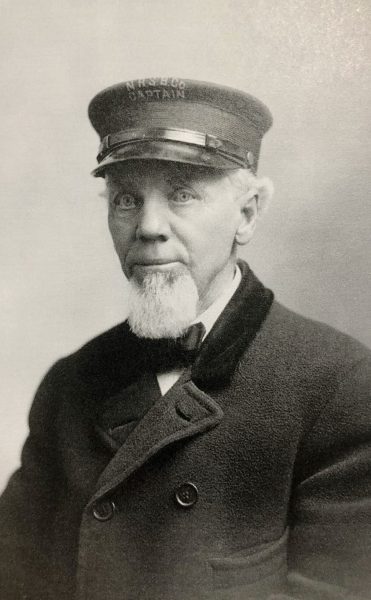
Captain John Lyon worked on the Hudson River for 71 years and became inseparable from the Nyack ferry. A small man with a booming voice, he reportedly called “All aboard!” loudly enough to be heard well beyond the landing. With his white goatee and immense gold watch and chain, Lyon became as familiar to generations of passengers as the ferry itself.
Stories about Lyon circulated long after his death. One favorite involved Theodore Roosevelt, whom Lyon supposedly encountered while Roosevelt was running on the Bull Moose ticket. Lyon offered the former president some unsolicited political advice: “You should have stayed at home. You shouldn’t break up the party.”
Lyon served as captain, ticket taker, and familiar personality aboard the ferry until the Rockland left service in 1923. He died shortly afterward.
Ice on the Tappan Zee
Ice was the bane of ferry service. Practically every year, operations were suspended for part of the winter, sometimes from January into March. In especially cold years, however, the frozen river created a different kind of crossing. An “ice bridge” formed across the Tappan Zee, and people crossed by foot, bicycle, automobile, and even taxi.
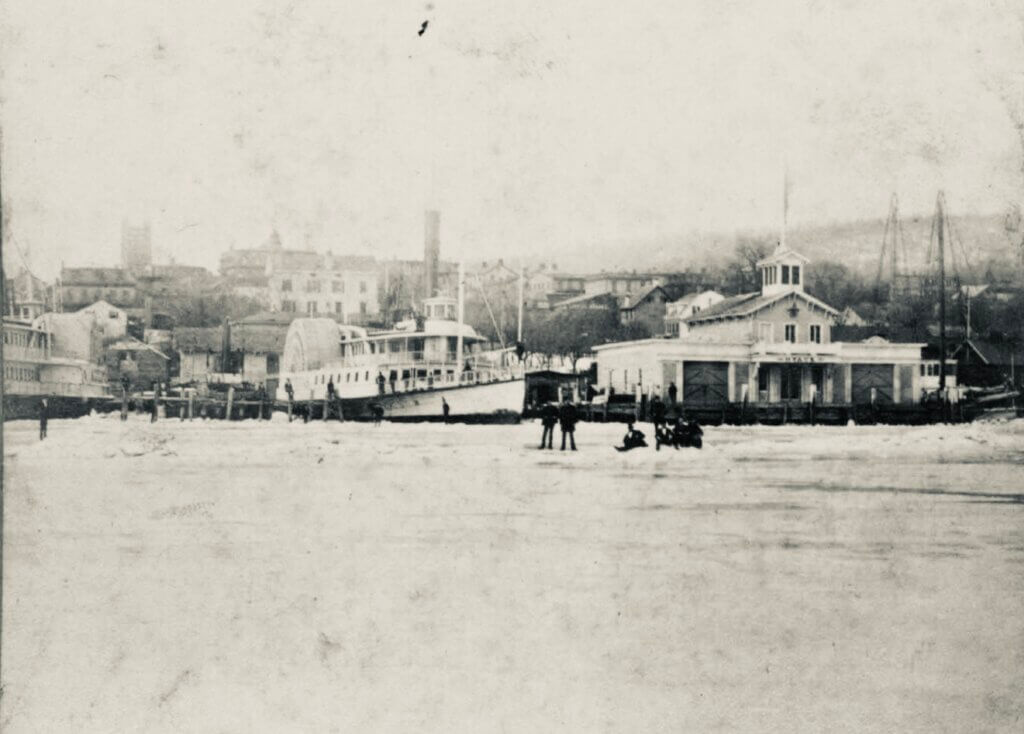
Later diesel-powered ferries were better able to operate in winter, while ice-cutting boats helped keep channels open. Even so, weather remained an unavoidable part of ferry travel. The Hudson was not simply the surface over which the ferry traveled; wind, fog, waves, and winter ice shaped every crossing.
From Ferry to Bridge
Competition transformed the ferry business during the early twentieth century. The North River Ferry Company entered the route in 1912, beginning a colorful period of competition in which rival ferries sometimes raced for waiting passengers and automobiles. Larger boats capable of carrying more cars eventually displaced the aging Rockland, which left service in 1923.
By the late 1930s, diesel-powered boats were serving the route, but the George Washington and Bear Mountain bridges had already reduced cross-river automobile traffic. During World War II, smaller passenger boats carried war workers across the Hudson.
The remaining passenger ferry survived until 1954. The opening of the Tappan Zee Bridge that year made the old Nyack-to-Tarrytown ferry obsolete.
Changing Views of a Rivertown
When the last ferry departed in 1954, Nyack lost more than a transportation link. For generations, the ferry landing had been one of the places where village life met the Hudson. Commuters, shoppers, tourists, workers, wealthy residents, carriages, and automobiles all passed through the same waterfront gateway.
The ferry terminal survived for another generation. Incorporated into the Lighthouse Marina complex in the 1960s, it was demolished in 1983. The Claremont condominium complex now occupies the site.
In 1996, a proposal to establish ferry service between Nyack and New York City met strong opposition from residents. A ferry that once seemed a natural part of a busy working waterfront now required something many villagers did not want: additional automobile traffic and a large parking garage.
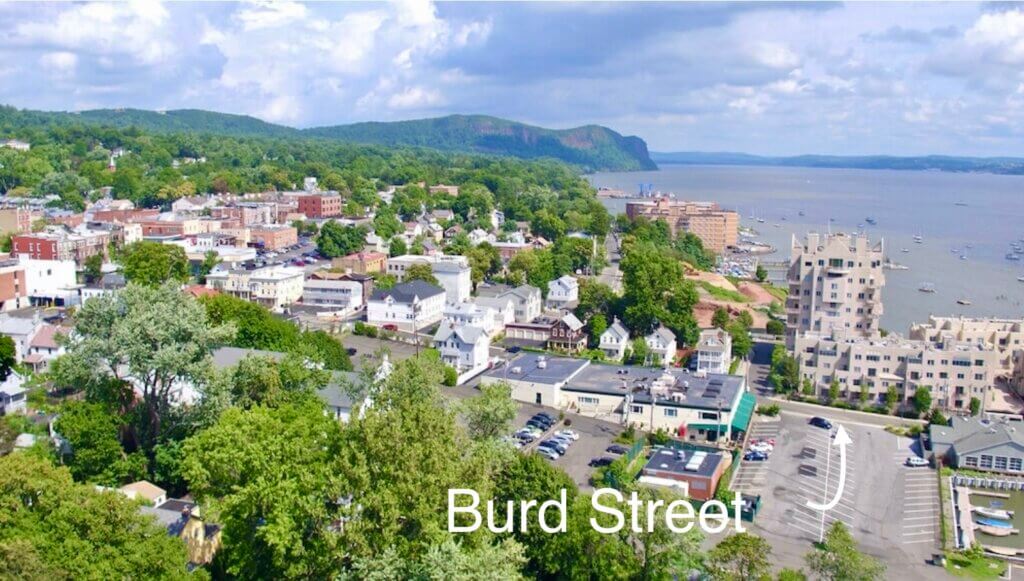
Little remains to suggest what happened here. From Burd Street, there is no ferry terminal, no line of waiting automobiles, and no boat preparing to cross the Tappan Zee. Nyack still calls itself a river village, and Memorial Park preserves one of its broadest public connections to the Hudson. But for nearly a century, that relationship was much more immediate. For generations, going down to the river and boarding the ferry was simply part of life in Nyack.
Just Published
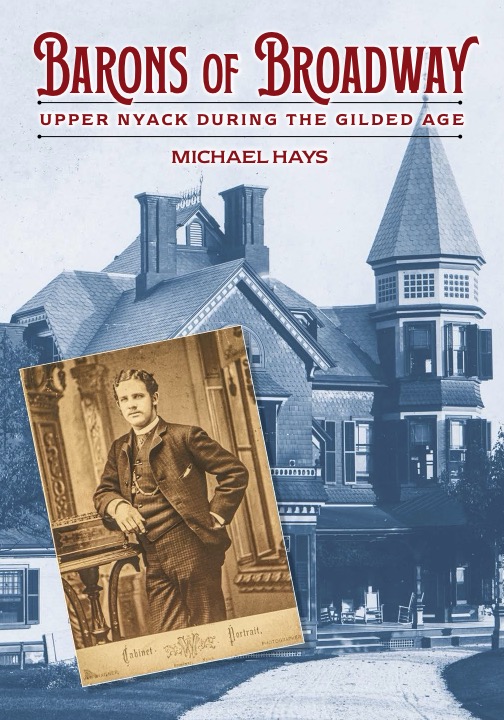
Barons of Broadway: Upper Nyack During the Gilded Age
Available at Pickwick Books, Historical Society of the Nyacks, and Amazon
About the author
Mike Hays has lived in the Nyacks for 38 years. After a career as an executive at McGraw-Hill Education in New York City, he now focuses on researching, writing, and interpreting local history.
He serves as Treasurer and past President of the Historical Society of the Nyacks. He is also a Trustee of the Edward Hopper House Museum & Study Center and Historian for the Village of Upper Nyack. In these roles, he works with community partners to preserve historic resources and expand public understanding of the area’s past.
Since 2017, he has written the popular Nyack People & Places column for Nyack News & Views. The series chronicles the history, architecture, and personalities of the lower Hudson Valley.
Hays has also developed museum exhibitions, written interpretive materials, and led well-attended walking tours that bring Nyack’s history to life.
He is married to Bernie Richey. He enjoys cycling, history walks, and winters in Florida. You can follow him on Instagram at @UpperNyackMike.