January 31 – February 1, 2026 (New Dates due to inclement weather)| Rockland Lake State Park
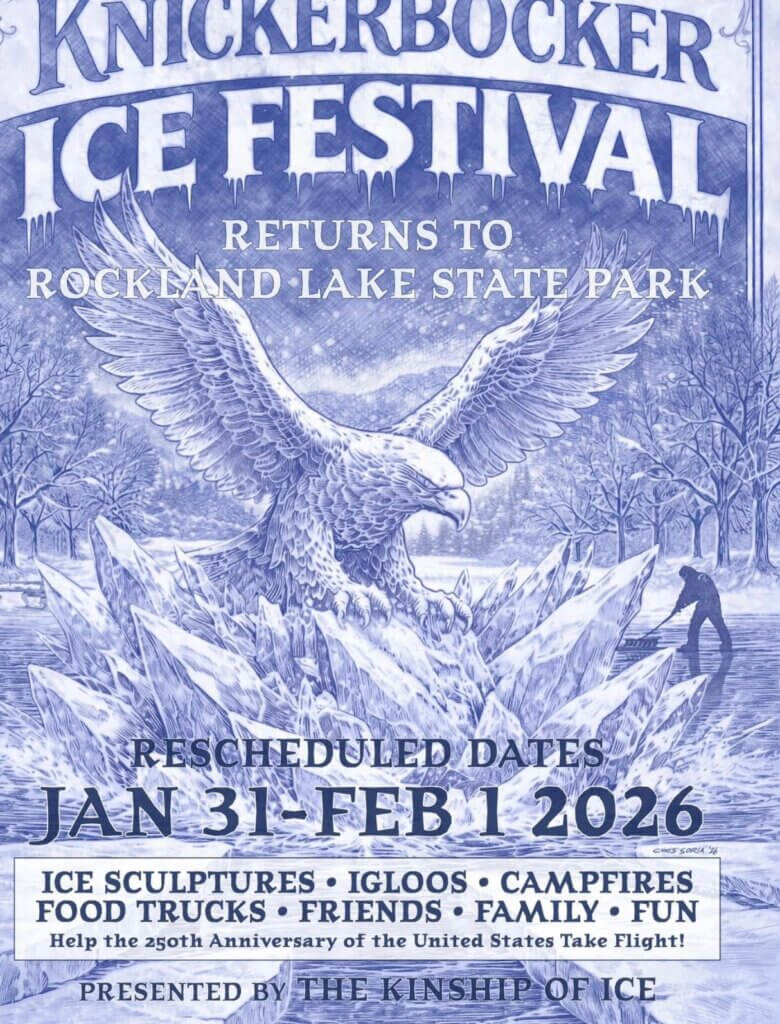
Winter once turned Rockland Lake into the center of one of New York’s most important industries. For one weekend this January, that frozen past returns in vivid form. The Knickerbocker Ice Festival comes back to Rockland Lake on January 31 and February 1, 2026, bringing ice sculpture, fire, food, and hands-on history for all ages.
The festival honors the memory of Rockland Lake’s beloved “Iceman,” Robert Patalano (1964–2025), who founded the event in 2007. Admission is free. Parking at the park costs $10.
What You Will See and Do
Visitors can watch professional ice sculptors carve massive five-thousand-pound blocks into intricate forms. Large historic photographs show teams of horses, sleds, and workers spread across the ice and along the shoreline. Original ice harvesting tools reveal the demanding nature of the work.
A rare early motion picture by Thomas Edison, filmed in 1902, plays on site. The film documents ice cutting, loading, and transport at Rockland Lake. Demonstrators explain how people once built igloos using simple tools. Food trucks serve hot meals and drinks throughout the day. At dusk, a glowing ice chimney and bonfire light up the shoreline.
Knickerbocker Ice Festival
Schedule & Highlights
Saturday
- 8:30 AM – Parking lots open
- 9:00 AM – Four teams begin building full-scale igloos from blocks of ice near the pavilion at the north end of the park
- 9:00 AM–4:00 PM – Sculptor Shintaro Okamoto and his team carve a massive bald eagle sculpture at the southern end of Lot 2, on the historic ice-harvesting grounds, in recognition of the nation’s upcoming 250th anniversary
All Day (Under the Pavilion)
Banner-sized historic photographs, paintings, and maps; historic film footage of Rockland Lake; a short film narrated by Lenape elder Diane Snake on her people’s origins; a display of Robert Palatino’s ice-industry tools; and the Knickerbocker Fire Company’s 19th-century hand pumper.
- 4:30 PM – Ice chimney bonfire on the lawn adjacent to the eagle sculpture
- All Day (Both Days) – Woodland installation of photographer Lisa Levart’s portraits of Lenape women; in the ruins of Ice House No. 3, visitors can hear the natural sounds made by frozen lakes
- 7:30 PM – Park closes
Sunday
- 10:00 AM – Shintaro Okamoto and crew begin carving a second sculpture, the American bison
- All Day – Campfires throughout the park; completed igloos open for visitors; food trucks serving food and beverages
- Nyack artist Chris Soria’s hand-drawn festival poster available as a 24" × 36" collectible reproduction
- Festival merchandise for sale, including hoodies and T-shirts
- Three Land Rover Defender vehicles on display, alongside a full-size ice replica of the iconic off-road vehicle
- Late Afternoon – Closing bonfire (without the ice chimney)
After the Festival
Pavilion displays may remain on view for one week, weather permitting. Ice sculptures will remain standing as long as they are deemed safe.
Robert Patalano: The Iceman
Few people loved Rockland Lake more deeply than Robert Patalano. He grew up steps from the lake and fell in love early with its history. Ice became his artistic medium.


Robert Patalano cutting ice on the lake and with two of his ice sculptures.
At seventeen, he carved his first sculpture using a meat cleaver. Over a lifetime, he estimated that he created more than ten thousand works. His sculptures anchored weddings, graduations, birthdays, and public events across the region.
From 2007 to 2014, Patalano revived Rockland Lake’s frozen past through the Knickerbocker Ice Festival. Tens of thousands walked out onto the ice to watch him stack three-hundred-pound blocks and carve them in clouds of snow. He gave every sculpture to the public at no cost. That generosity defined him.


Images from previous Knickerbocker Ice Festivals
Rockland Lake and the Ice Trade
By the late nineteenth century, ice harvesting ranked as Rockland County’s largest industry. Each January, as many as eight hundred men and eighteen hundred horses gathered at Rockland Lake to begin cutting ice. That frozen harvest preserved food, supplied iceboxes, and chilled drinks at hotels and restaurants in New York City through the hottest months.

From Hand Tools to Industry
Early ice cutting relied on hand saws and axes. Farmers stored blocks in springhouses for local use. Everything changed in 1827, when Nathaniel Jarvis Wyeth, a Boston inventor, patented a horse drawn ice cutter. His invention scored ice into regular grids and produced uniform blocks. Ice harvesting quickly scaled up.
Rockland Lake offered rare advantages. Its spring fed waters stayed clean and clear. By 1836, New York City’s Astor House listed Rockland Lake ice by name on its menus. Demand surged.
The Knickerbocker Ice Company
In 1855, competing firms merged to form the Knickerbocker Ice Company. The company built enormous double walled ice houses insulated with sawdust. At peak capacity, they stored more than one hundred thousand tons of ice.
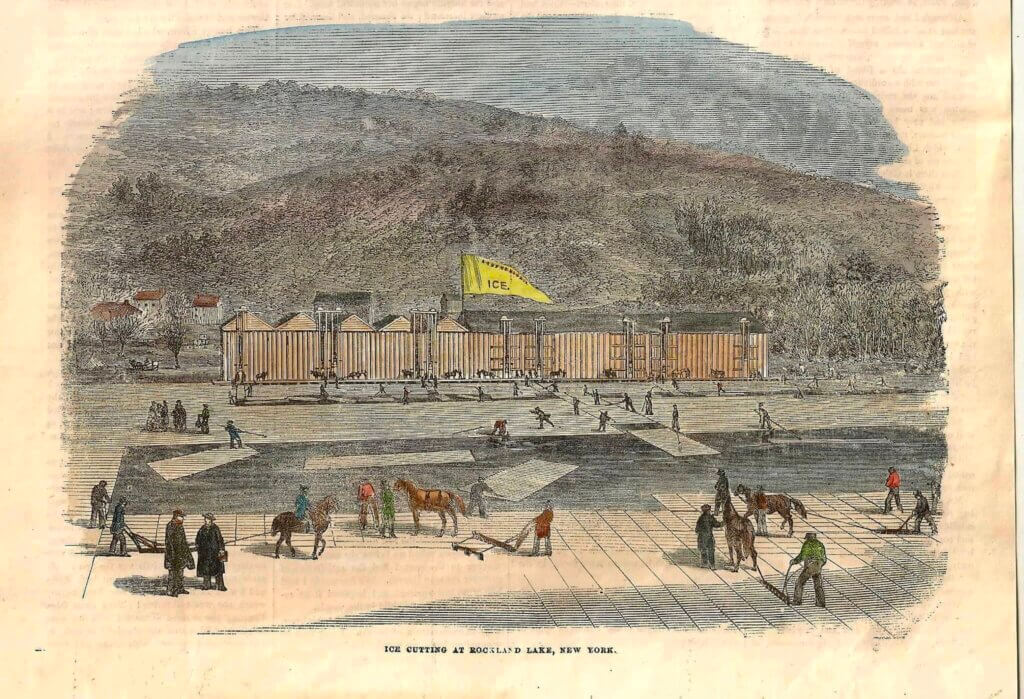
Knickerbocker soon supplied more than one third of New York City’s ice. Its reputation spread so widely that foreign exporters later borrowed the name.
The Ice Train to the Hudson
Rockland Lake sits high above the Hudson River, but elevation alone does not explain the challenge. Between the lake and the river rises the rugged Palisades ridge, cut by a narrow clove leading to Rockland Lake Landing.

To solve this problem, the Knickerbocker Ice Company built an ingenious ice train system that combined animal power, mechanical lift, and gravity. Horses hauled loaded ice cars from the ice houses along the lake to a powered incline leading into the Village of Rockland Lake. Once the powered incline lifted the ice cars to the top of the ridge, horses pulled them through the village and past the firehouse to a transfer platform.
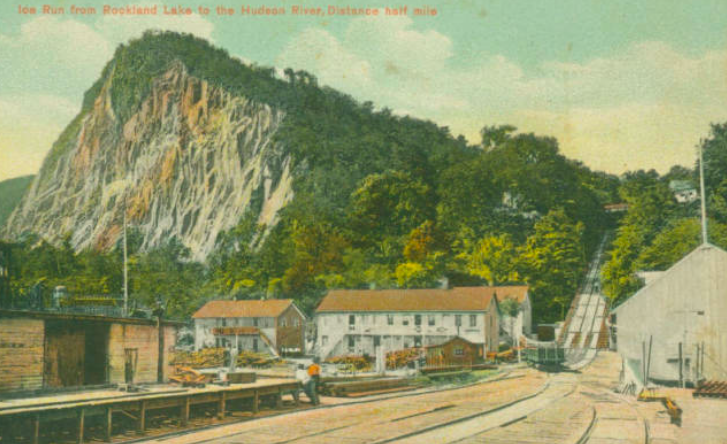
From there, a gravity-fed incline railroad carried the cars down the clove on a one-thousand-foot wooden chute to Rockland Lake Landing. Workers stopped the cars at a loading platform and transferred the ice onto barges waiting at the docks. Barges carried the ice to New York City, where wagons distributed it throughout the city.

This carefully choreographed system allowed thousands of tons of ice to move efficiently from lake to river.
Work, Risk, and Decline
Ice harvesting demanded strength and endurance. Workers stood on ice beside near-freezing water and handled heavy blocks under dangerous conditions. Accidents occurred often, yet the wages attracted large crews.

With the invention of mechanical refrigeration, operations at Rockland Lake declined and ended in 1924. Two years later, demolition crews sparked a massive fire fueled by sawdust insulation. Flames threatened the entire village. Natural ice harvesting never returned. The company survived by shifting to manufactured ice plants in Brooklyn.
Why This Festival Matters
The Knickerbocker Ice Festival does more than entertain. It reconnects Rockland Lake to a time when winter powered an entire regional economy. Sculpture, film, tools, and fire turn that history into something visitors can see and understand.
Mike Hays has lived in the Nyacks for 38 years. A former executive at McGraw-Hill Education in New York City, he now serves as Treasurer and past President of the Historical Society of the Nyacks, Trustee of the Edward Hopper House Museum & Study Center, and Historian for the Village of Upper Nyack.
Since 2017, he has written the popular Nyack People & Places column for Nyack News & Views, chronicling the rich history, architecture, and personalities of the lower Hudson Valley. As part of his work with the Historical Society, Mike has researched and developed exhibitions, written interpretive materials, and leads well-attended walking tours that bring Nyack’s layered history to life.
Married to Bernie Richey, he enjoys cycling, history walks, and winters in Florida. You can follow him on Instagram as @UpperNyackMike
Editor’s note: This article is sponsored by Sun River Health and Ellis Sotheby’s International Realty. Sun River Health is a network of 43 Federally Qualified Health Centers (FQHCs) providing primary, dental, pediatric, OB-GYN, and behavioral health care to over 245,000 patients annually. Ellis Sotheby’s International Realty is the lower Hudson Valley’s Leader in Luxury. Located in the charming Hudson River village of Nyack, approximately 22 miles from New York City. Our agents are passionate about listing and selling extraordinary properties in the Lower Hudson Valley, including Rockland and Orange Counties, New York.