Nyack History A to Z
Visitors to Nyack Beach today enter a remarkably tranquil landscape. Just inside the entrance, two narrow roads branch beneath a canopy of mature trees. One winds uphill to the Plateau; the other descends toward the Hudson, the old sandstone bathhouse, and shaded parking areas along the river. The wooded slopes seem to have been this way forever. Nothing about the scene suggests that one of Nyack’s largest industrial operations once occupied this spot.
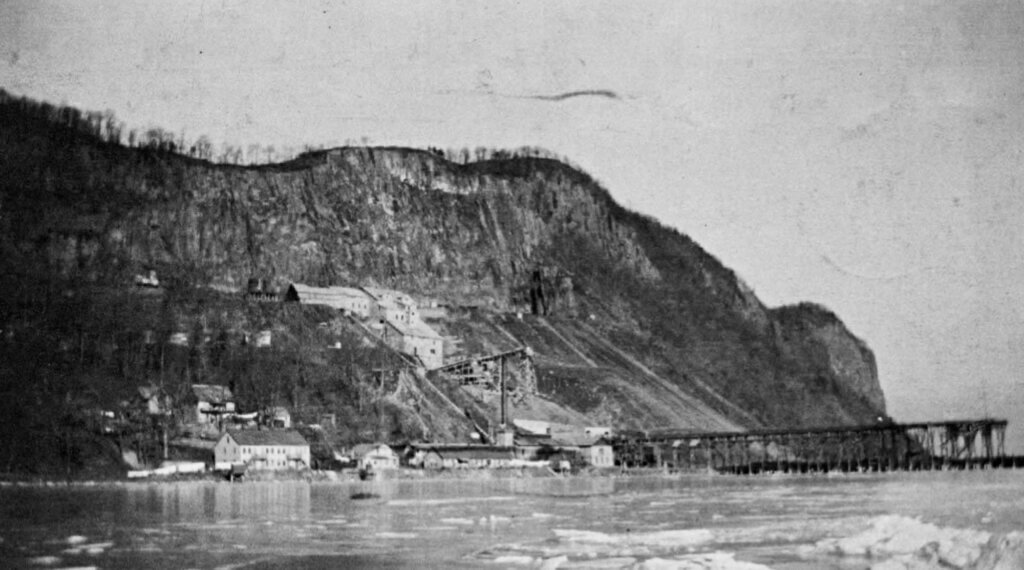
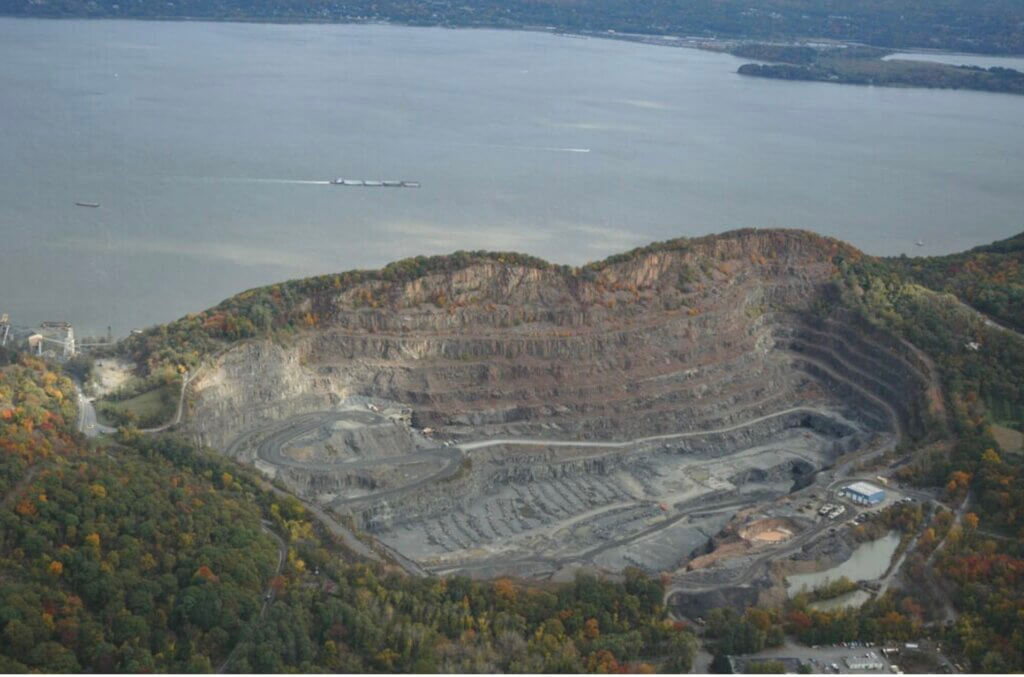
Beginning in 1898, quarrymen blasted a huge notch into Hook Mountain to extract trap rock for the booming New York construction market. Dynamited stone was hauled across what is now the Plateau, crushed and sorted, then sent down the mountainside to barges waiting at a long river pier. Blasting, dust, noise, and the permanent alteration of the Palisades provoked years of litigation and became part of a much larger movement to preserve the Hudson’s western cliffs.
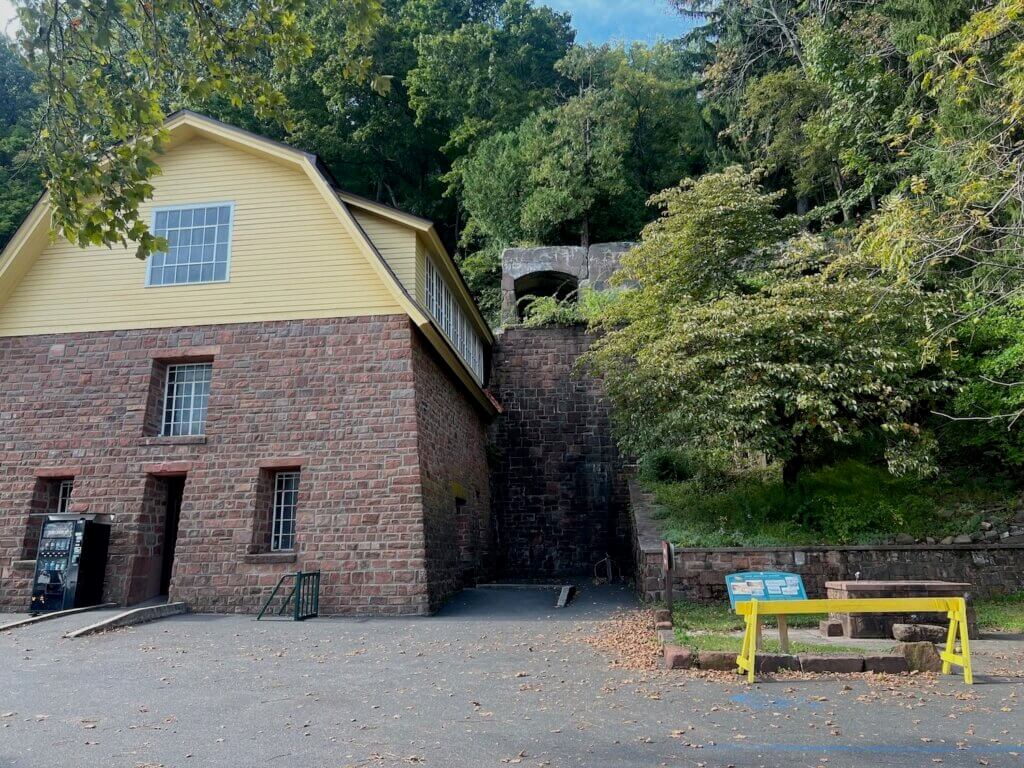
The quarry closed little more than a decade after it opened, but it did not disappear. The Plateau is its old working floor. Concrete supports for the crusher remain hidden beside the road. Two openings associated with the stone handling operation can still be seen above the bathhouse. And the bathhouse itself grew from the quarry’s former powerhouse.
A century of trees has hidden much of what happened here. The quarry remains all around us.
Before the Blasting
For most of the nineteenth century, the eastern face of Hook Mountain remained heavily wooded. Beneath those trees, however, lay something increasingly valuable.
The Palisades are formed largely of diabase, a hard igneous rock commonly called trap rock by the construction industry. Crushed into different sizes, it was well suited to road building, railroad beds, concrete, and other construction. As metropolitan New York expanded late in the nineteenth century, demand soared.
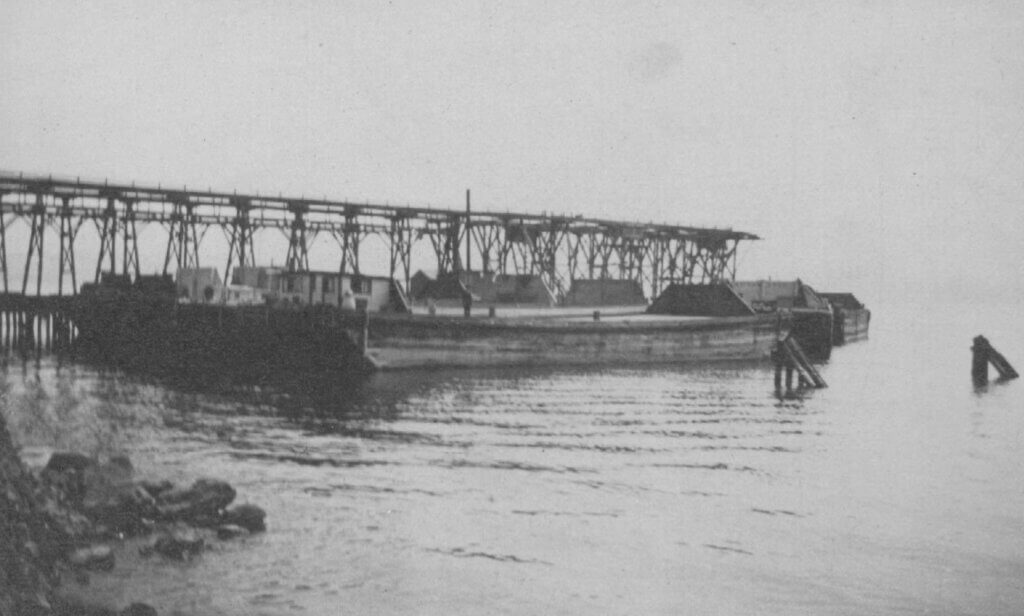
Hook Mountain offered another advantage: transportation. Stone quarried almost directly beside the Hudson could be crushed, loaded aboard barges, and shipped south without the expense of hauling it overland.
By the 1890s, quarries were already cutting into the Palisades farther south. In 1898, commercial quarrying reached Hook Mountain.
Cutting Into Hook Mountain
The corporate history of the quarry is surprisingly difficult to untangle. Contemporary accounts connect the operation at different times with Mack Paving, Manhattan Trap Rock, and National Asphalt. By its later years, the Hook Mountain operation was identified as the Manhattan Trap Rock Company, a subsidiary of the Barber Asphalt Company.
Whatever name appeared on the company records, the operation had a straightforward purpose: break Hook Mountain into standardized sizes of stone and sell it to the growing metropolitan construction market.
Quarrymen drilled the exposed rock and set explosives. After a blast brought sections of the cliff down, workers loaded the broken stone onto small rail cars. A network of narrow gauge tracks spread across the quarry floor, carrying the rock toward a multistory crushing plant built into the slope.
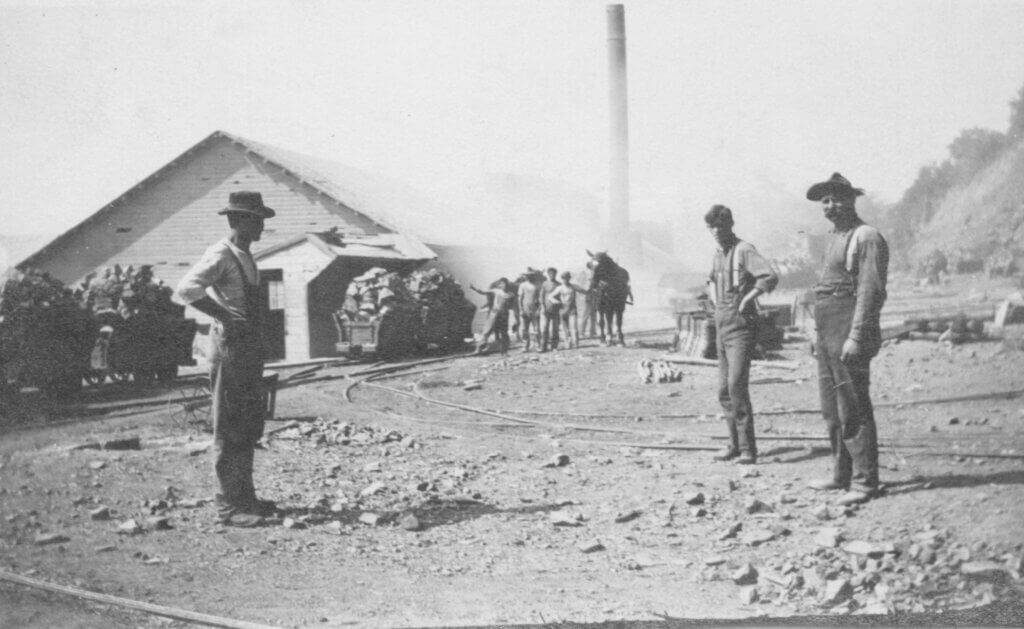
The crusher did more than break rock into manageable pieces. It sorted the stone into marketable sizes. Municipal contracts specified quantities of larger aggregate, smaller stone, and screenings. In 1909, Manhattan Trap Rock won a Yonkers contract to supply 6,000 cubic yards in several sizes with a bid of 93 cents per cubic yard, beating competing bids from the nearby Rockland Lake and Clinton Point quarries.
From the quarry floor, gravity helped move the stone through successive stages of crushing and sorting. The finished material accumulated below the machinery. Small rail cars then carried it toward the Hudson, where tracks extended along the loading trestle above the barges. The surviving photographs do not reveal exactly how the stone was transferred from the crusher to those cars.
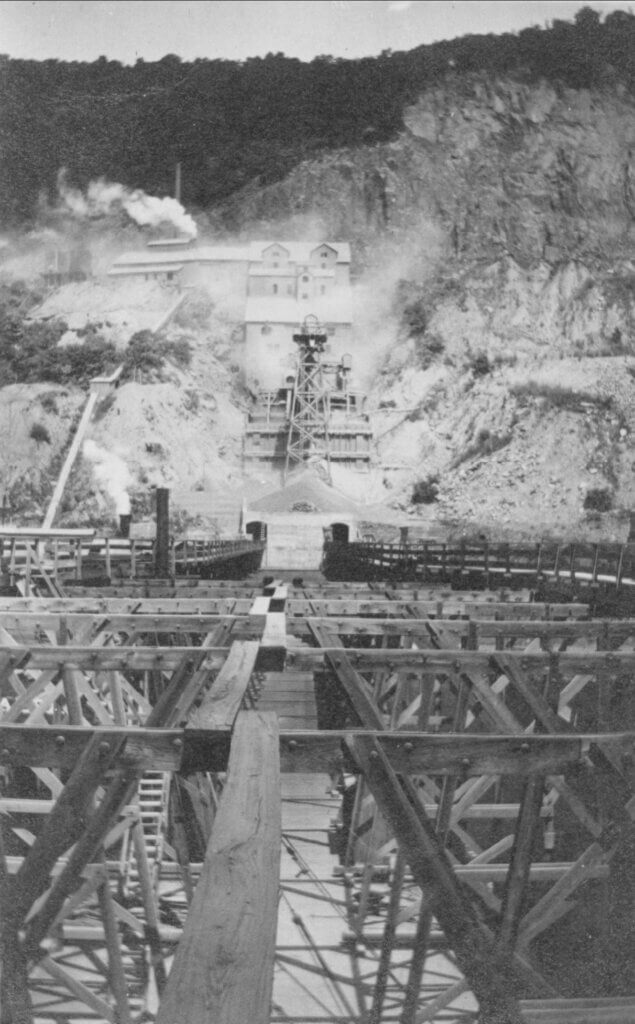
A long wooden trestle extended into the Hudson, allowing barges to tie up beneath the loading system. The river provided the final link between Hook Mountain and construction projects throughout the metropolitan area.
A Mountain Under Assault
The quarry was difficult to ignore. Manhattan Trap Rock operated day and night shifts during much of the quarrying season. Explosions reverberated across the Hudson, while the crushing plant added its own noise and dust. Residents on both sides of the river complained that blasts shook their houses, knocked plaster from walls, sent objects falling to floors, and sometimes awakened them at night.
The quarry also provided jobs, many of them to Italian immigrants. At its busiest, about 200 men worked at Hook Mountain. Operations followed the seasons, with winter ice sometimes interrupting barge shipments. Some quarrymen found winter employment harvesting ice for the Knickerbocker Ice Company at Rockland Lake.
Those who remained formed a small community at the Hook. One newspaper reported that Italian workers spent a winter staging plays written and performed by members of the colony.
Quarrying was dangerous work. In February 1905, an Italian laborer named Sancisco Lemare was crushed to death by sliding rock near the stone crusher. About 200 fellow workers refused to resume work after the accident. Other injuries followed, including a fractured skull suffered by a worker in 1908
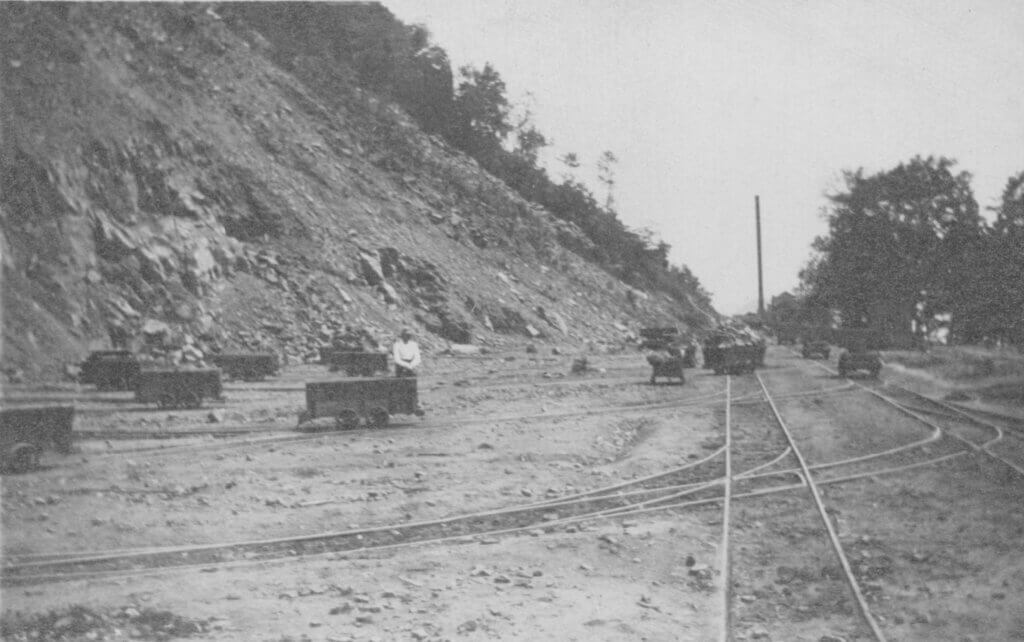
Each blast also enlarged the exposed scar on Hook Mountain, visible for miles across the Tappan Zee. The operation was not simply taking place beside the mountain. The mountain itself was being removed.
Fighting the Quarry in Court
Opposition began almost as soon as the quarry did. In 1898, Arthur C. Tucker, whose Underclyffe estate stood nearby on North Broadway, sued the Mack Paving Company and sought an injunction against the operation. His attorney was another Upper Nyack resident, Arthur S. Tompkins. Tucker was soon joined by his neighbor James P. McQuaide of Larchdell.
In 1899, Justice William D. Dickey found that work at the quarry had already caused “actual physical discomfort” and “tangible, visible injury” to neighboring property. Yet he stopped short of shutting it down. The company argued that improved blasting and screening methods would allow it to operate without harming its neighbors. Dickey had doubts, but decided to give the quarry a “fair trial.” His injunction prohibited flying stone and dust from reaching neighboring property and barred damaging shock or concussion.
The compromise did not end the controversy. The company continued quarrying while litigation continued through appeals and additional suits. In November 1906, Sarah McQuaide won damages in a case involving the quarry’s effect on the rental value of the McQuaide property.
Later that year, Cornelia M. Arnold of Ossining pursued a complaint that explosions at Hook Mountain had damaged her house across the Hudson. Her case focused in part on mudcap blasting, a technique in which explosives were placed against the rock and covered rather than inserted into drilled holes. It produced especially loud explosions and heavy concussion. Justice Martin J. Keogh restricted the technique and awarded Arnold damages.
Still, the quarry operated. As late as 1911, Dr. Helmer, who had purchased the former McQuaide property, sued after rocks from blasting allegedly landed on his land.
The courts had imposed restrictions and awarded damages, but they had not stopped the removal of Hook Mountain.
A Fight Bigger Than Nyack
Opposition to the quarry spread beyond Nyack, especially among property owners across the Hudson in Westchester County.
Among them was John D. Rockefeller, whose Pocantico estate faced the quarry from the opposite side of the river.
In January 1907, newspapers reported that Rockefeller was willing to contribute $1 million toward stopping the quarrying. One syndicated story presented the dispute with a remarkable headline: “ROCKEFELLER OFFERS $1,000,000 TO BE RID OF THE LARGE NOISE.” Its accompanying illustration showed blasts at Hook Mountain traveling beneath the Hudson toward Rockefeller’s residence. The drawing was a newspaper artist’s explanation of the vibrations, not a geological survey.
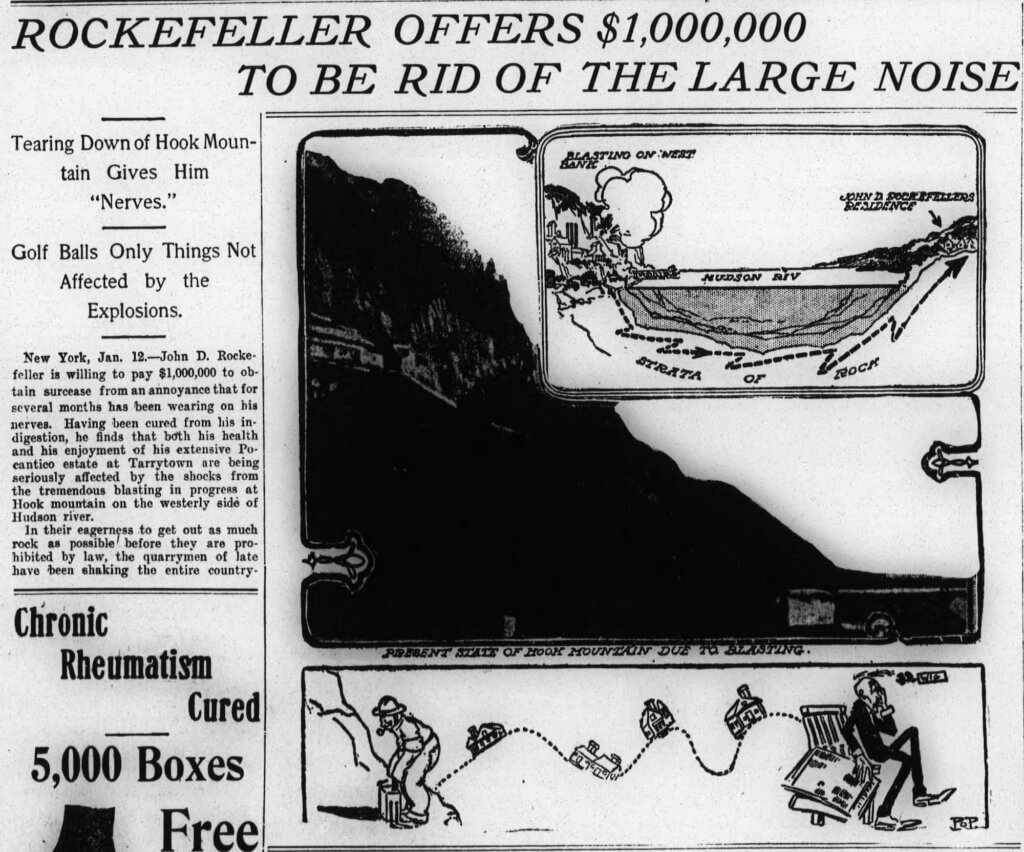
The publicity showed how far the controversy had spread. What had begun as a dispute between a quarry and its Upper Nyack neighbors had become a regional fight over the future of Hook Mountain.
Saving Hook Mountain
The Palisades Interstate Park Commission had been created in 1900 to protect the cliffs farther south. In 1906, its authority was extended northward into Rockland County, bringing Hook Mountain within its reach. But authority alone could not stop the blasting. The commission needed money to acquire the quarry.
By 1911, it had assembled substantial public and private funds for expanding the park. J. DuPratt White, an Upper Nyack resident and secretary of the commission, emerged as a central figure in the effort to acquire Hook Mountain.
In March, White announced that the commission had reached an agreement to purchase the Manhattan Trap Rock Company’s quarry at the northern edge of Nyack. Contemporary newspapers did not disclose the purchase price. PIPC historian Eric N. Binnewies later put it at $415,000 and identified Manhattan Trap Rock as a subsidiary of the Barber Asphalt Company. Nyack attorney Irving Hopper assisted in settling the details.
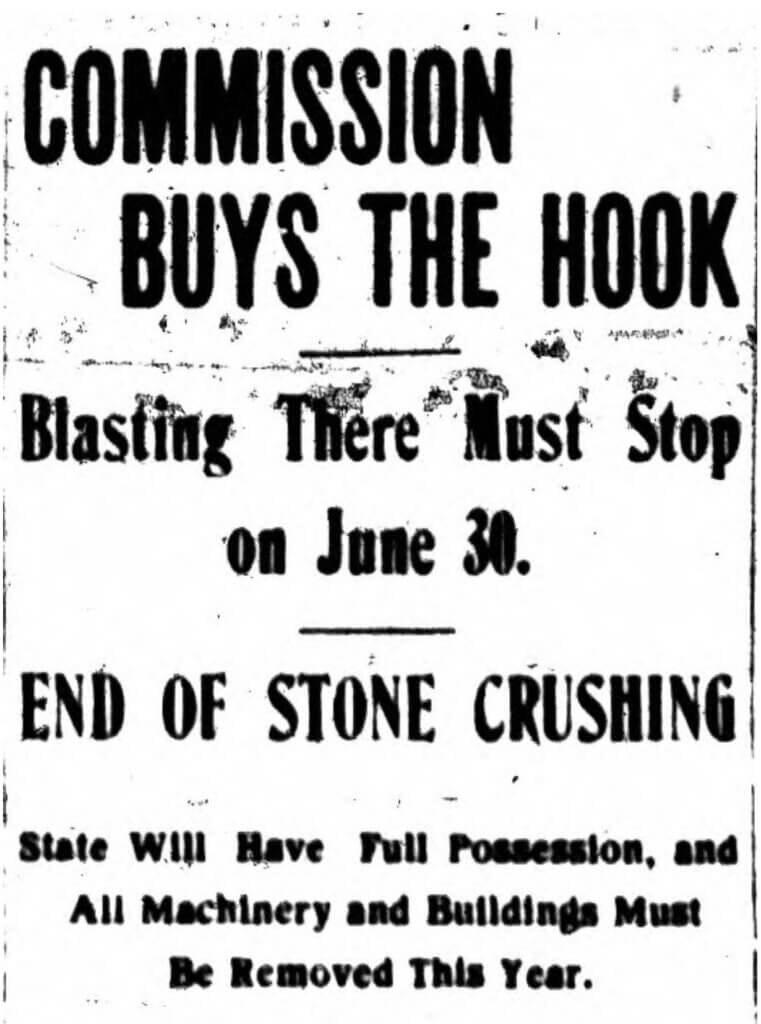
The agreement did not close the quarry overnight. It established a timetable. Blasting could continue through June 30. The company could crush stone already quarried during July and had until the end of the year to remove its machinery and equipment.Contemporary reporting added an important restriction: during those final months, the existing skyline of Hook Mountain was not to be further destroyed.
The scale of what was ending was substantial. One newspaper reported that the quarry had shipped more than 200,000 cubic yards of stone during the previous year alone, enough to cover a football field to a depth of more than 30 feet.
Yet the purchase did not end quarrying around Hook Mountain. The larger Rockland Lake quarry to the north and the Clinton Point operation remained active.
On the evening of June 30, 1911, the last blasts were fired at the Nyack quarry. The following day’s New York Herald reported that the explosions heard for miles along the Hudson since 1898 had finally stopped. Stone crushing continued for another month under the terms of the agreement.
After thirteen years, the blasting at Nyack Beach was over.
The Quarry is Stopped
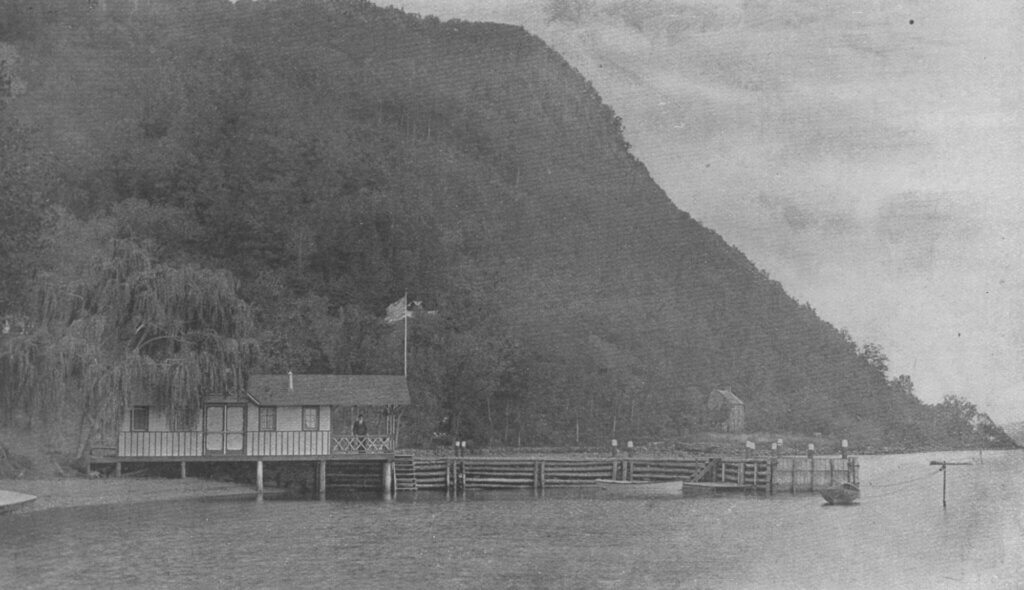
During the remaining months of 1911, the company dismantled its operation. Machinery and equipment disappeared, along with much of the elaborate crushing plant. What remained was a stark industrial landscape: an enormous, exposed cut in the mountain, abandoned concrete structures, the powerhouse at the river’s edge, and the long loading pier stretching into the Hudson.
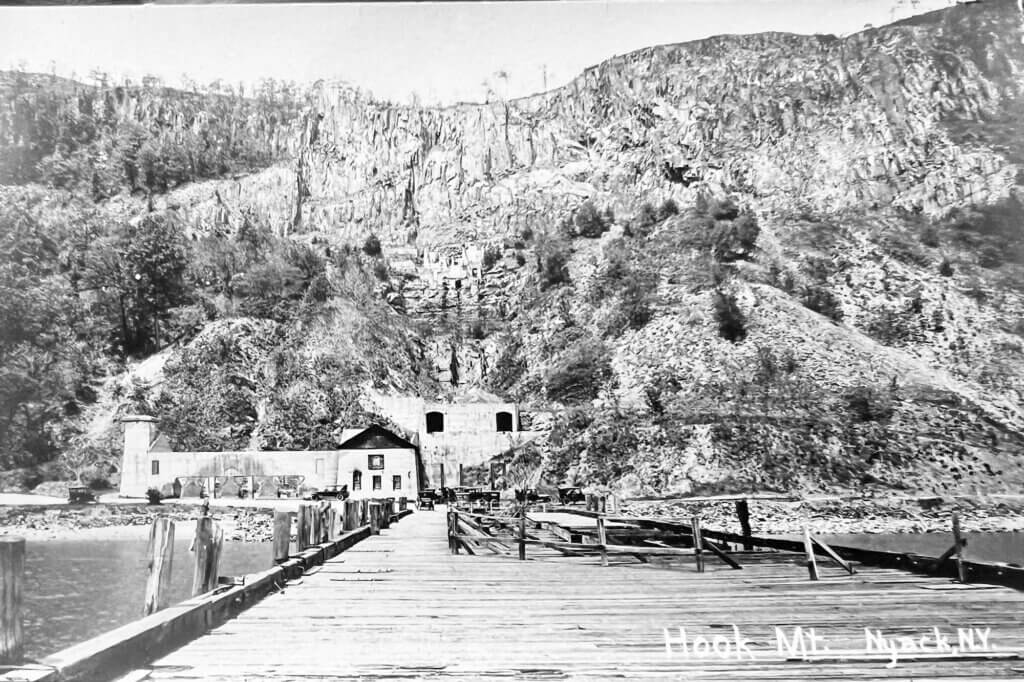
The commission had accomplished what years of private litigation had failed to do: the blasting had stopped permanently. But it had inherited a scarred industrial property with no obvious future.
What Do You Do with a Quarry?
The commission had acquired a dramatically altered landscape rather than a ready-made park. The Hudson waterfront was attractive, but behind it stood a stripped quarry face, broken stone, abandoned industrial structures, and difficult terrain. Making the property useful and accessible to the public would occupy the commission for years.
One persistent idea was a road along the Hudson. Proposals for a route beneath the Palisades had circulated even before the Hook Mountain purchase. In 1911, a larger plan envisioned extending the Henry Hudson Drive northward, perhaps eventually as far as Bear Mountain. White was deeply involved in the commission’s debate over the proposed road, although the evidence so far does not establish that he specifically advocated carrying it through the former Nyack quarry.
Other schemes were even more ambitious. In 1917, an engineer proposed drilling through Hook Mountain to create a 120-foot waterfall. In 1923, the commission considered renewed quarrying as part of a plan to reshape the property and construct a road.
Seen today, there is an irony in these proposals. Some plans for developing the park would have required further alteration of the landscape that the commission had just acted to preserve.
Meanwhile, nature and visitors were beginning to provide answers of their own. Vegetation slowly returned to the stripped slopes, while people increasingly came to the Hudson waterfront for recreation.

Hopper’s Quarry
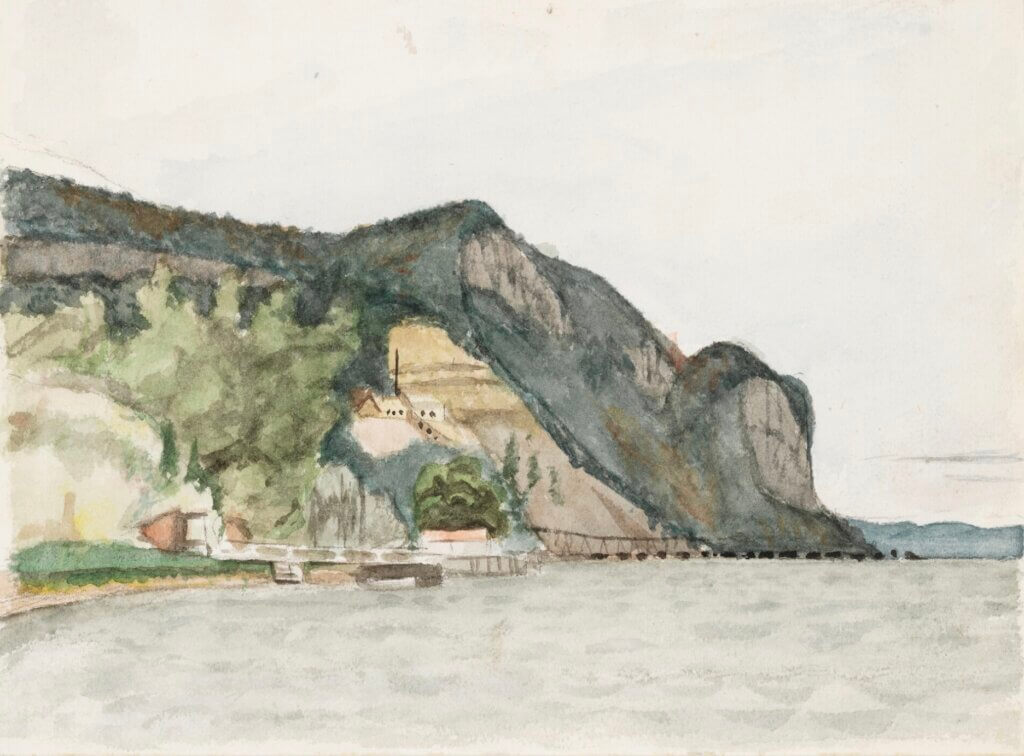
Nyack-born artist Edward Hopper knew Hook Mountain before and after quarrying transformed it. In a watercolor painted around 1899, the enormous geometric cut in the mountain is already unmistakable. The work offers an unusually early view of the changes that would continue for another twelve years.
Making Nyack Beach
The transformation of the abandoned quarry into a public park took more than twenty years. By the early 1930s, the Palisades Interstate Park Commission had developed plans to turn the former industrial site into a recreational destination. Depression-era relief programs provided the workers and funding needed to carry them out.
The work was extensive. The quarry had left a barren mountainside, piles of broken stone, and concrete structures built for industrial use. Some remnants could not be removed. Instead, workers incorporated them into the new landscape.
In 1924, the Marydell sisters donated land for the park entrance from North Broadway. A cemetery that had stood near the present traffic circle was relocated as part of the changes.
The old quarry floor, approximately 300 feet above the Hudson, was leveled, cleared, and covered with earth and sod. It became the Plateau, a broad playfield and picnic ground overlooking the river. The road from North Broadway was widened and surfaced for automobiles. Workers built trails, picnic facilities, fireplaces, and stone walls using reddish-brown sandstone gathered by hand from the nearby shoreline and slopes, rather than the dark trap rock once produced by the quarry.
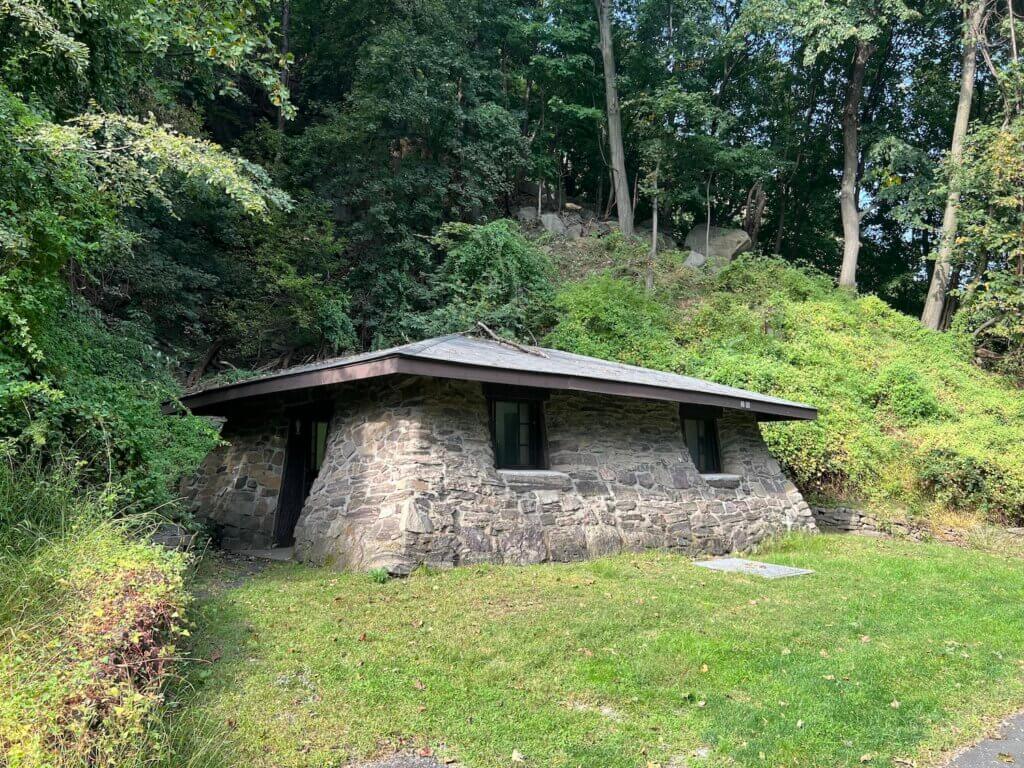
The most striking transformation was the former quarry powerhouse at the river’s edge. Workers retained its concrete walls, faced them with local sandstone, and added a Dutch gambrel-style roof. Major W. A. Welch, the park’s general manager and chief engineer, designed the renovation. The original industrial chimney survived as part of the building’s enormous fireplace. Iron bands visible near the top of the chimney in photographs taken before and after the conversion help identify it as the same structure.
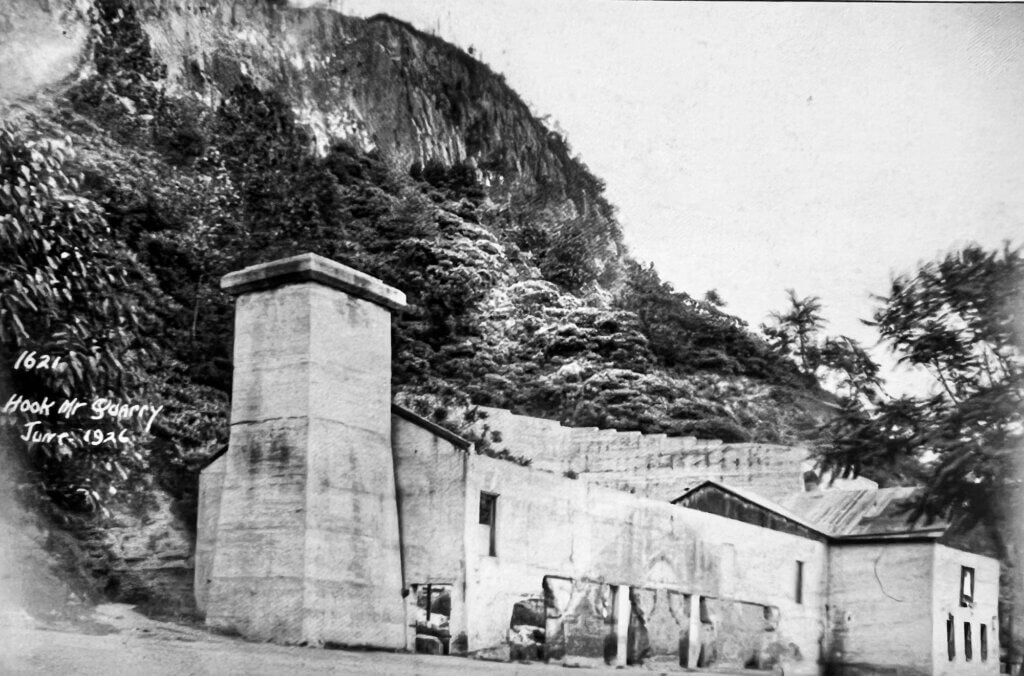
The renovated building provided facilities for swimmers and visitors, including a cafeteria and an upstairs gallery overlooking the Hudson. Its new appearance concealed much of its industrial origin, but the concrete structure and chimney remained.
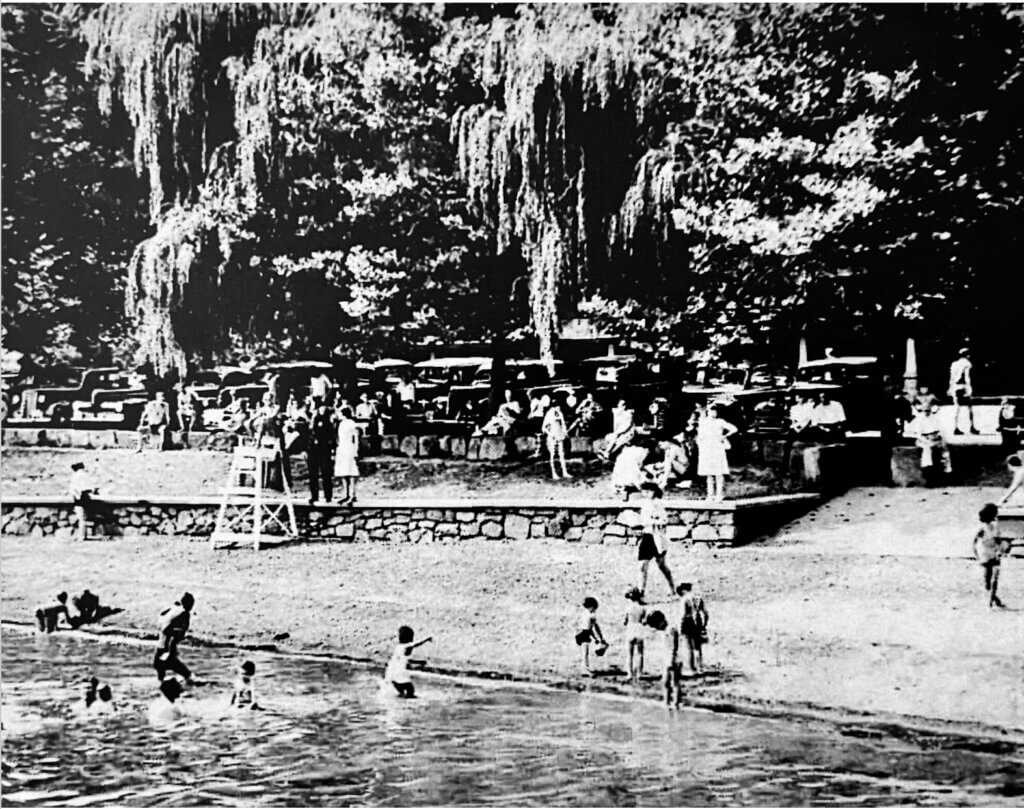
The improvements extended beyond the bathhouse. Trails followed the shoreline and climbed the wooded slopes. Picnic grounds, stone fireplaces, benches, and shelters encouraged visitors to spend the day. The former quarry had become a place for swimming, walking, and outdoor recreation.
By the late 1930s, Nyack Beach had taken on much of the appearance familiar to visitors today. The transformation did not erase the quarry. It adapted its roads, buildings, and excavated landscape to an entirely different purpose.
Hidden in Plain Sight
Visitors to Nyack Beach still encounter the quarry at almost every turn, although a century of tree growth has made its remains easy to overlook.
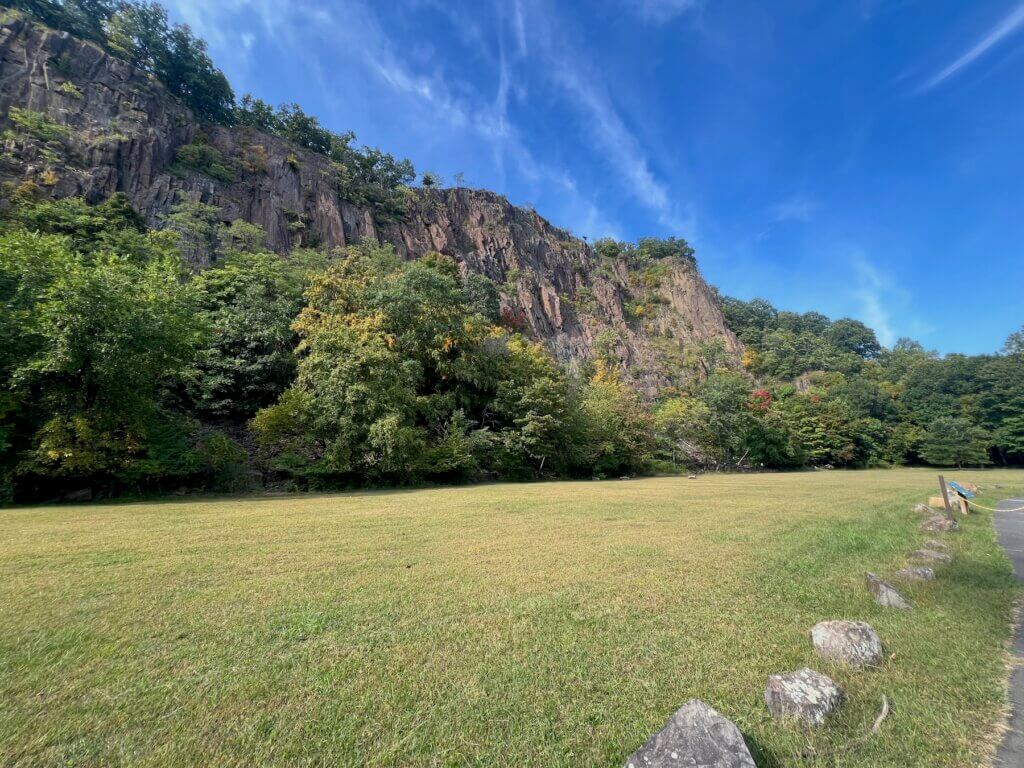
The Plateau is the most obvious example. Its broad, level surface was once the quarry’s working floor, where rail cars carried blasted rock toward the crusher. The steep rock face above it is not a natural cliff. It marks the edge of the mountain removed by quarrymen more than a century ago.
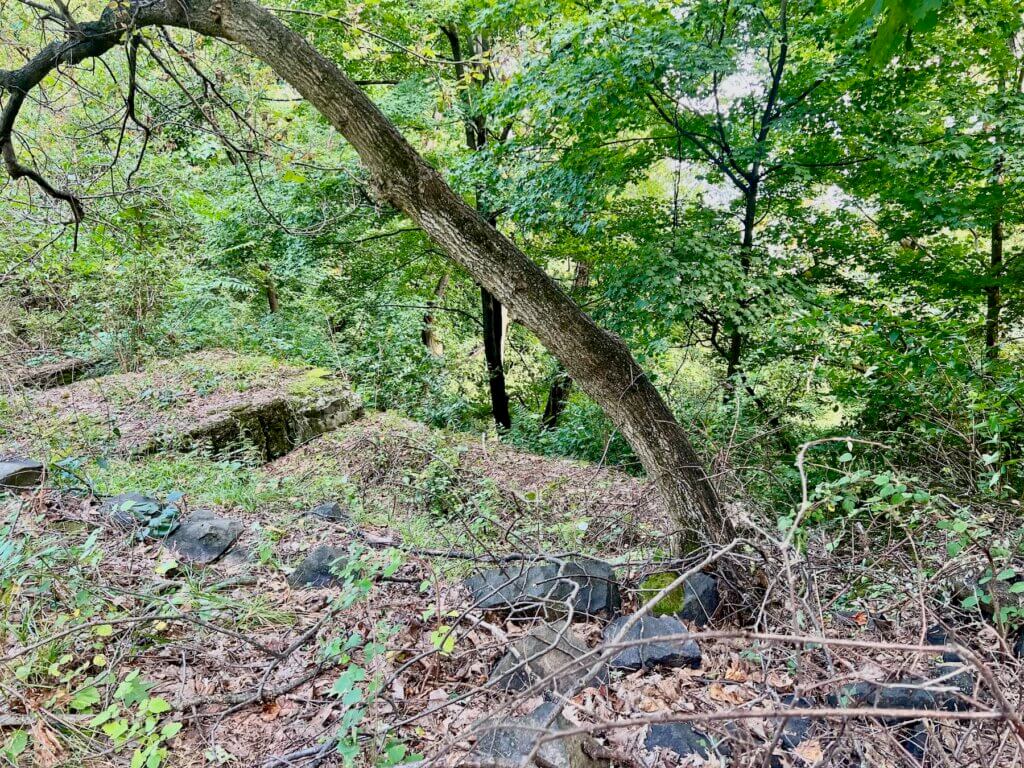
Other traces are harder to find. Just below the road near the top of the Plateau, concrete foundations from the stone crusher survive among the trees and undergrowth. They stand at the edge of a sheer drop of several hundred feet toward the Hudson.
Down by the Hudson, the bathhouse provides the clearest link between the industrial quarry and the recreational park. Its sandstone exterior disguises the original concrete powerhouse. Behind the building, two openings in the hillside survive from the quarry’s stone-handling system.
The quarry that once threatened Hook Mountain became the foundation of one of the Hudson Valley’s most distinctive public parks. Its industrial structures were adapted, its working floor became a recreation area, and trees gradually covered the scars left by blasting. Much of that history remains visible to anyone who knows where to look.
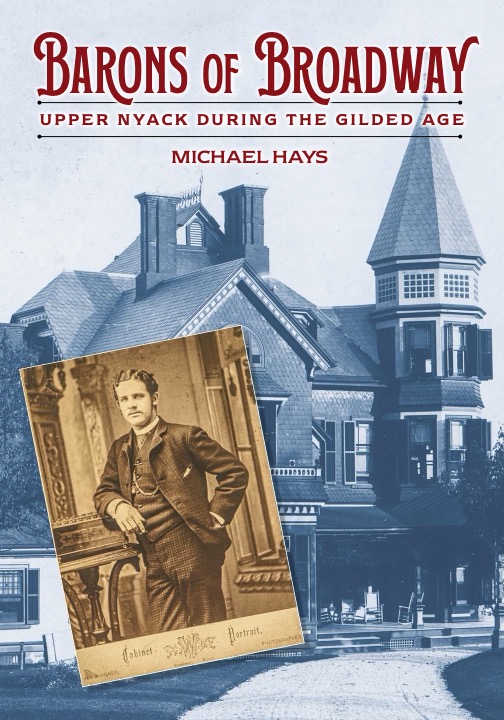
Just Published
Barons of Broadway: Upper Nyack During the Gilded Age
Available at Pickwick Books, Historical Society of the Nyacks, and Amazon
About the author
Mike Hays has lived in the Nyacks for 38 years. After a career as an executive at McGraw-Hill Education in New York City, he now focuses on researching, writing, and interpreting local history.
He serves as Treasurer and past President of the Historical Society of the Nyacks. He is also a Trustee of the Edward Hopper House Museum & Study Center and Historian for the Village of Upper Nyack. In these roles, he works with community partners to preserve historic resources and expand public understanding of the area’s past.
Since 2017, he has written the popular Nyack People & Places column for Nyack News & Views. The series chronicles the history, architecture, and personalities of the lower Hudson Valley.
Hays has also developed museum exhibitions, written interpretive materials, and led well-attended walking tours that bring Nyack’s history to life.
He is married to Bernie Richey. He enjoys cycling, history walks, and winters in Florida. You can follow him on Instagram at @UpperNyackMike.
Editor’s note: This article is sponsored by Sun River Health and Ellis Sotheby’s International Realty. Sun River Health is a network of 43 Federally Qualified Health Centers (FQHCs) providing primary, dental, pediatric, OB-GYN, and behavioral health care to over 245,000 patients annually. Ellis Sotheby’s International Realty is the lower Hudson Valley’s Leader in Luxury. Located in the charming Hudson River village of Nyack, approximately 22 miles from New York City. Our agents are passionate about listing and selling extraordinary properties in the Lower Hudson Valley, including Rockland and Orange Counties, New York.