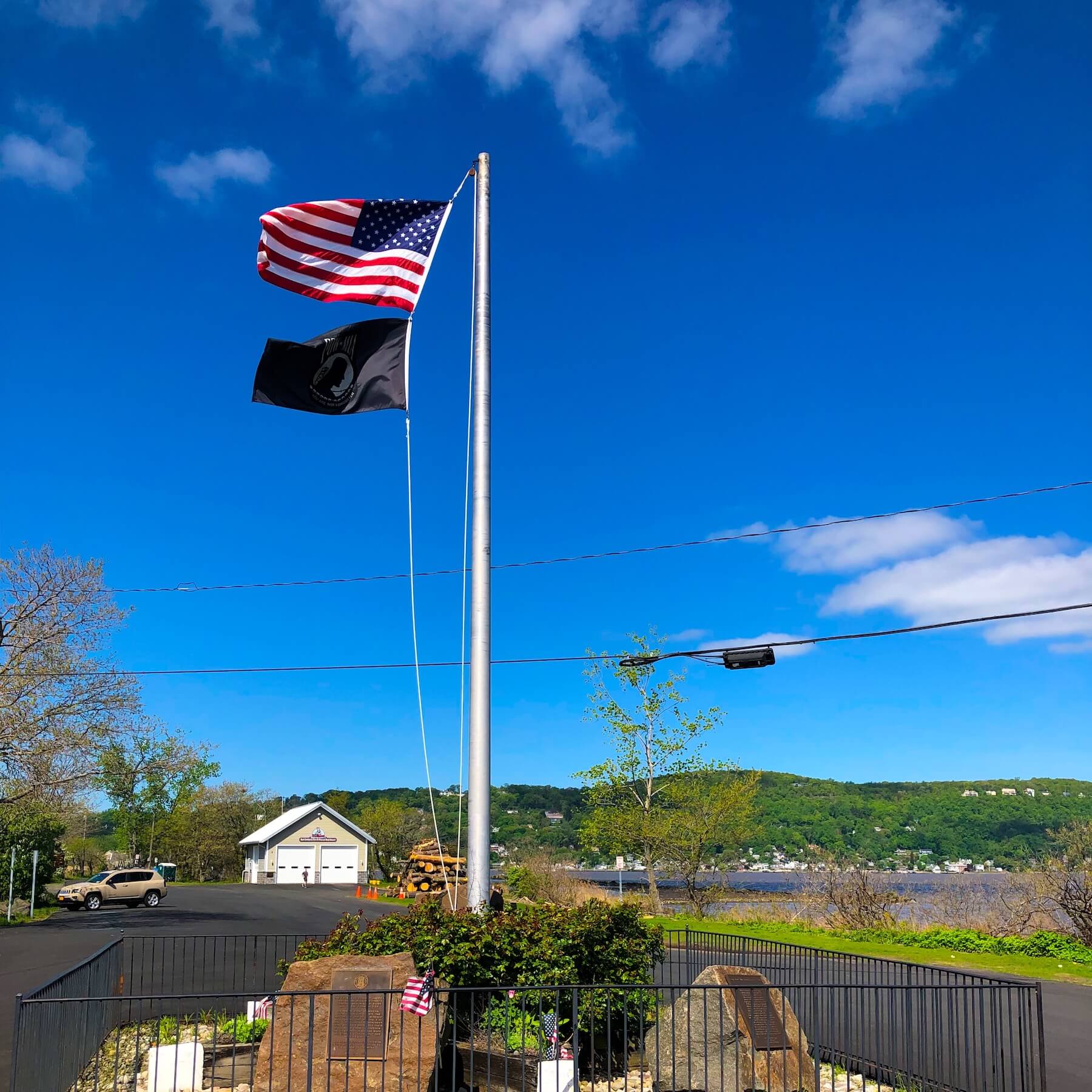
Standing on Piermont Pier, near the Camp Shanks memorial, I think of March 1, 1944. On that day, my father, Capt. Ray Hays, arrived after a four-day train journey from California. He was about to board a troopship bound for Europe.
Like thousands of soldiers who passed through Camp Shanks during World War II, he had no way of knowing when, or whether, he would return.
My father’s journey would take him across the Atlantic, into General Eisenhower’s headquarters, and eventually to the room in Reims, France, where Germany surrendered in May 1945.
My mother, Sally, faced a different wartime journey. With an infant daughter, she drove from California to her parents’ farm in Illinois, where she waited for news of her husband. Their experiences were different, but both were shaped by the war.
Ray and Sally: A Love Story in Wartime

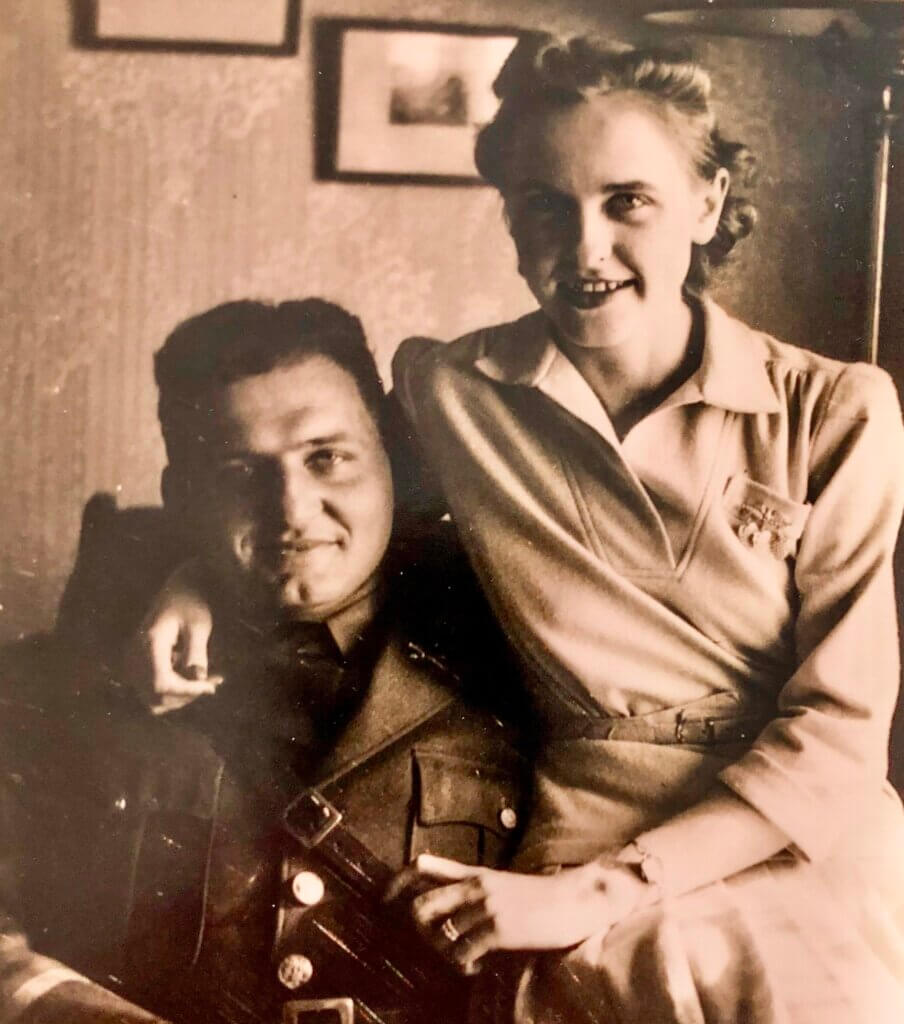
My father, Ray Leroy Hays, was born December 6, 1919, in Salem, Illinois. His father, Elijah, was a teacher and Baptist minister. His mother was Rose. Ray became the first member of his family to attend college, enrolling at the University of Illinois in Champaign-Urbana.
There he met Clara Alice Foster, known to her nursing school colleagues as Sally. She grew up on a farm east of Champaign.
Ray graduated in June 1941 and entered the Army as a lieutenant, reporting to Fort Sill, Oklahoma. Seven months later, on January 21, 1942, Ray and Sally married while he was on leave. The United States had entered World War II just 45 days earlier.
Sally joined him at Fort Sill. Over the next two years, the young couple lived in rented housing near Army bases as Ray’s assignments changed.
Training in California


Camp Cooke, California. Ray trained with armored forces at the Army base near Santa Maria. The couple’s first child, Patricia Ann, was born there in January 1943.
Ray’s next assignment took him to California, where he trained with Patton’s armored forces. The couple settled near Camp Cooke, an Army base at Santa Maria. In January 1943, their first child, my sister Patricia Ann, was born.
A year later, Ray received orders to report east for overseas duty. Sally faced a difficult journey of her own. With their one-year-old daughter, she drove alone from California to her parents’ farm in Illinois. Meanwhile, Ray traveled by train across the country to New York, where he would embark for Europe. They did not know when they would see each other again.
Camp Shanks: Last Stop: USA


Camp Shanks, known as “Last Stop, USA,” occupied approximately 2,000 acres in Orangetown, New York. Nearly 1.5 million American soldiers passed through the camp on their way overseas, including many who would take part in the D-Day invasion.
The installation was a small city, with barracks, mess halls, recreation facilities, and staging areas. African American soldiers were housed in segregated quarters, reflecting the racial divisions of the wartime Army. The camp also served as a processing center for German and Italian prisoners of war.
My father had never been to New York. He spent several days at Camp Shanks before marching in the early March cold to Piermont Pier. There he boarded a vessel that would carry him to the Queen Mary, one of the world’s great ocean liners, now serving as a troopship.
Crossing the Atlantic on the Queen Mary


The Queen Mary at war. The great ocean liner carried thousands of American troops across the Atlantic. Its luxurious peacetime accommodations gave way to crowded sleeping quarters.
Painted gray for wartime service, the Queen Mary carried my father and more than 11,000 other soldiers across the Atlantic. The accommodations were crowded, and many soldiers suffered from seasickness. My father made the crossing without becoming ill.
On March 6, 1944, the ship reached Gourock, near Glasgow, Scotland. From there, Ray traveled south to Shipton-under-Wychwood, a village west of Oxford. He later transferred to the intelligence section of Supreme Headquarters Allied Expeditionary Force, better known as SHAEF, in London.
On his first day in the war room, he was handed a thick folder containing plans for the invasion of Europe. He was told to learn everything in it. The folder contained plans for D-Day, the Allied invasion of Normandy that would begin on June 6, 1944.
After the invasion, SHAEF followed the advancing Allied armies across Europe. Headquarters moved to France, including the Trianon Palace Hotel at Versailles, and later to Reims and Frankfurt, Germany.
Inside Eisenhower’s War Room

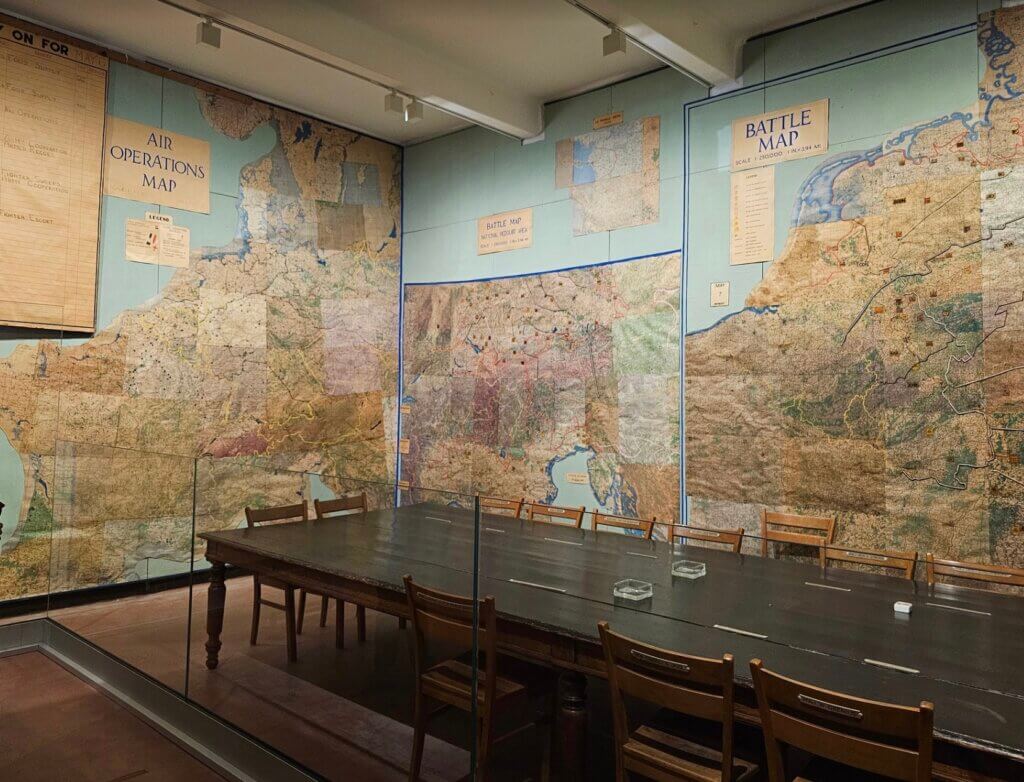
At Reims, my father worked in the Allied command headquarters, where enormous maps covered the walls. Officers and staff tracked the changing positions of Allied and German forces, using long sticks to move markers across the maps as troops advanced or retreated.
Ray helped keep the maps current for senior commanders, including General Dwight D. Eisenhower. He remembered the cigarette smoke that filled the room and the tension during the Battle of the Bulge, when Germany launched its last major offensive in the west.
My father once had an unexpected encounter with Eisenhower. While trying to reach someone on a telephone line, another voice interrupted. Annoyed, Ray told the man to get off the line. The man identified himself as General Eisenhower.
By the spring of 1945, Germany’s defeat was approaching. The headquarters at Reims would soon become the site of the German surrender
Preparing the Room Where Germany Surrendered

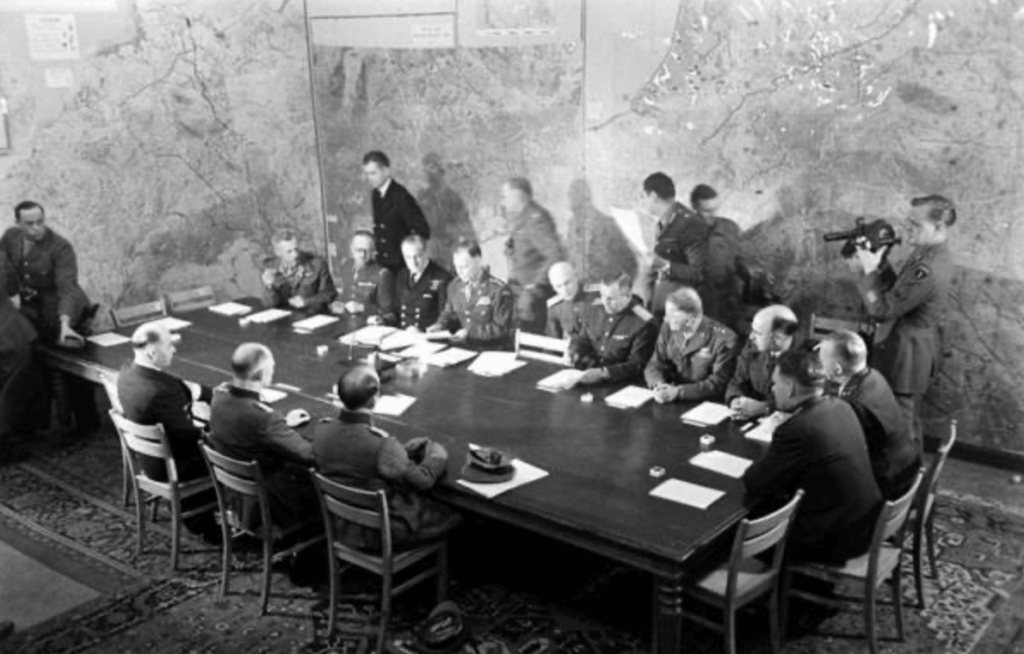
As Germany’s defeat approached, my father was assigned to help prepare the war room for the formal surrender ceremony. He slept on a cot nearby, ready to be called when needed. Awakened around 1 a.m., he hurried to complete the arrangements. He remembered using a ruler to measure the exact placement of papers on the signing table.
At 2:41 a.m. on May 7, 1945, German representatives signed the unconditional surrender before Allied officers. Ray was not in the room during the ceremony. He stood outside. He took pride in having helped prepare the room for such an important event.
The surrender took effect the following evening, May 8, celebrated as Victory in Europe Day.
Ray had left Piermont Pier just over fourteen months earlier. Now he was serving at the headquarters where the war in Europe came to an end.
A Familiar Face in Life Magazine

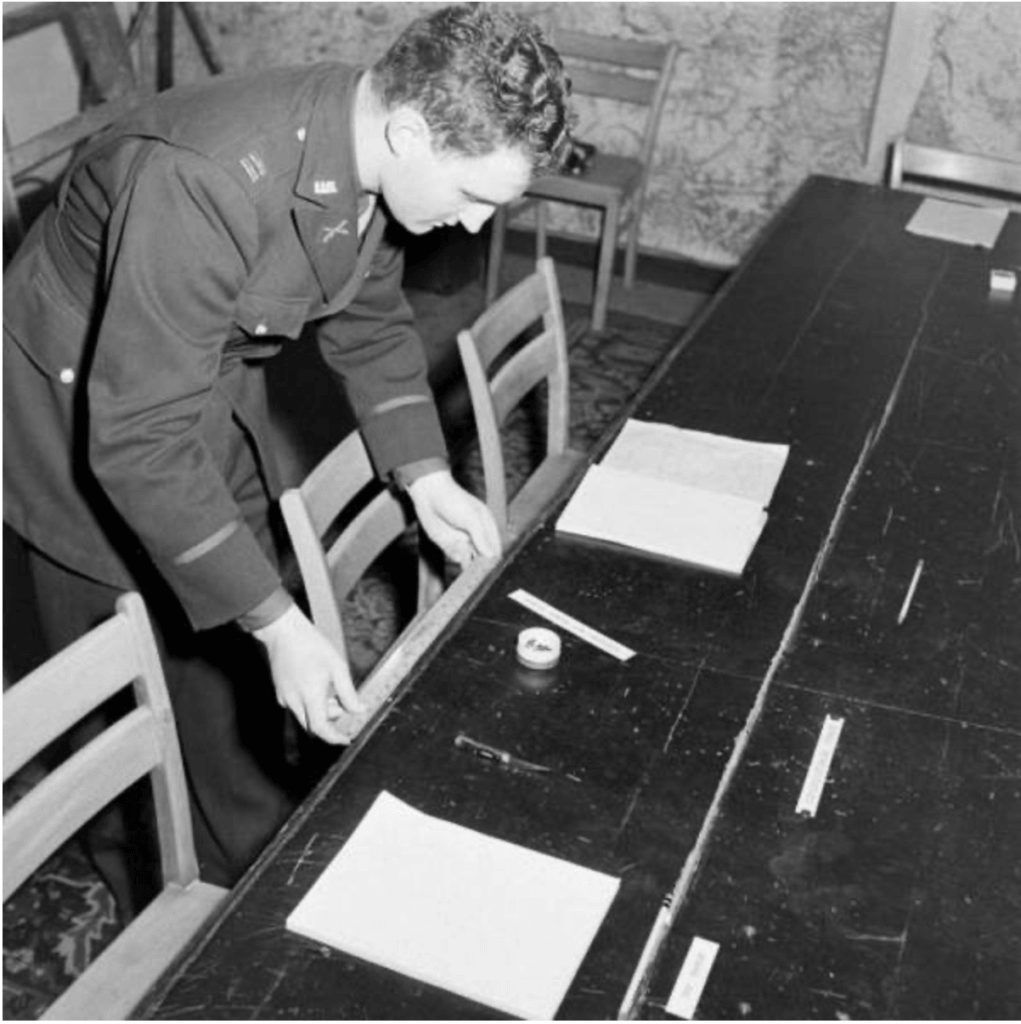
A Life magazine photographer was present during the preparations and the signing. He photographed the room, the officers, and the work that went on behind the scenes. At one point, he used a ladder that my father normally climbed to update the enormous wall maps.
One photograph, published in the May 21, 1945, issue, showed Ray in profile, carefully arranging papers on the signing table.
Thousands of miles away, at her parents’ farm in Illinois, Sally collected the morning mail. Among the deliveries was the latest issue of Life. As she looked through the magazine, she recognized a familiar face.
“It’s him!” she exclaimed, running into the house to show her parents.
They could hardly believe that their son-in-law, serving somewhere in Europe, had appeared in one of America’s most widely read magazines. For a long time, they insisted, “It’s not him.”
But Sally knew her husband. It was Ray.
Preserving the Surrender Room

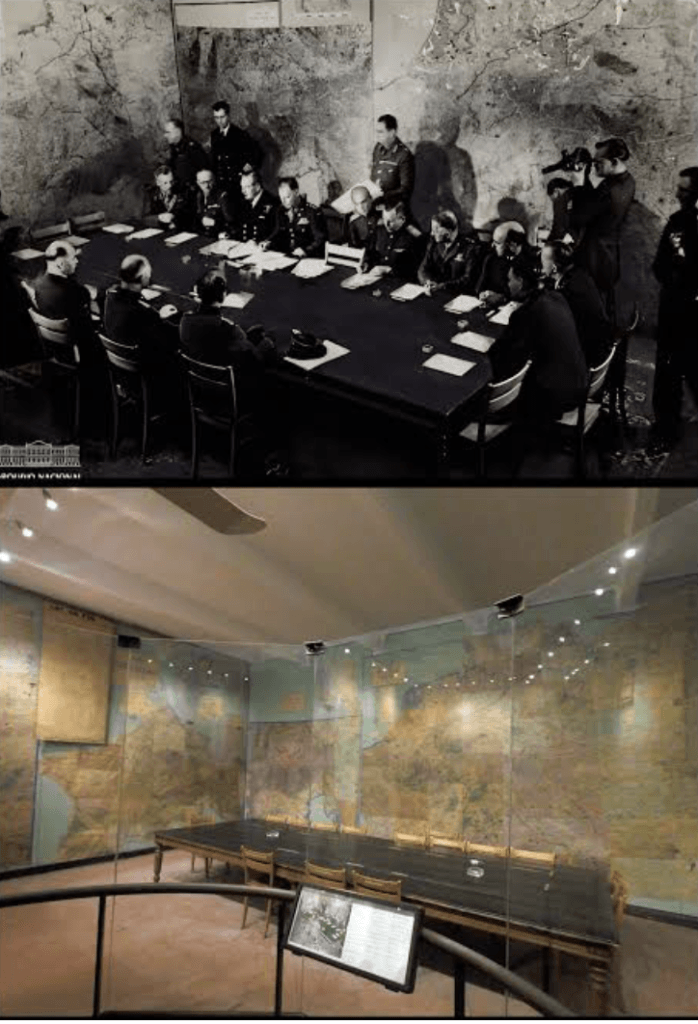
After Germany’s surrender, Eisenhower left Reims in late May 1945, and my father moved with Allied headquarters to Frankfurt. The surrender room was locked. Ray was later called back to Reims because he knew the room and its arrangements firsthand. He helped ensure that the room was preserved as it had appeared during the historic signing.
The original table and enormous battle maps remain in place today at the Museum of the Surrender (Musée de la Reddition). My father was particularly proud of this assignment. Some forty years later, he returned to visit the museum.
A Personal Connection to History
My father rarely discussed the war at home, although he occasionally repeated favorite stories including a few words of French. He was a self-effacing man who never boasted about having worked so close to the center of Allied command. But he was proud of his work at Reims, especially preparing the surrender room and returning after the war to help preserve it. He kept his Army uniform for the rest of his life.
I have visited the museum, too. Standing in the room where he had worked, surrounded by the enormous maps and the surrender table, I felt his presence. I could imagine him carefully carrying out his duties, making his own contribution to the defeat of Hitler.
Ray returned home in September 1945, having risen to the rank of major. His decorations included the Bronze Star› and an appointment as a Member of the Order of the British Empire.
My mother had spent those years caring for their daughter, moving across the country, and waiting for his return. She kept detailed notes of their wartime experiences, preserving much of the chronology that allows me to tell their story today.
Their experiences were different, but both were part of a generation whose lives were forever changed by the war.
Every Veterans Day, when I stand on Piermont Pier, I remember them both.

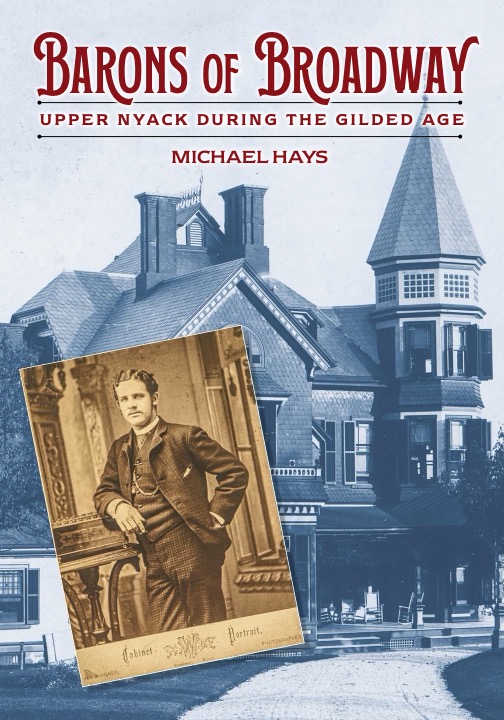
Just Published
Barons of Broadway: Upper Nyack During the Gilded Age
Available at Pickwick Books, Historical Society of the Nyacks, and Amazon
About the author
Mike Hays has lived in the Nyacks for 38 years. After a career as an executive at McGraw-Hill Education in New York City, he now focuses on researching, writing, and interpreting local history.
He serves as Treasurer and past President of the Historical Society of the Nyacks. He is also a Trustee of the Edward Hopper House Museum & Study Center and Historian for the Village of Upper Nyack. In these roles, he works with community partners to preserve historic resources and expand public understanding of the area’s past.
Since 2017, he has written the popular Nyack People & Places column for Nyack News & Views. The series chronicles the history, architecture, and personalities of the lower Hudson Valley.
Hays has also developed museum exhibitions, written interpretive materials, and led well-attended walking tours that bring Nyack’s history to life.
He is married to Bernie Richey. He enjoys cycling, history walks, and winters in Florida. You can follow him on Instagram at @UpperNyackMike.
Editor’s note: This article is sponsored by Sun River Health and Ellis Sotheby’s International Realty. Sun River Health is a network of 43 Federally Qualified Health Centers (FQHCs) providing primary, dental, pediatric, OB-GYN, and behavioral health care to over 245,000 patients annually. Ellis Sotheby’s International Realty is the lower Hudson Valley’s Leader in Luxury. Located in the charming Hudson River village of Nyack, approximately 22 miles from New York City. Our agents are passionate about listing and selling extraordinary properties in the Lower Hudson Valley, including Rockland and Orange Counties, New York.