Fact and Folklore Behind New York’s Last Witch Trial
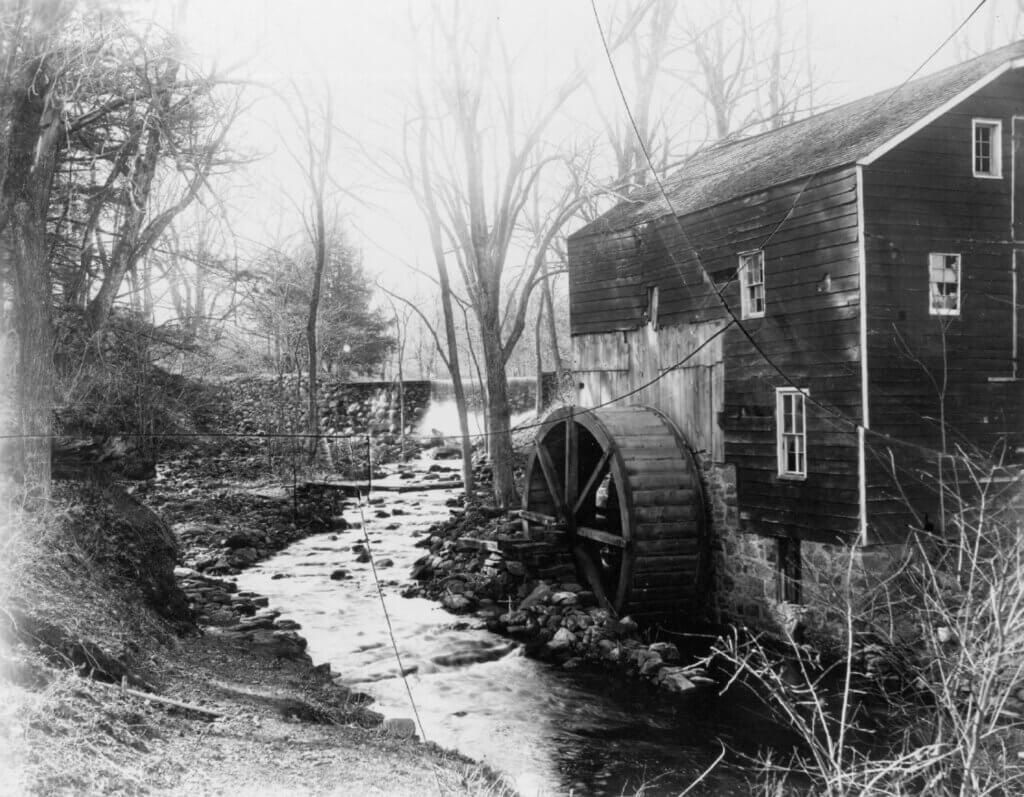
In 1816, according to local legend, a crowd of neighbors gathered in Clarksville, now West Nyack, to determine whether an elderly woman known as Naut Kanniff was a witch. They brought her to the Polhemus gristmill and seated her on one side of a large grain scale. On the other, they placed a heavy Dutch family Bible.
If the Bible outweighed Naut, she was a witch. If Naut outweighed the Bible, she was innocent. Naut sent the Bible upward and walked free.
Often called New York’s last witch trial, the story did not appear in print until historian Frank Green recorded it in 1886, some seventy years after the supposed event. Later historians added names, locations, and dramatic incidents. Still later versions attached the trial to buildings that did not exist in 1816.
Did the trial really happen? Who was Jane, or Hannah or “Naut” Kanniff? And where does history end and folklore begin?
New York’s Last Witch Trial
No contemporary newspaper, court record, diary, or church document describing the trial has been found. If a proceeding occurred, it was not a legal trial. No recognized court convened, no formal charge was filed, and no law authorized a group of neighbors to test someone for witchcraft.
Green’s 1886 History of Rockland County contains the earliest known published version. He wrote that Clarksville had “the doubtful honor” of being the scene of “the last trial for witchcraft held in New York State.”
Green did not identify the source of the trial story. He did claim to have spoken with people who knew Kanniff and praised the results of her herbal remedies. His account nevertheless appeared about seventy years after 1816, leaving plenty of time for memories to fade and stories to grow.
Arthur S. Tompkins published a second detailed version in 1902. He said a town resident related the story and pronounced it “undoubtedly true.” Yet Tompkins added a threatened millpond ordeal, named several participants, and identified two different mills. None of those details appears in Green.
Who Was Naut Kaniff?
Even her name is uncertain. Green calls her Jane Kanniff. Tompkins calls her Hannah. Her surname appears in several forms, including Kanniff and Kaniff.
Her neighbors reportedly called her “Naut.” The meaning of the name remains unclear. It may have developed from local Dutch usage or from a familiar form of a Dutch given name. Later suggestions that it meant “naughty” or described her differences remain speculative.
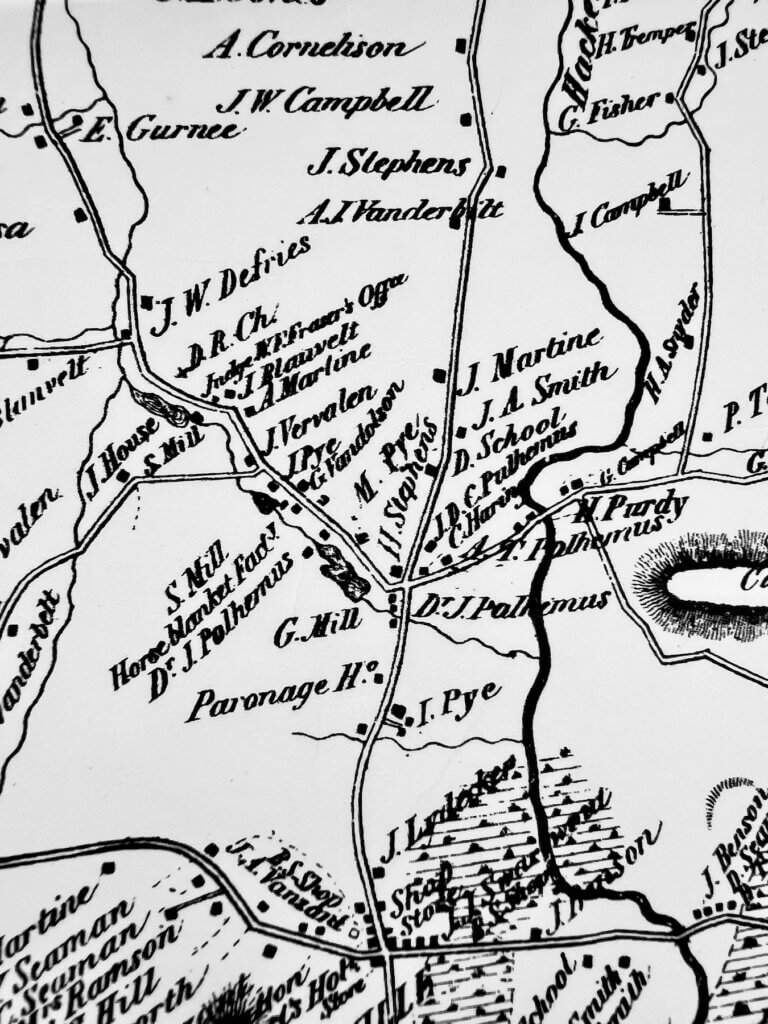
Clarksville was a small settlement of farms, mills, and interrelated families centered near Germonds and New City roads. Many residents were of Dutch ancestry, and Dutch was still spoken in the neighborhood. A creek and several millponds powered local saw, grist, and fulling mills.
Green describes Kanniff as the widow of a Scottish physician who moved to Clarksville before 1816. Tompkins says she lived with her adult son, Tobias Lowrie, from an earlier marriage. Reformed Church baptismal records appear to establish members of the Lowrie family in the community, although varying names and spellings make the relationships difficult to follow.
The 1820 census lists Tobias Lowrie as head of a local household containing an older woman. Because the census names only the head of household, it does not identify her. She may have been the woman remembered as Naut Kanniff. If so, mother and son apparently remained in Clarksville after the supposed trial.
An Outsider in Clarksville
The written accounts describe Kanniff as an outsider in a community where nearly everyone else was connected by blood or marriage.
Green calls her “exceedingly eccentric.” He says she dressed in unusual combinations of colors, arranged her hair in strange fashions, and avoided her neighbors. Tompkins describes her as “eccentric and reticent.” Other versions add a black cat and talking parrot as companions for Kanniff and her son.
These details create an unforgettable character. They also resemble the conventional image of a witch: an elderly solitary woman, unusual clothing, unruly hair, mysterious animals, and an isolated cottage. It is impossible to know how much describes the real Kanniff and how much was shaped by later storytelling.
Kanniff reportedly possessed some knowledge of herbal medicine learned from her deceased husband. Green says she gathered local plants, prepared remedies, and treated those who came to her “with most excellent results.”
An herbalist would not necessarily have been unusual when physicians were scarce and household medicine depended heavily on plants. Yet specialized knowledge could inspire suspicion, particularly when practiced by an unconventional woman already regarded as an outsider.
Children reportedly hurried past her house “with palpitating hearts and starting eyes.” Green believed Kanniff soon learned what people were saying about her and that their fear only aggravated her peculiar behavior. Suspicion and resentment may have reinforced one another.
When Ordinary Events Become Witchcraft
No single incident appears to have provoked the trial. Green describes it as the culmination of several “suspected misdoings.”
Local housewives reportedly complained that their cream would not turn into butter. When several churns were emptied, a horseshoe-shaped mark was supposedly found burned into the bottom.
Another story concerned a farmer who spent a sleepless night listening to his distressed cattle. In the morning, he discovered the best milk cow in his herd standing inside a farm wagon. According to the legend, the cow never produced milk again.
The incidents need not have been invented. They could have happened substantially as described but had ordinary causes. Cream can fail to turn into butter because of its temperature, age, acidity, or handling. A frightened cow, perhaps chased by a dog or another animal, might behave unpredictably and jump into a wagon.
Green himself offered these explanations. He dryly observed that it apparently did not occur to Kanniff’s “intelligent” neighbors that heat applied during churning or “the known proclivity of the domestic dog to chase cattle” might have caused the disturbances.
Instead, they sought what Green called a “preternatural cause” and blamed Naut Kanniff. The folklore may lie not in the incidents themselves, but in the supernatural thread drawn between them.
The Trial by Bible
Green wrote that Kanniff’s neighbors apparently realized no legally appointed judge would entertain a witchcraft charge. Worse, the complainants might become a “public laughing stock.” They therefore took the law into their own hands.
Only “reputable citizens” were supposedly allowed to participate. A local physician served as judge, while farmers from the neighborhood formed the jury.
Green does not name the physician. Historian John Scott later identified him as Dr. Abraham Cornelison, a prominent local doctor who lived across from the De Clark–Polhemus mill. Cornelison reportedly weighed more than 300 pounds, an ironic qualification for a judge in a trial decided by a grain scale. Because Green left the judge unnamed, Scott’s identification remains a reasoned conclusion rather than a documented fact.
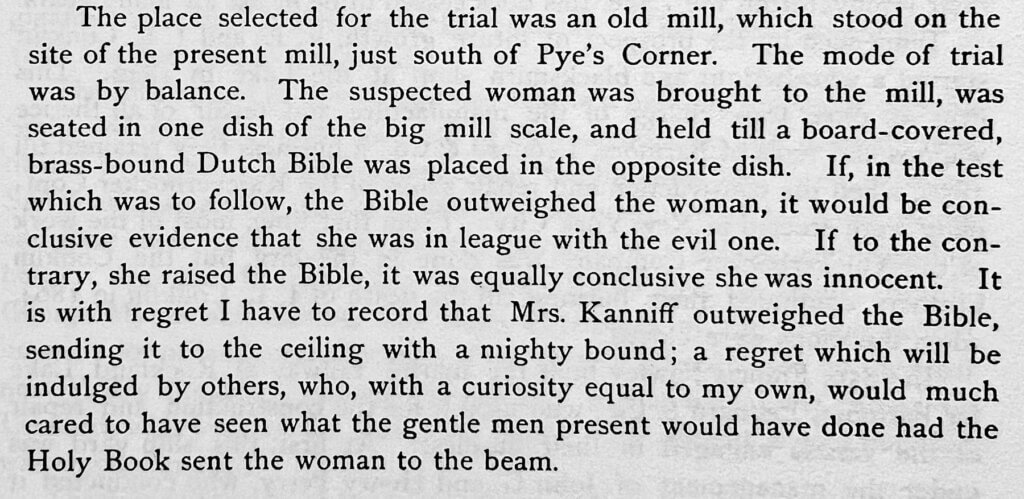
Green places the proceeding at an old mill just south of Pye’s Corner. Kanniff was seated in one dish of a large mill scale. In the other, the men placed a “board-covered, brass-bound Dutch Bible.”
If the Bible outweighed Kanniff, the crowd would take it as proof that she was “in league with the evil one.” If Kanniff raised the Bible, she would be declared innocent. She outweighed it easily.
Green recorded the result with mock regret, wondering what the “gentle men” present would have done if the Bible had somehow sent Kanniff upward instead. His tone makes his opinion clear: he regarded the proceeding as both ridiculous and potentially dangerous.
Tompkins Adds the Millpond
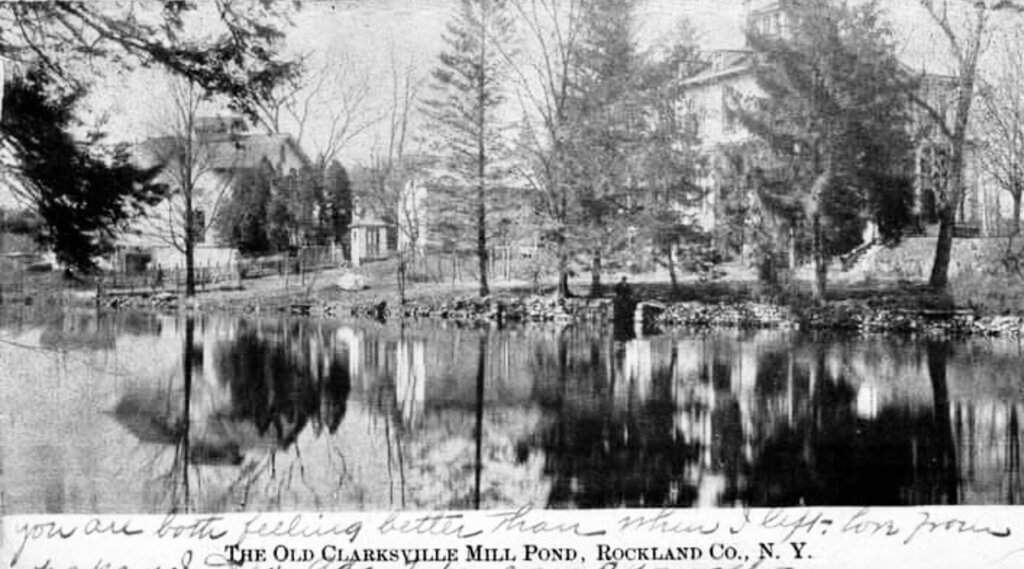
Tompkins later made the story considerably more dramatic. In his version, prominent men and women first met secretly at a fulling mill owned by the Pye family. There they decided to bind Kanniff hand and foot and throw her into a nearby millpond.
If she floated, they would declare her a witch. If she sank, they would accept her innocence, although she might drown in the process.
The committee reportedly brought Kanniff to the pond beside A. A. Demarest’s house. She was bound and about to be thrown into the water when Squire Yaupy (Jacob) Vanderbilt and Jake Clark arrived and persuaded the crowd to adopt a different test.
They took Kanniff to Aunert Polhemus’s gristmill. Tompkins describes the Bible as an old Holland Dutch volume with wooden covers, iron bindings, and an iron carrying chain. Kanniff outweighed it and was released.
Tompkins adds that she threatened legal action against her persecutors. The dispute was supposedly settled before reaching court, and Kanniff returned home to her son, cat, and parrot.
Tompkins may have drawn upon an independent local tradition unavailable to Green. Alternatively, the millpond, last-minute intervention, named rescuers, and chained Bible may have entered the story after Green’s account. No contemporary evidence decides between those possibilities.

The Polhemus Mill Site Today. The stream that powered the gristmill still flows past surviving stonework at 135 Strawtown Road. The age and original function of the upright stone pier have not been confirmed. Kanniff’s Bible test reportedly occurred at the mill on this site. Photograph by the author.
Naut’s Revenge
Tompkins gave the legend an ominous postscript. Shortly after the supposed trial, he wrote, a son of the owner of the Pye fulling mill was crushed beneath one of its enormous wooden hammers. Neighbors attributed the death to Kanniff’s revenge.
The accident was real, but its connection to Kanniff was not.
John Scott found the incident recorded in the Pye Genealogy and Diary of David Pye. In 1776, eight-year-old James Pye was fatally injured by a fulling hammer weighing approximately 500 pounds. The tragedy occurred at least forty years before Kanniff’s supposed trial.
In the retelling, a genuine mill accident had been moved forward in time and transformed into a supernatural curse. Few details demonstrate more clearly how the Kanniff legend grew.
Where Did She Live?
Tompkins offers the clearest early description of Kanniff’s home. He places it west of the old Clarkstown church, on the road toward Bardonia Station. He describes it as “a small wooden, unpainted building” occupied by the elderly widow and her son.
John Scott placed the home just above the burial ground adjoining the old Dutch meetinghouse on Germonds Road. His location appears broadly consistent with Tompkins.
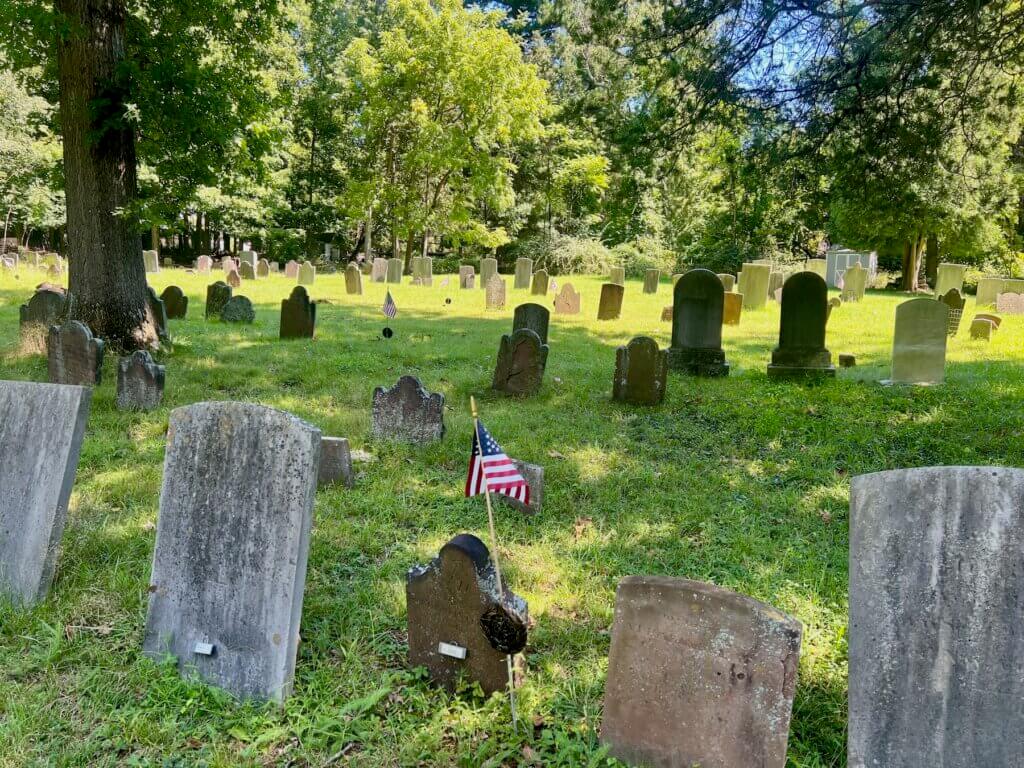
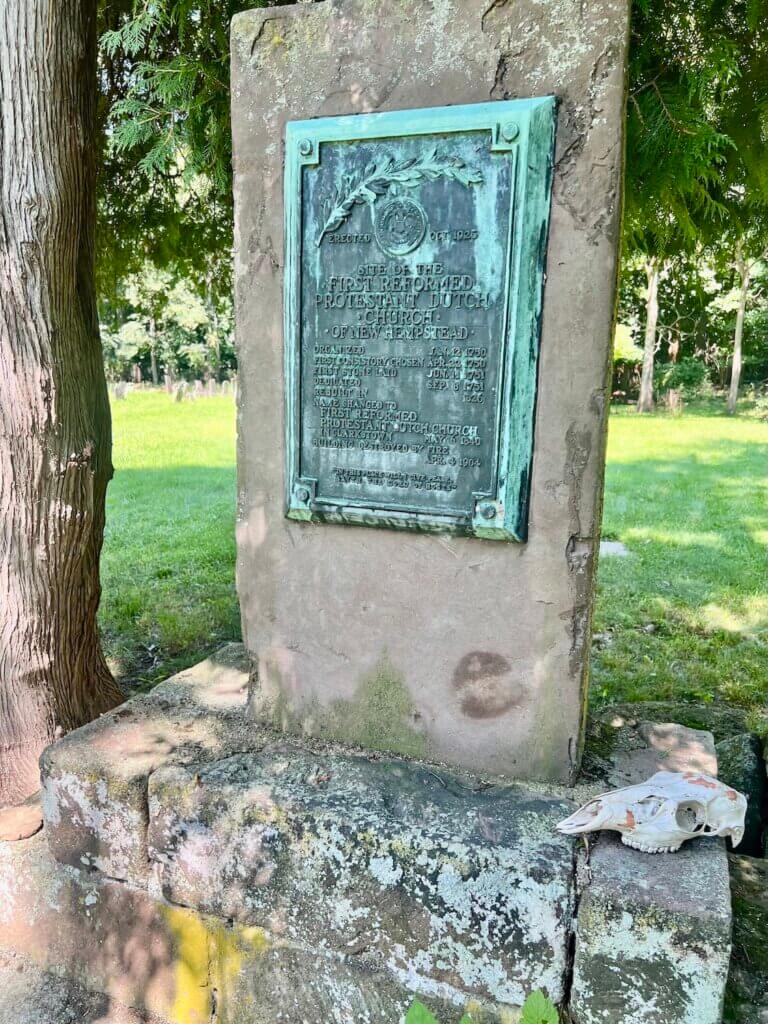
Kanniff’s date of death and burial place remain unknown. If Scott correctly located her home beside the churchyard, she may have been buried in what is now the Old Clarkstown Reformed Church Cemetery. No burial record or identified gravestone survives.
Some recent accounts instead place her in the Germonds Presbyterian Cemetery, originally associated with the Dutch Evangelical Church of Clarksville. That congregation was not organized until 1860. Since Kanniff was already described as elderly in 1816, the later cemetery appears an unlikely burial place, although her unknown death date prevents a definitive conclusion.
The Mysterious Red Barn
The earliest accounts place Kanniff’s weighing at a mill and make no mention of a barn. Yet a second location entered the written story by 1967.
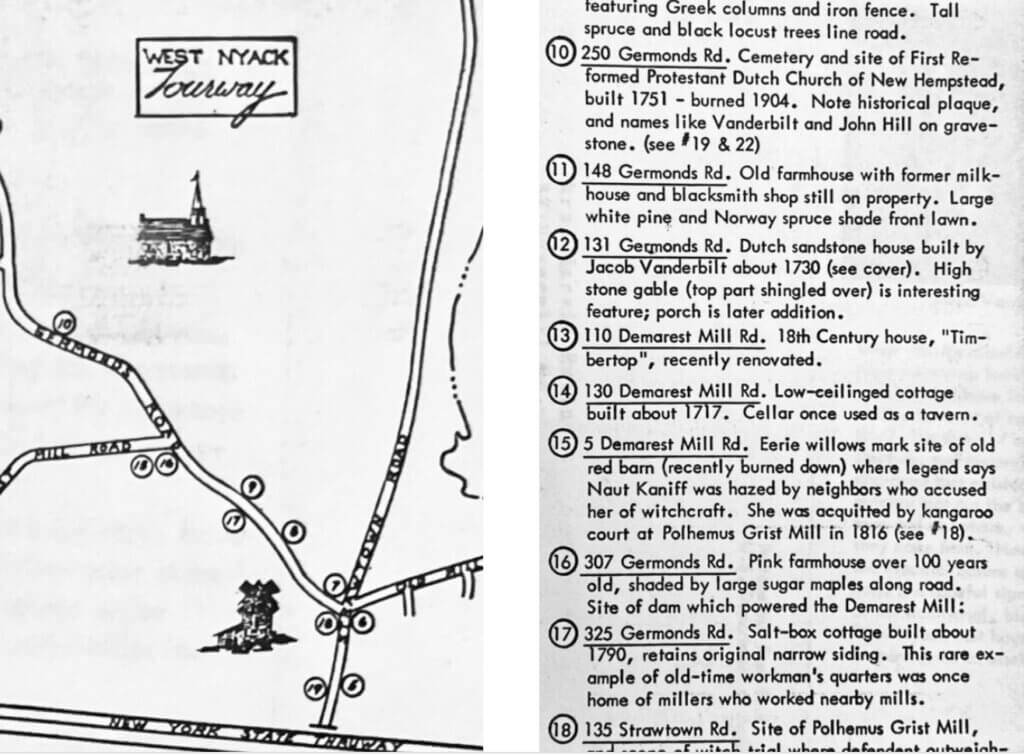
A Historical Society landmarks guide identified 5 Demarest Mill Road as the site of a red barn where, “legend says,” Kanniff was hazed by her neighbors. It separately placed her kangaroo court and acquittal at the Polhemus gristmill at 135 Strawtown Road.
The barn location appeared again in a 1968 newspaper article and map. In 1976, an annotated version of the 1854 O’Connor map labeled the property “Site of Naut Kaniff Barn.” These later references appear to descend from the 1967 guide rather than from separate early sources.
The guide reported that the red barn had recently burned, apparently in the early 1960s. Its connection to Kanniff may preserve a hyperlocal oral tradition known to the guide’s researchers. It might also reflect a later effort to attach Tallman’s description of the episode as “hazing” to a remembered local building. The original source of the identification has not been found.
What can be established is that by 1967, local historical researchers associated a specific barn with Kanniff’s ordeal—nearly 150 years after it supposedly occurred.
A Legend in Search of a Landmark
As the story continued to circulate, it acquired still more locations and punishments.
A 1974 newspaper article claimed that Kanniff was tried and acquitted at the Clarksville Inn. Yet the same article dated the inn to 1840, about twenty-four years after the supposed trial. Neither Green nor Tompkins placed the proceeding there. The surviving inn apparently offered later storytellers a convenient landmark for an event whose actual setting had disappeared.
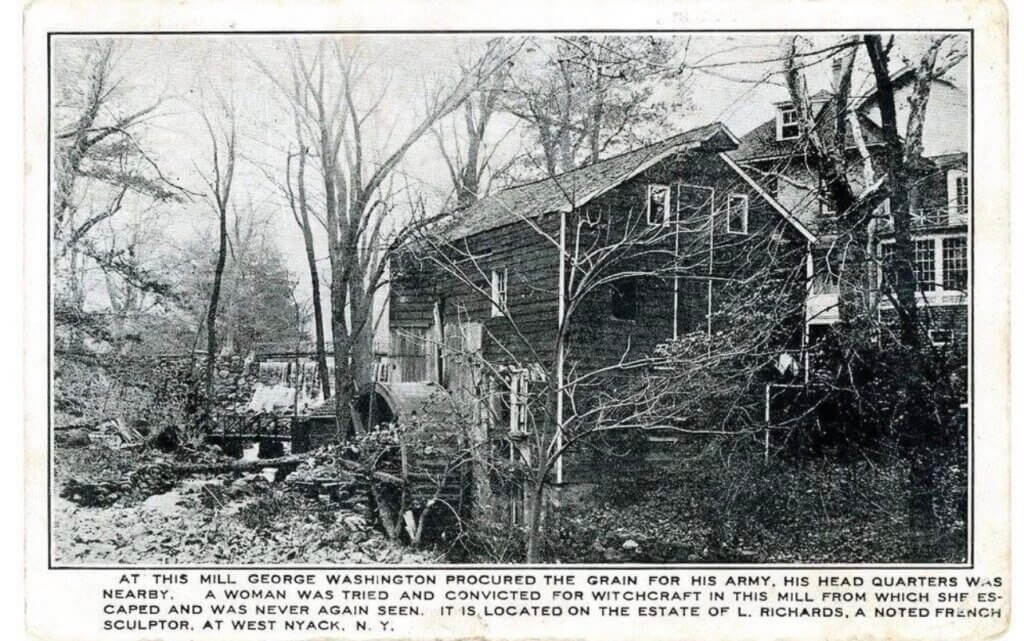
A 1976 Bicentennial quilt showed Kanniff fleeing from a hangman’s noose, although no early account mentions hanging. An early twentieth-century postcard described by Scott went further, claiming that Rockland County’s last witch had been burned at the stake at the Polhemus mill.
In 1959, she had also become the inspiration for The Clarkstown Witch, a light opera produced during the Hudson-Champlain anniversary celebration. The operetta borrowed from Nathaniel Hawthorne’s “Feathertop,” in which a witch brings a scarecrow to life, an episode with no connection to the West Nyack story. The production did not preserve Kanniff’s history. It demonstrated how completely she had passed into folklore.
Fact, Folklore, or Something Between?
Historical records establish the people, roads, church, millponds, and mills that form the setting for the Kanniff legend. Church and census records may confirm part of her family story and suggest that she remained in Clarksville after 1816.
Yet the absence of a court record does not prove that nothing happened. The gathering was never described as a legal trial. Kanniff may have been confronted, mocked, threatened, or subjected to an informal test at a neighborhood mill. Green may have preserved the outline of an actual event remembered seventy years later.
With each retelling, the ordeal became more elaborate. Green described a Bible weighing. Tompkins added a secret meeting, a threatened drowning, a last-minute rescue, and a fatal curse. Later guides supplied a red barn. A newspaper moved the trial into an inn built decades too late. A quilt added a noose, and another postcard burned Kanniff at the stake.
Wilfred B. Tallman concluded that the proceeding was less a witch trial than a form of community hazing, a crude attempt to frighten or control a troublesome woman. That interpretation is possible but remains speculative. Some neighbors may have believed in witchcraft. Others may have wanted to humiliate Kanniff or force her to leave. Still others may have devised the Bible test as a harmless way to end a dangerous confrontation.
More than two centuries later, Jane, or Hannah, “Naut” Kanniff remains hidden beneath the descriptions imposed upon her by neighbors, historians, mapmakers, journalists, and playwrights. The one version of the story that might resolve the mystery, Naut Kanniff’s own, was never recorded.
Sources
The History of Rockland County, Frank Green, 1886, pp. 418-419.
Historical Record of Rockland County to the Close of the 19th Century, Arthur S. Tompkins, 1902, pp.444-446.
“Jane ‘Naut” Kaniff: The Witch of West Nyack” John Scott, in South of the Mountain 2005-04, Vol 49 No. 2 pp. 13-16.
“The Witch of Clarkstown” in Now and Then and Long Ago, Cornelia Bedell, 1976, pp. 173-176
The True Story of Jane “Naut” Kaniff- The Recent ‘Witch” of West Nyack, Town of Clarkstown, 2004, online.
“The Clarkstown Witch” in How Things Began, Wilfred Blanch Talman, 1977, pp. 274-276.
Just Published
Barons of Broadway: Upper Nyack During the Gilded Age
Available at Pickwick Books, Historical Society of the Nyacks, and Amazon
About the author
Mike Hays has lived in the Nyacks for 38 years. After a career as an executive at McGraw-Hill Education in New York City, he now focuses on researching, writing, and interpreting local history.
He serves as Treasurer and past President of the Historical Society of the Nyacks. He is also a Trustee of the Edward Hopper House Museum & Study Center and Historian for the Village of Upper Nyack. In these roles, he works with community partners to preserve historic resources and expand public understanding of the area’s past.
Since 2017, he has written the popular Nyack People & Places column for Nyack News & Views. The series chronicles the history, architecture, and personalities of the lower Hudson Valley.
Hays has also developed museum exhibitions, written interpretive materials, and led well-attended walking tours that bring Nyack’s history to life.
He is married to Bernie Richey. He enjoys cycling, history walks, and winters in Florida. You can follow him on Instagram at @UpperNyackMike.
Editor’s note: This article is sponsored by Sun River Health and Ellis Sotheby’s International Realty. Sun River Health is a network of 43 Federally Qualified Health Centers (FQHCs) providing primary, dental, pediatric, OB-GYN, and behavioral health care to over 245,000 patients annually. Ellis Sotheby’s International Realty is the lower Hudson Valley’s Leader in Luxury. Located in the charming Hudson River village of Nyack, approximately 22 miles from New York City. Our agents are passionate about listing and selling extraordinary properties in the Lower Hudson Valley, including Rockland and Orange Counties, New York.