Nyack History A to Z
Nyack’s First Meeting Place Still Welcomes the Community

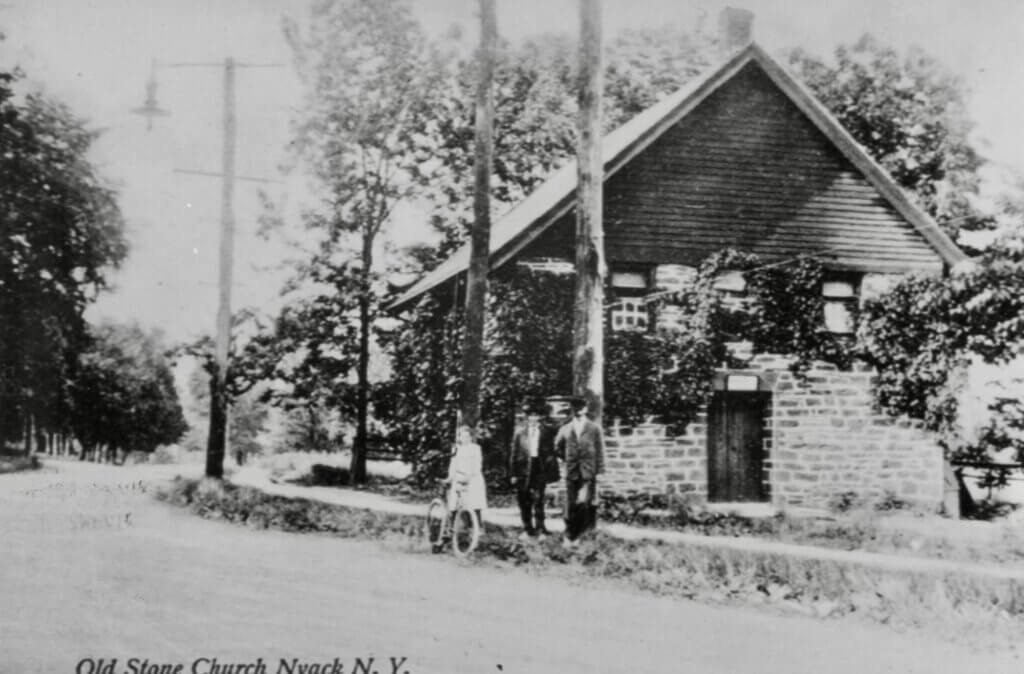
The Old Stone Church in the early twentieth century. Two men stand near the entrance while a female bicyclist pauses along North Broadway. Courtesy of the Nyack Library.
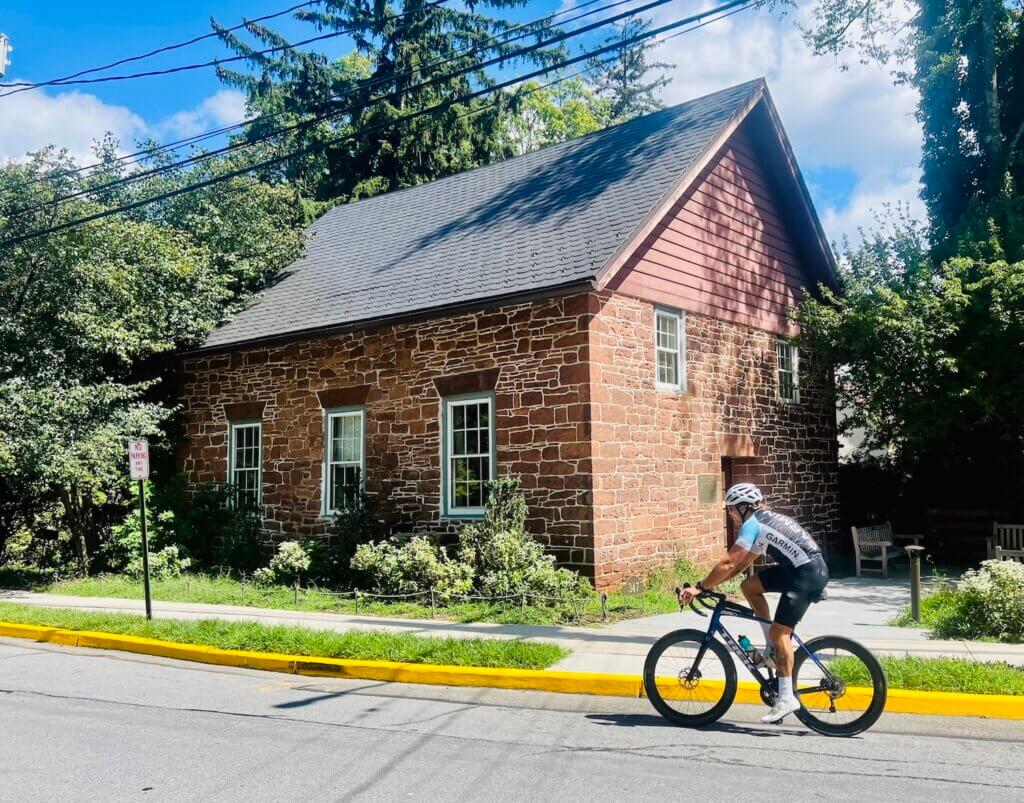
In 1813, a small group of Nyack residents set out to create the first building in their scattered community intended exclusively as a place for people to gather. William Palmer supplied the land and stone from his nearby quarry, while other founders contributed money toward construction. The sandstone church they erected still stands on North Broadway in Upper Nyack.
Today, the Old Stone Meeting House is the oldest church in Rockland County still standing in its original building. Although generations knew it as the Old Stone Church, “meeting house” is not merely a modern name. A Bible purchased for the congregation in 1814 identifies it as belonging to the “Nyack Meeting House.” More than two centuries later, the building hosts village meetings, concerts, lectures, and other community gatherings.
Before Nyack Had a Church
During the Revolutionary era, residents of the Nyacks had to travel to the Reformed churches at Tappan or New Hempstead to worship. Both required long journeys over rough roads, especially in winter.
Methodist circuit riders began preaching in the Nyacks around 1806. Without a church of their own, Methodists and Baptists met on alternating Sundays in a schoolhouse on South Broadway. Traveling ministers served the small congregation. One of them, the Reverend George Banghart, became known as the “singing preacher” because of his powerful voice.
In 1812, local residents petitioned the Classis of Paramus for permission to organize a Reformed church in Nyack. The Classis feared that another congregation would weaken the established churches nearby and rejected the request. It permitted services in private homes on alternating Sundays in Nyack and Blauvelt, but the petitioners remained dissatisfied. They wanted a meeting place of their own.
Building a Meeting House
After the Reformed Church rejected their petition, several of the petitioners changed course. William Palmer, Nicholas Williamson, and John Green met at Green’s house and resolved to organize a Methodist Episcopal congregation. They adopted a remarkably direct resolution, “That we begin to build the church tomorrow morning”.
The new congregation selected five trustees. William Palmer, a son of Revolutionary War veteran Captain Henry Palmer, donated the site and allowed the builders to quarry stone from his property. His brother James owned the adjoining farm. John Green was a South Nyack sloop captain and lumber dealer. Nicholas Williamson owned a large farm farther north, and Garret Onderdonk was a quarry and sloop owner from Rockland Lake. Green, Williamson, and Onderdonk also contributed money.
The trustees received title to the church lot on February 18, 1813. Construction followed that year, and the congregation dedicated its new meeting house on March 2, 1814.

Why Was It Built Here?
The meeting house may seem isolated today, but the Nyacks had no established center in 1813. Farms, boatyards, and river landings extended for several miles along the Hudson. No one could have known where the future village would develop.
The church stood north of the intersection of the Road to the Hook, now North Broadway and the Road to the Pond, now Old Mountain Road. This route connected the riverfront with Rockland Lake and the county’s interior.

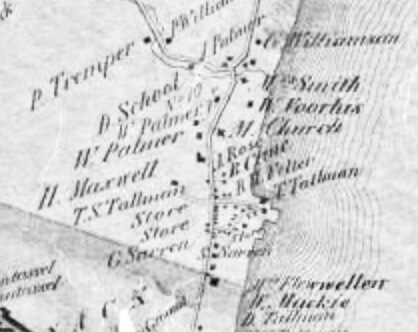
John Van Houten had settled nearby in 1798 and later developed docks, a boatyard, stores, and residences along the waterfront. He opened Upper Nyack’s first store in 1824, built Rockland County’s first marine railway there in 1834, and became Nyack’s first postmaster in 1835. Steamboats carried passengers and mail to and from his docks. For a time, the area around Van Houten’s Landing appeared capable of becoming Nyack’s commercial center.
Instead, the opening of the Nyack Turnpike and the growth of steamboat service at docks farther south drew businesses toward Main Street. As downtown Nyack developed, the meeting house that had once stood near a promising center began to seem remote.
How the Meeting Meeting House Was Built
The builders gave the meeting house a simple Federal-style design, a rectangular stone structure with a gable roof and symmetrically arranged windows. Keystone-shaped lintels above the openings provide its principal decoration.

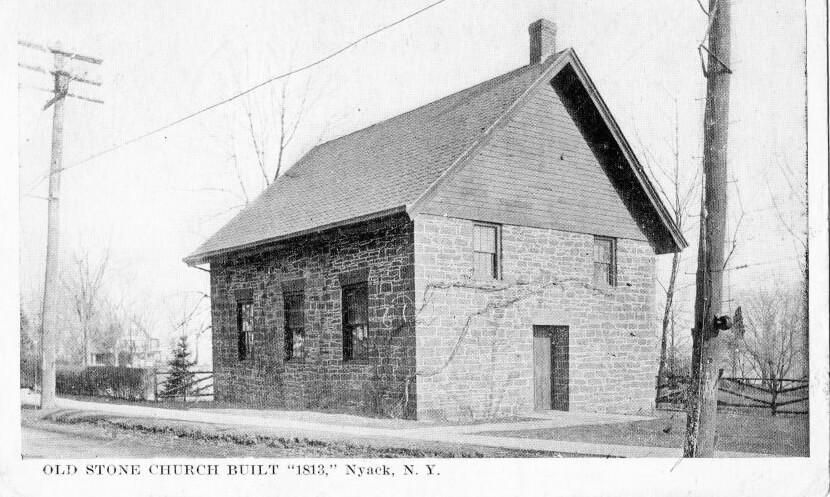
Local red sandstone, roughly squared and laid in courses with lime mortar, formed the walls. Massive floor, ceiling, and roof beams were shaped from local timber with broadax and adze. The builders reinforced the interior’s lime plaster with horsehair and used pine boards for the floor and wainscot.
The entrance door employed board-on-board construction, with vertical tongue-and-groove boards outside and horizontal boards inside. Long iron doornails fastened the layers together, while a local blacksmith probably supplied the hardware. The original roof most likely had wooden shingles. The building had no plumbing.
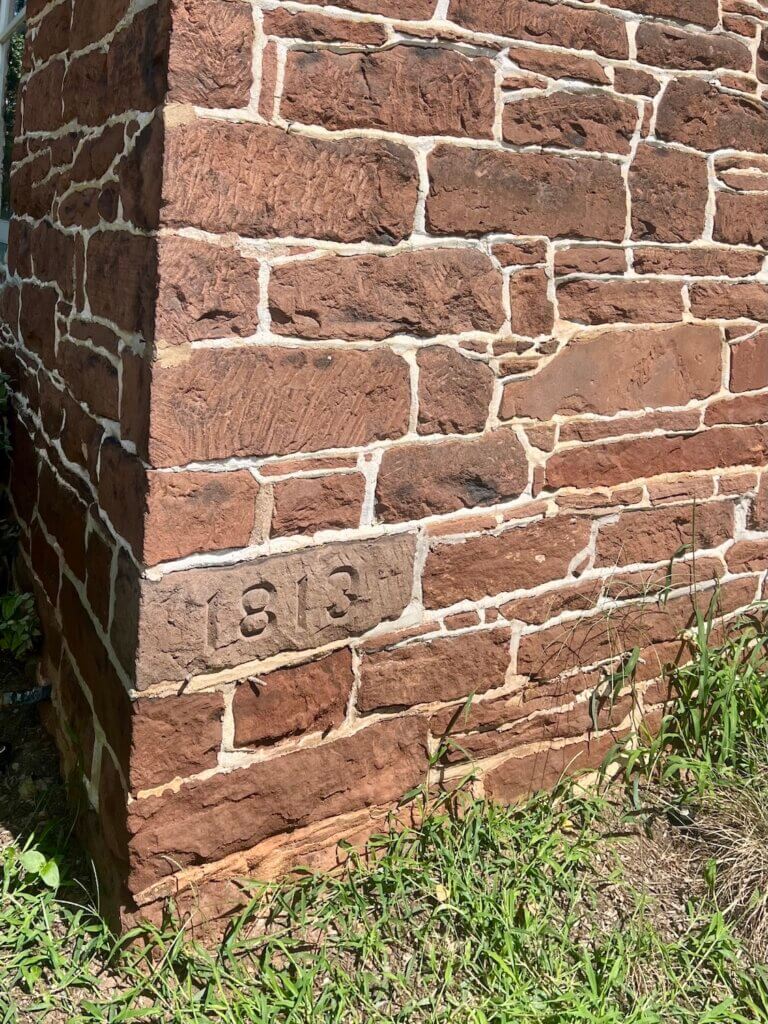
A date stone carved with “1813” remains near the lower corner of the south wall. Local historian Winston C. Perry Jr. noted another dated stone, perhaps a rejected first attempt, set high in the east wall near the southern corner.

Inside the Meeting House
Closely spaced, straight-backed pews accommodated approximately 100 worshippers, while about 20 more could sit in the gallery, or balcony. A high, square box pulpit stood against the north wall. The minister reached it by climbing six steps and entering through a small door. A three-foot altar rail with upright slats stood below it, resembling a picket fence.
A cast-iron stove supplied heat. A copper oil lamp hanging from the center of the ceiling and about half a dozen tin candleholders provided light. The congregation had no organ.
Eleven subscribers contributed money to purchase a Bible. Its flyleaf reads: “This Bible was procured by Joseph Bennet for the use of the Nyack Meeting House of Methodist E. Church.” The inscription confirms that local people called the building a meeting house almost from the beginning.
Local accounts state that, as in many churches of the period, Black worshippers sat separately in the balcony. Later generations fitted the balcony with hinged panels that could be lowered from the ceiling, converting the space into a separate classroom. Its sloping floor improved sight lines toward the pulpit.

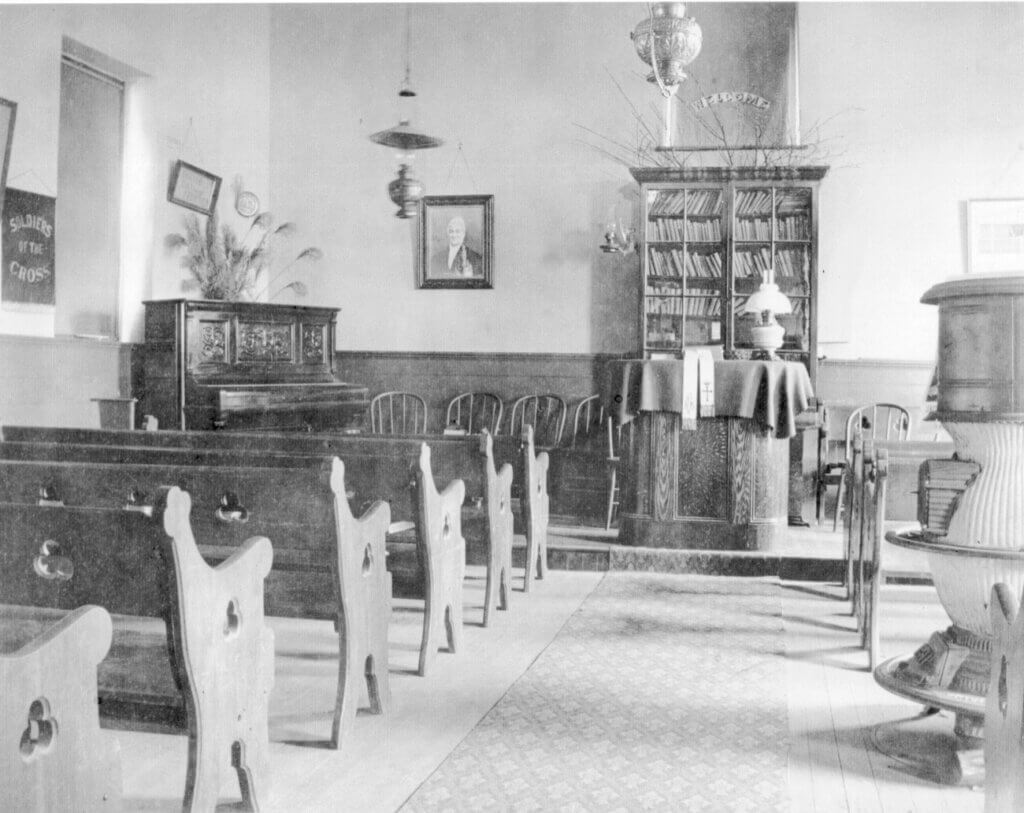
Inside the Old Stone Church. This view from the gallery looks toward the north wall around 1900. By then, the original high pulpit had disappeared, and the room contained a piano and a Sunday school library. A potbelly stove and hanging lamps remained in use. The portrait on the far wall is believed to depict founding trustee James Palmer. Courtesy of the Nyack Library.
Labor That Was Not Freely Given
The community effort that produced the meeting house included labor that was not freely given. Several founding trustees and neighboring farmers enslaved people.
One named worker was Peter Williamson, a young Black man enslaved by trustee Nicholas Williamson. An 1886 obituary reported that Williamson “worked on the Stone Church during its erection,” although it does not identify his particular task or establish his exact age at the time.
After gaining his freedom, Williamson remained in Upper Nyack and operated a small store. When he died in 1886, his funeral took place in the church he had helped erect. His fuller story will appear later in this series in “W” for Williamson.
A Growing Methodist Congregation
Visiting ministers, circuit riders, and local preachers served the new church. Despite the absence of an organ, services drew large congregations for nearly 30 years.
During the pastorate of the Reverend Benjamin Day, a series of revival meetings brought many new members into the congregation. The revivals took place in a building on the site later occupied by Union Hall in downtown Nyack.
Growth eventually created a problem: the church’s center of membership was moving away from the meeting house.
The Center of Nyack Shifts South
By the early 1840s, downtown Nyack had begun to grow while Upper Nyack remained much less populated. Many church members now lived a mile or more from the Stone Church and wanted a larger meeting place closer to the developing village center.
A proposal to sell the building failed by only two votes. Garret Williamson and Jacob Voorhis cast the deciding votes against the sale. Dissatisfied members then built the Second Methodist Episcopal Church on Piermont Avenue in 1843–44.
That building later became the Masonic Temple. In 1877, its congregation took the name St. Paul’s Methodist Episcopal Church. The original Stone Church remained in use for a time as a Methodist Sunday school.
Saved More Than Once
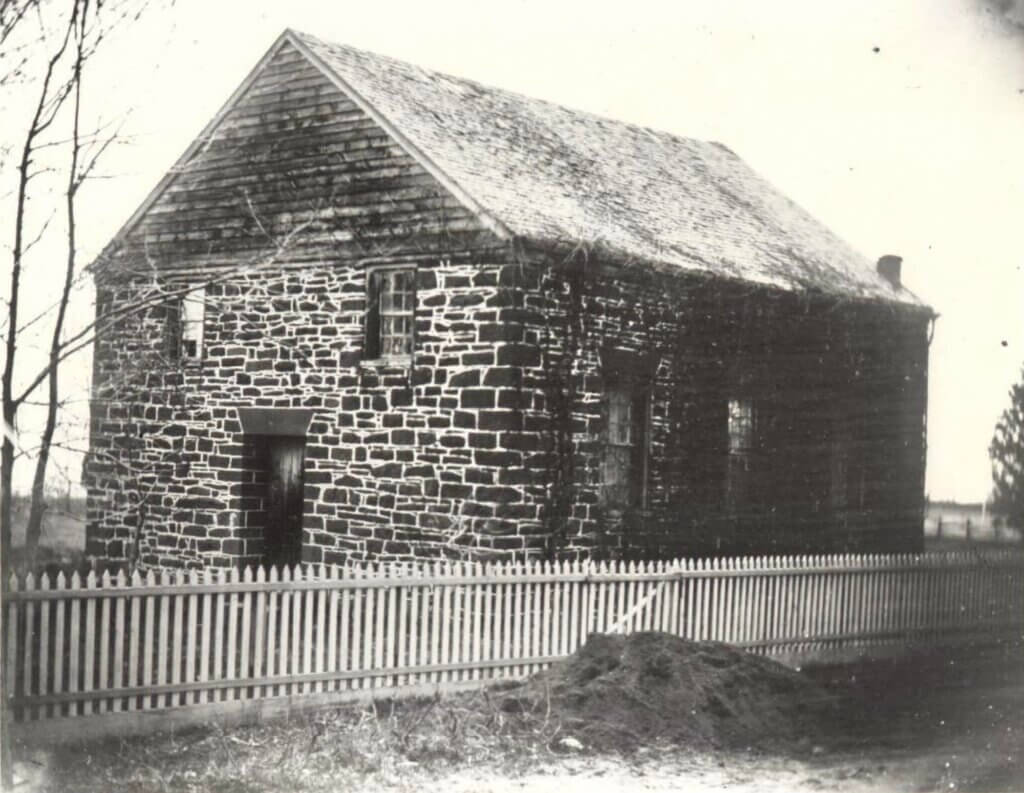
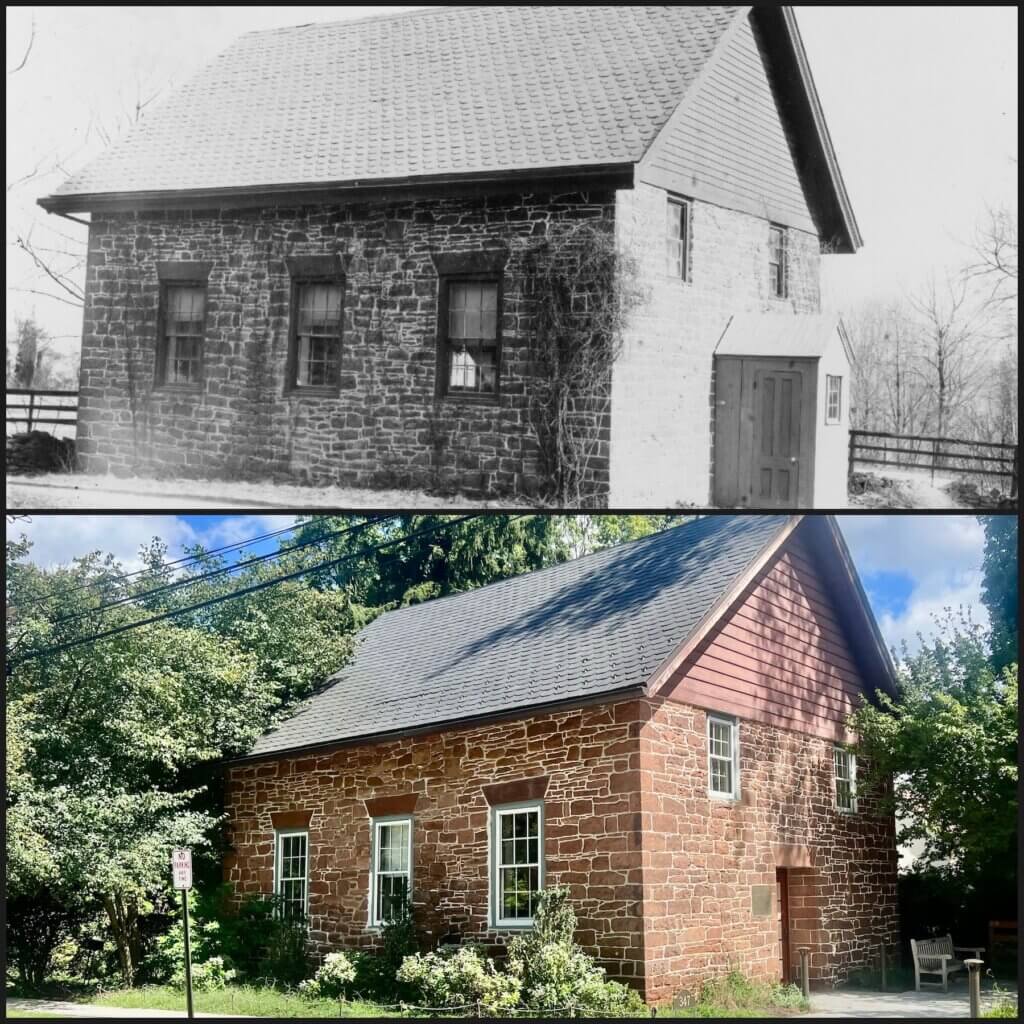
By 1870, the Stone Church had fallen into serious disrepair. George Green, the son of founding trustee John Green and the owner of a large Upper Nyack farm, led an effort to save it. Contemporary accounts describe the installation of a new roof and the repair and replastering of the interior. The building’s higher-pitched roof and slate covering probably date from this major rehabilitation.
When another attempt was made to sell the Stone Church in 1877, local defenders again prevented its loss.

From Old Stone Church to Meeting House
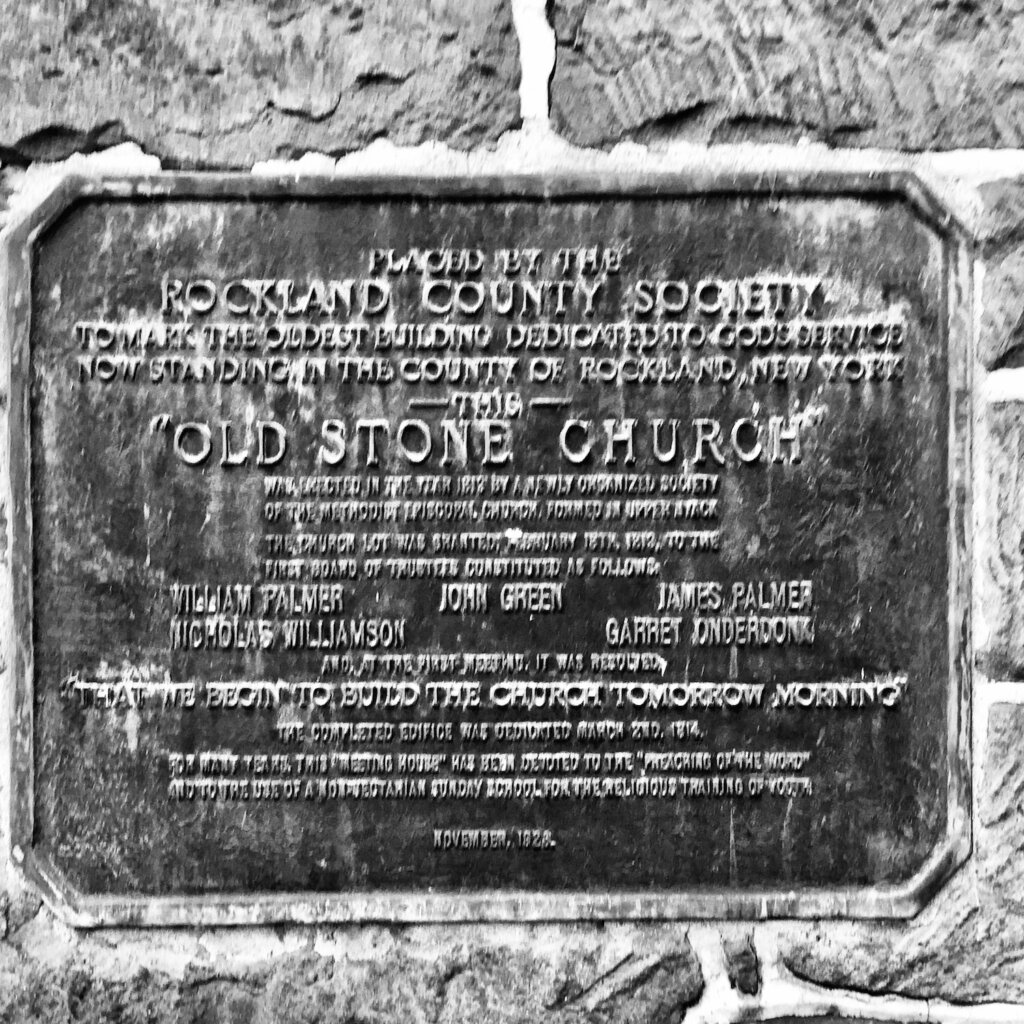
A nondenominational organization known as the Old Stone Church cared for the building through much of the twentieth century. In 1928, the Rockland County Society placed the bronze commemorative plaque beside the entrance.
In 1976, insects and rot forced the replacement of the floor. A small restroom was also added. The building entered the National Register of Historic Places in 1999.
By 2005, several organizations had passed responsibility for the building from one to another. Neighbors complained about poor maintenance and late-night noise. In 2006, the Village of Upper Nyack acquired title through a court order, purchasing the interests of the Methodist Church and other organizations. The village formally adopted the name Old Stone Meeting House, returning the building to a name—and a purpose—with deep historical roots.
The United Methodist Church designated it a historic site in 2017. A major project replaced its slate roof in 2020. Modern heating, air conditioning, lighting, and bathroom facilities now make the building suitable for regular public use. The chimney visible in older photographs no longer survives.
Today, village meetings, concerts, lectures, classes, and other events once again fill the room. More than two centuries after Nyack residents erected their first building intended exclusively for assembly, people still gather within its sandstone walls. Its congregation and name have changed, but its essential purpose has not.

Acknowledgment
Much of the research for this article draws on the extensive writings of Win Perry, my predecessor as Village Historian of Upper Nyack Village, particularly his work on the Old Stone Meeting House and the history of the village.

Just Published
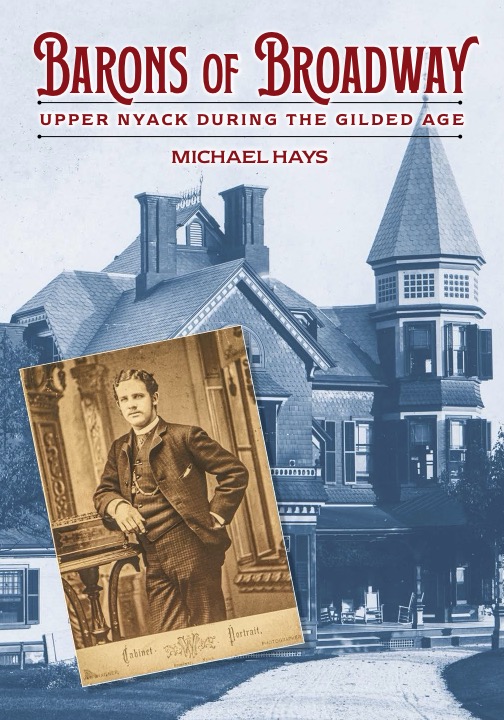
Barons of Broadway: Upper Nyack During the Gilded Age
Available at Pickwick Books, Historical Society of the Nyacks, and Amazon
About the author
Mike Hays has lived in the Nyacks for 38 years. After a career as an executive at McGraw-Hill Education in New York City, he now focuses on researching, writing, and interpreting local history.
He serves as Treasurer and past President of the Historical Society of the Nyacks. He is also a Trustee of the Edward Hopper House Museum & Study Center and Historian for the Village of Upper Nyack. In these roles, he works with community partners to preserve historic resources and expand public understanding of the area’s past.
Since 2017, he has written the popular Nyack People & Places column for Nyack News & Views. The series chronicles the history, architecture, and personalities of the lower Hudson Valley.
Hays has also developed museum exhibitions, written interpretive materials, and led well-attended walking tours that bring Nyack’s history to life.
He is married to Bernie Richey. He enjoys cycling, history walks, and winters in Florida. You can follow him on Instagram at @UpperNyackMike.
Editor’s note: This article is sponsored by Sun River Health and Ellis Sotheby’s International Realty. Sun River Health is a network of 43 Federally Qualified Health Centers (FQHCs) providing primary, dental, pediatric, OB-GYN, and behavioral health care to over 245,000 patients annually. Ellis Sotheby’s International Realty is the lower Hudson Valley’s Leader in Luxury. Located in the charming Hudson River village of Nyack, approximately 22 miles from New York City. Our agents are passionate about listing and selling extraordinary properties in the Lower Hudson Valley, including Rockland and Orange Counties, New York.