Commemorating the Battle’s 250th Anniversary
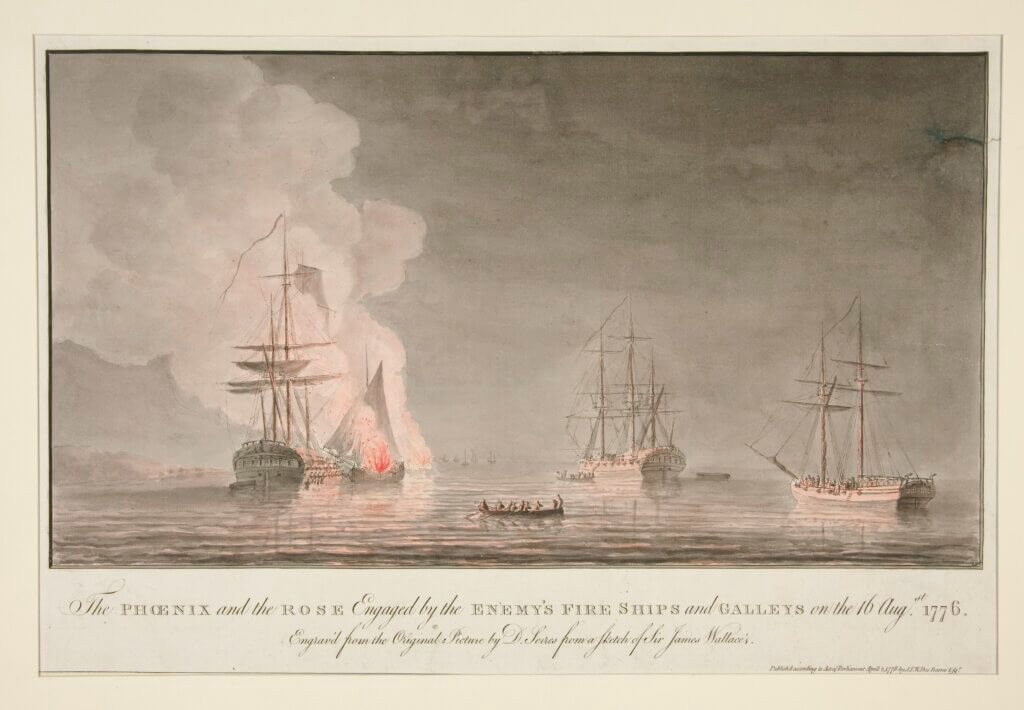
Residents along the western shore of the Tappan Zee were awakened during the night by cannon fire as one of the American Revolution’s earliest naval battles erupted on the Hudson River. Looking across the water, families watched Patriot fireships drift toward two British warships while flashes of cannon fire illuminated the night sky. For nearly two hours, Patriot boats battled Royal Navy warships in a desperate attempt to drive away the British squadron.
Today, even many Hudson Valley residents have never heard of the Battle of the Tappan Zee. Overshadowed by famous events such as Benedict Arnold’s treason and the Battle of Stony Point, this dramatic clash unfolded only five weeks after the Declaration of Independence and brought the Revolution to the doorsteps of Nyack’s earliest residents.
The Watch Begins
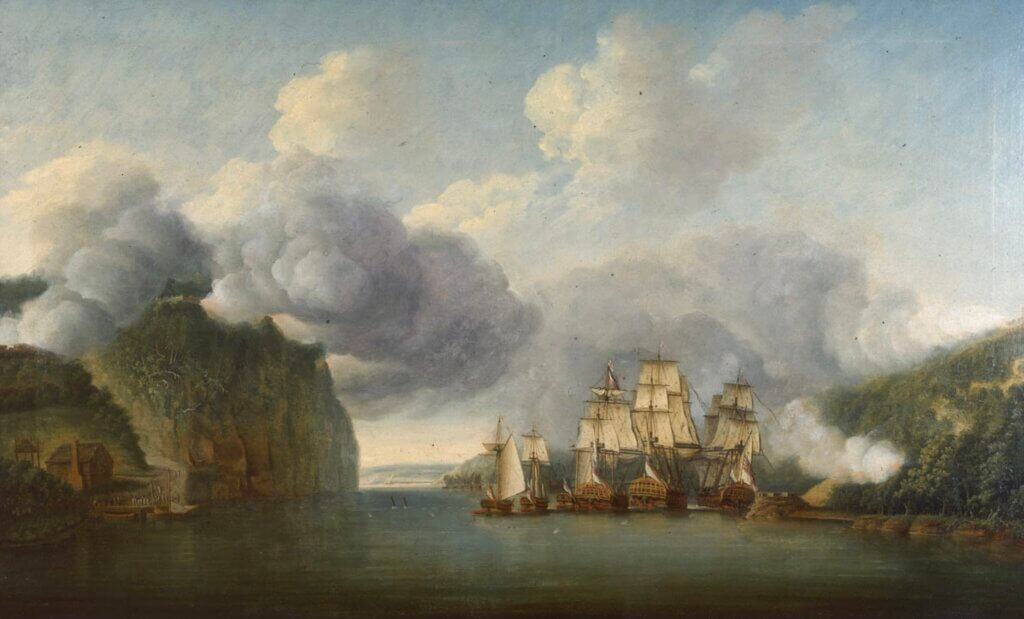
For more than a month before the battle of August 16, the British frigates Phoenix and Rose prowled the lower Hudson River. Having forced their way past American defenses at New York City on July 12, the two warships anchored in the Tappan Zee, where they threatened river traffic, gathered intelligence, and could send armed boats ashore almost anywhere along the western bank.
Responsibility for defending the western shore fell to Colonel Ann Hawkes Hay. Serving under his command were local militia officers and volunteers of the Shore Guard, a citizen force formed to watch the river, report British movements, and assemble whenever enemy boats threatened to land. Among them were Nyack residents Major John L. Smith, Captain Aury Smith, Captain Henry Palmer, Michael Cornelison, and their neighbors
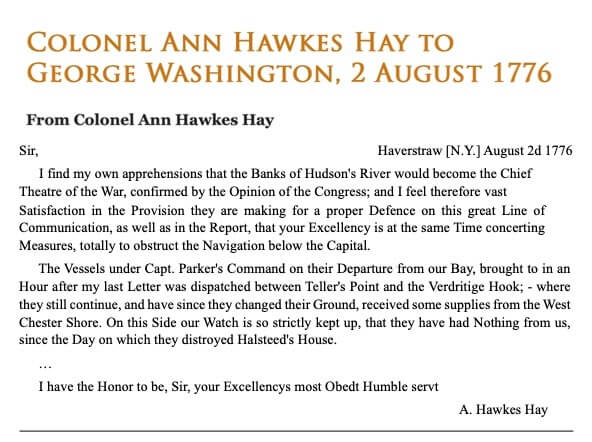
Hay recognized just how vulnerable the river communities had become. Writing to George Washington on August 2, 1776, he reported that British ships still occupied the Tappan Zee but proudly noted, “On this Side our Watch is so strictly kept up, that they have had Nothing from us…” The vigilance of the Shore Guard had denied the British supplies from the western shore, but Hay knew that constant watchfulness alone could not remove the threat.
The British Squadron
After anchoring below Croton Point, HMS Phoenix and HMS Rose dominated the Tappan Zee during the summer of 1776. The Phoenix, commanded by Captain Hyde Parker, was a powerful forty-four-gun frigate whose broadside far outmatched anything the Americans could place afloat on the Hudson. Her consort, the smaller twenty-gun Rose, commanded by Captain James Wallace, was faster and more maneuverable, making the two ships a formidable combination.
Wallace soon sent armed parties ashore near Tompkins Cove, where British sailors seized livestock from Jacob Halstead’s farm and burned nearby outbuildings. Similar raids could strike almost anywhere along the western shore.
For nearly three weeks after reaching the Tappan Zee, the British squadron faced only scattered resistance.
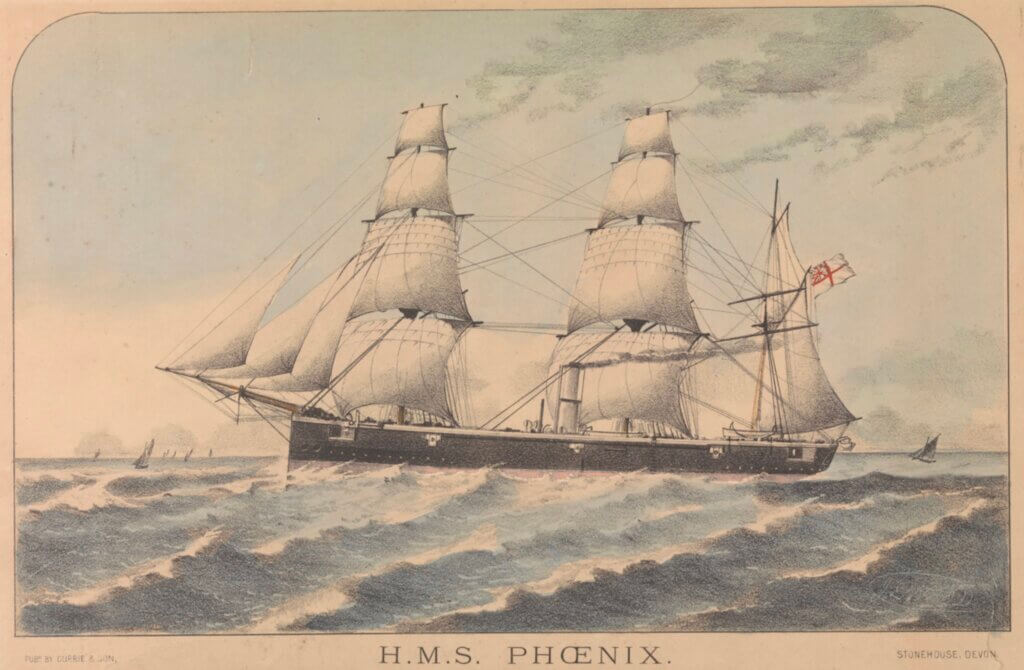
The forty-four-gun British frigate that led the squadron on the Hudson River in 1776.
Testing there British Squadron
On the afternoon of August 3, the uneasy standoff gave way to open battle.
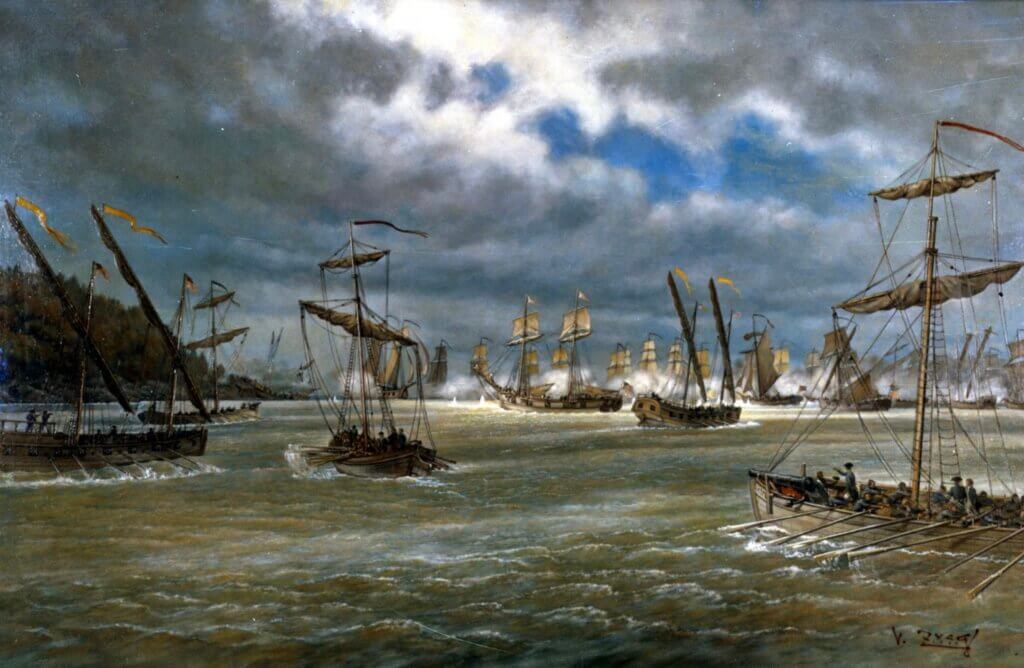
Five American row galleys, Lady Washington, Crown, Spitfire, Whiting, and Shark, advanced upriver under Lieutenant Colonel Benjamin Tupper. A veteran of the war from Massachusetts, Tupper commanded the gunboats on the Hudson River. Flying the new American colors, the flotilla boldly challenged the British squadron anchored near Croton Point.
“The Phenix(sic) fired the first gun,” Tupper later reported, “which was returned by the Lady Washington.”
For nearly two hours, the American galleys exchanged fire with Phoenix and Rose. Unlike the deep-draft British frigates, the shallow American vessels combined sails and oars, allowing them to maneuver quickly in the shifting winds and currents of the Tappan Zee. Although badly outgunned, they fought with surprising determination. One large cannon shot reportedly passed completely through the Phoenix, while many British cannonballs sailed harmlessly over the lower American craft.
Lessons of the First Battle
After nearly two hours of fighting, Benjamin Tupper withdrew his battered flotilla toward Dobbs Ferry. The Lady Washington‘s rigging had been badly damaged, the Spitfire lost one sailor killed and several wounded, the Shark suffered nine casualties, and one American cannon burst during the engagement.
Tactically, the British held the field. Strategically, however, the battle demonstrated that the Royal Navy could be challenged on the lower Hudson.
The engagement also exposed the weakness of the Patriot flotilla. Courage and accurate gunnery alone could not overcome the broadsides of British frigates.
American commanders began searching for a different weapon. They chose fire.
Preparing the Fireships
Unable to match the British squadron in conventional combat, American commanders turned to one of the oldest and most feared weapons of naval warfare: the fireship.
These expendable vessels were packed with tar, pitch, kindling, and gunpowder, then ignited and sent drifting toward enemy ships. If they could grapple onto an opponent, flames could race through the sails, rigging, and ammunition, destroying even the largest warship. Under cover of darkness, smoke, shifting tides, and confusion often proved as deadly as the fire itself.
Tupper organized the attack using a flotilla of row galleys, converted boats, and fireships. Their only chance lay in surprise, favorable tides, and the courage of crews willing to steer burning vessels toward the enemy before escaping in small boats.
A River of Fire
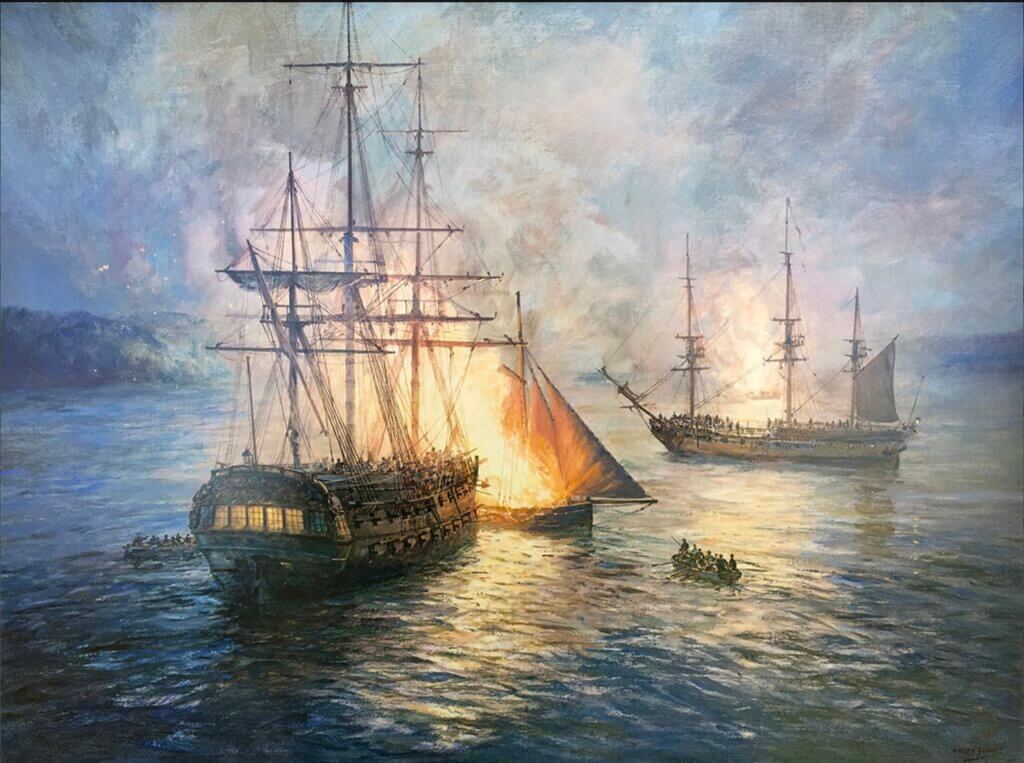
Late on the night of August 16, 1776, the American flotilla slipped north from Spuyten Duyvil, hugging the eastern shore as the rising tide carried the fireships toward the unsuspecting British squadron.
Watching from shore was Major General William Heath, a division commander reporting to Washington. He later described the eerie silence as the American boats drifted through the darkness. For several tense moments, almost nothing could be seen. Then came the familiar watch call from aboard the British ships:
“All is well.”
Seconds later, the night exploded.
Two American fireships drifted toward the British squadron. One, commanded by Thomas Thomas, struck the British tender Charlotte. Another, under Captain Silas Talbot, attacked the HMS Phoenix. Talbot came so close that the fireship’s jib boom passed over the Phoenix’s gunwale. Once the vessels became entangled, the attackers ignited the train, escaped through a hatch cut in the stern, and climbed into whale boats towed behind.
Panic swept the Phoenix. Captain Hyde Parker rushed to the quarterdeck shouting orders while sailors fought the flames. For nearly twenty terrifying minutes the fireship remained alongside the Phoenix. Sailors climbed high into the rigging, hacking desperately at grappling hooks while burning embers rained across the deck. Others cut the anchor cable and struggled to unfurl sails amid choking smoke and confusion.
Smoke and flame engulfed the river. As General William Heath later recalled, “The water was completely illuminated by the burst of combustibles.”
At last, the Phoenix broke free, however, the British tender Charlotte burned to the waterline. American forces later towed the wreck ashore and recovered cannon, swivels, gun barrels, cutlasses, grappling irons, chains, and other equipment from the burned vessel.
Once the British frigates regained maneuverability, their heavier broadsides began to tell. Several Patriot boats were damaged, and American casualties mounted as cannon fire tore through the lighter vessels. As the fighting subsided, the surviving American flotilla withdrew downriver.
After the Smoke Cleared
The Battle of the Tappan Zee ended without a decisive victor. George Washington initially viewed the attack as a disappointment. Writing to John Hancock on August 17, he reported that it “has not succeeded to our wishes.”
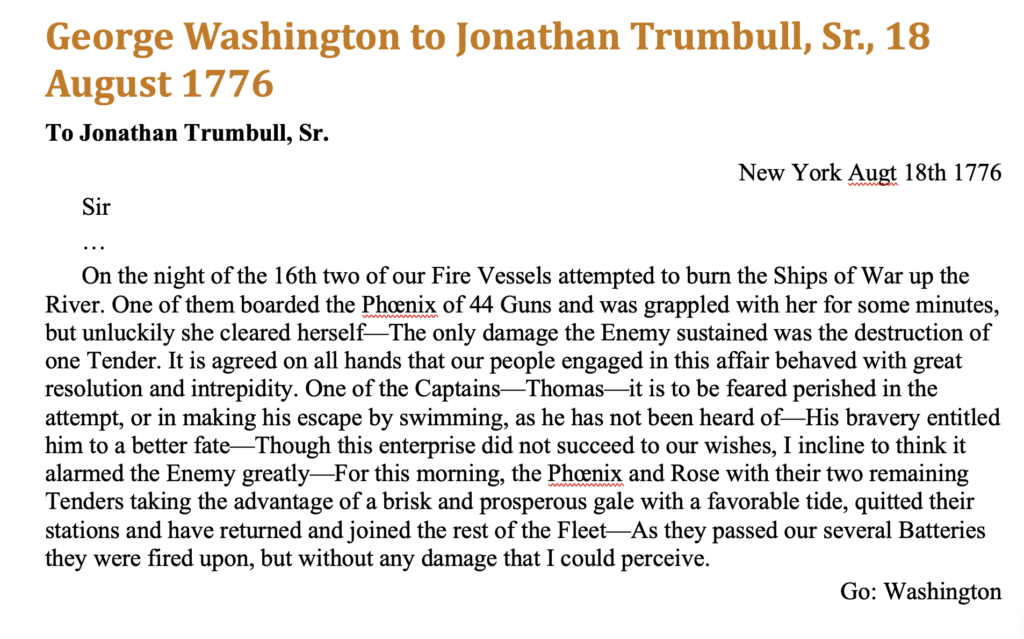
As additional reports reached headquarters, however, his assessment changed. The following day he informed Connecticut Governor Jonathan Trumbull, “I incline to think it alarmed the Enemy greatly.”
Washington’s judgment proved correct. In the same letter, he reported that Phoenix and Rose had taken advantage of a favorable wind and tide, abandoned their station near Croton Point, and rejoined the main British fleet farther south.
For the people of Nyack and the western shore, the British withdrawal brought only temporary relief. Major John Smith, Captain Aury Smith, Captain Henry Palmer, Michael Cornelison, and the Shore Guard remained on watch beneath Hook Mountain as British patrols continued to threaten the river communities.
The cannon fire that echoed across the Tappan Zee during August 1776 marked the beginning of six years of war along the Hudson. What had once been a river of commerce had become a contested frontier, where ordinary residents would continue to witness the Revolution from their own doorstep.
About the author
Mike Hays has lived in the Nyacks for 38 years. After a career as an executive at McGraw-Hill Education in New York City, he now focuses on researching, writing, and interpreting local history.
He serves as Treasurer and past President of the Historical Society of the Nyacks. He is also a Trustee of the Edward Hopper House Museum & Study Center and Historian for the Village of Upper Nyack. In these roles, he works with community partners to preserve historic resources and expand public understanding of the area’s past.
Since 2017, he has written the popular Nyack People & Places column for Nyack News & Views. The series chronicles the history, architecture, and personalities of the lower Hudson Valley.
Hays has also developed museum exhibitions, written interpretive materials, and led well-attended walking tours that bring Nyack’s history to life.
He is married to Bernie Richey. He enjoys cycling, history walks, and winters in Florida. You can follow him on Instagram at @UpperNyackMike.
Editor’s note: This article is sponsored by Sun River Health and Ellis Sotheby’s International Realty. Sun River Health is a network of 43 Federally Qualified Health Centers (FQHCs) providing primary, dental, pediatric, OB-GYN, and behavioral health care to over 245,000 patients annually. Ellis Sotheby’s International Realty is the lower Hudson Valley’s Leader in Luxury. Located in the charming Hudson River village of Nyack, approximately 22 miles from New York City. Our agents are passionate about listing and selling extraordinary properties in the Lower Hudson Valley, including Rockland and Orange Counties, New York.