Was the destruction of St. Joseph’s Seminary an accident — or an act of anti-Catholic hatred?
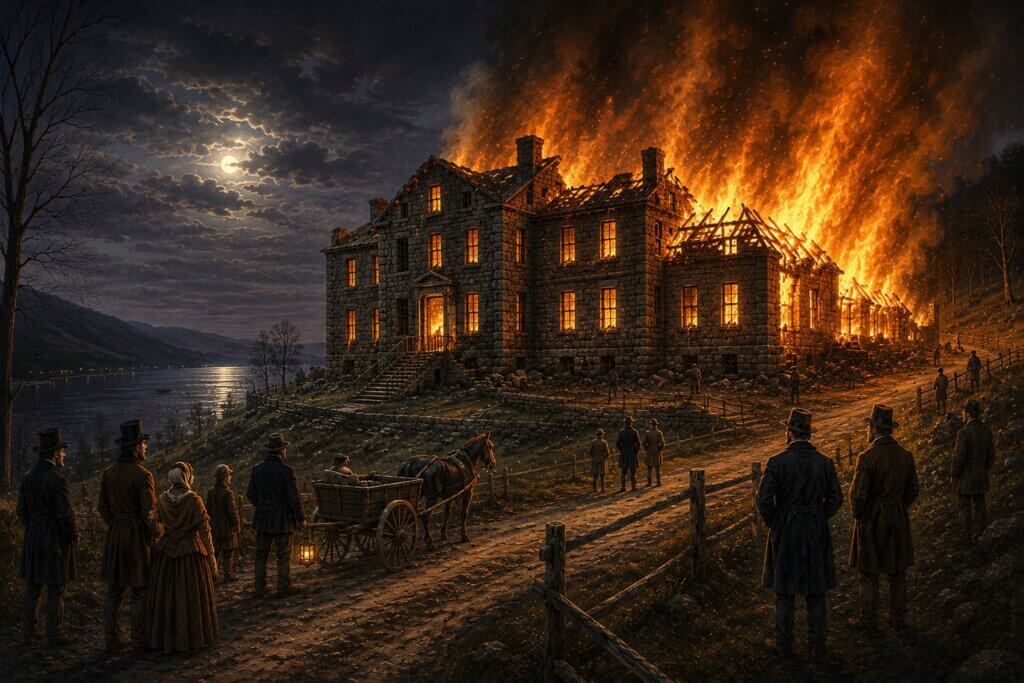
The unfinished Catholic institution burned just before opening, and local accounts later claimed cheers were heard when the roof collapsed. Reconstruction by author.
Flames lit the hillside above the Hudson as residents gathered along a narrow farm lane in rural Upper Nyack.
The great stone seminary rising between Broadway and the mountain had never even opened its doors.
Some came to help. Others reportedly cheered when the roof collapsed.
Nearly two centuries later, the destruction of St. Joseph’s Seminary remains one of the most mysterious and forgotten events in Nyack history. Was the fire simply a tragic accident? Or was it the result of anti-Catholic hatred in a deeply Protestant community uneasy about change?
Today no trace of the seminary remains. Yet for a brief moment in the 1830s, Upper Nyack nearly became the center of Catholic education in the Hudson Valley.
A Protestant River Village
In the early 1830s, Nyack was still little more than a rural river settlement.
Upper Nyack contained only a handful of farms stretching between the Hudson River and Hook Mountain. Most local families descended from Dutch Protestant settlers, English Puritans, and French Huguenots who had arrived generations earlier. Churches were more than places of worship. They served as the social and cultural centers of their communities.
Only a short distance from the future seminary site stood the Old Stone Meeting House, built in 1814 by a newly formed Methodist congregation. At the time, it was one of the few churches in the area and represented the growing influence of organized Protestant religion in the young village.

Built in 1814, the Old Stone Meeting House stood only a short distance from the proposed seminary. In the 1830s, churches served as the social centers of small Hudson River communities like Upper Nyack. Courtesy of the Nyack Library.
Into this deeply Protestant landscape stepped Bishop John Dubois.
Bishop Dubois Arrives
Dubois was an unlikely figure to reshape religious life in Rockland County. Born in France, he fled the violence and religious persecution of the French Revolution and emigrated to America in 1791. He eventually became the third Roman Catholic bishop of New York and the first non-Irish bishop of the diocese.
Ironically, a man who escaped religious intolerance in Europe soon encountered suspicion again in America.
Many Protestants in the United States viewed Catholicism as foreign and dangerous. Anti-Catholic prejudice grew during the 1830s as Irish and German Catholic immigrants arrived in increasing numbers. Riots, church burnings, and attacks on Catholic institutions occurred in several American cities.
Rockland County was no exception.
Writing decades later, historian Frank Green described the county as intensely conservative and deeply suspicious of Catholicism. He noted that many local residents viewed the Roman Catholic Church as “the abomination of abominations” and the Pope as “Anti-Christ.”
According to Green, old fears carried across generations still shaped local attitudes:
“Tales of homes abandoned in the night… of sudden change from affluence to poverty… were still fresh in their minds.”
Frank Green, The History of Rockland County
Even many residents with no strong religious affiliation opposed the idea of a large Catholic institution in the community.
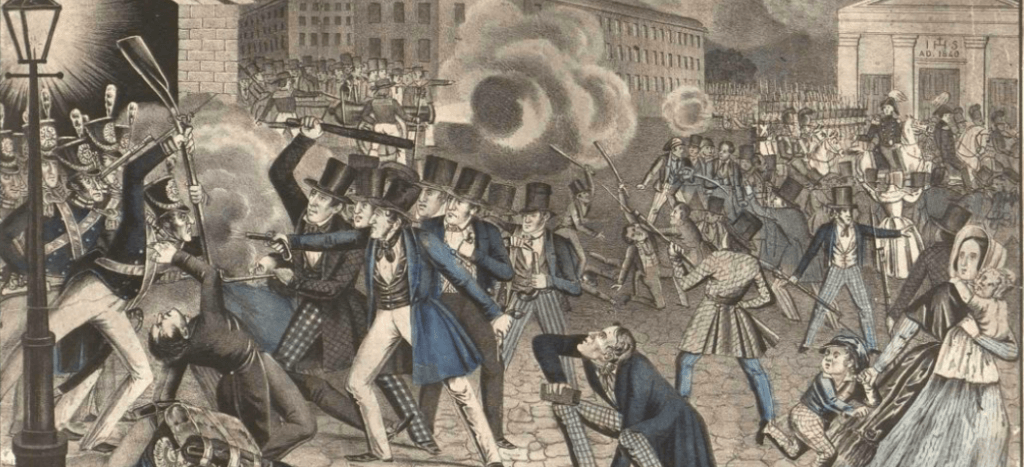
Anti-Catholic riots and attacks on Catholic institutions spread across parts of the United States during the 1830s and 1840s. Similar tensions shadowed the proposed seminary in Upper Nyack. Courtesy of the Historical Society of Pennsylvania.
A Seminary on the Hillside
Despite the hostility, Dubois saw opportunity in Nyack.
The riverside quarry industry was expanding rapidly, and he believed Catholic immigrant laborers would soon arrive in large numbers. In 1832, Dubois purchased 162 acres from the heirs of William Perry. The property stretched from the Hudson River west toward Hook Mountain and included farmland once associated with the old Aury Smith estate.
A rough farm lane crossed the property. That lane would later become Lexow Avenue.
Construction of St. Joseph’s Seminary began the following year. The stone for the building was quarried directly from the hillside. Local lumber was brought in from Nyack yards. The massive three-story structure measured roughly eighty feet long and forty feet deep, with a central section and two wings capped by a vaulted slate roof.
For rural Upper Nyack, the building must have seemed enormous.
Rising above open fields and scattered farmhouses, the seminary dwarfed nearby churches and homes. It may have been one of the largest institutional buildings ever attempted in Nyack up to that time.
The project was ambitious in both scale and purpose. According to later Catholic histories, Bishop Dubois envisioned the Nyack institution as New York’s first seminary and modeled it after Mount St. Mary’s Seminary in Emmitsburg, Maryland, one of the leading Catholic schools in America at the time.
The cornerstone was reportedly laid on May 29, 1833. Plans called for a combined theological and collegiate institution that would educate future priests for the growing Catholic population of New York State.
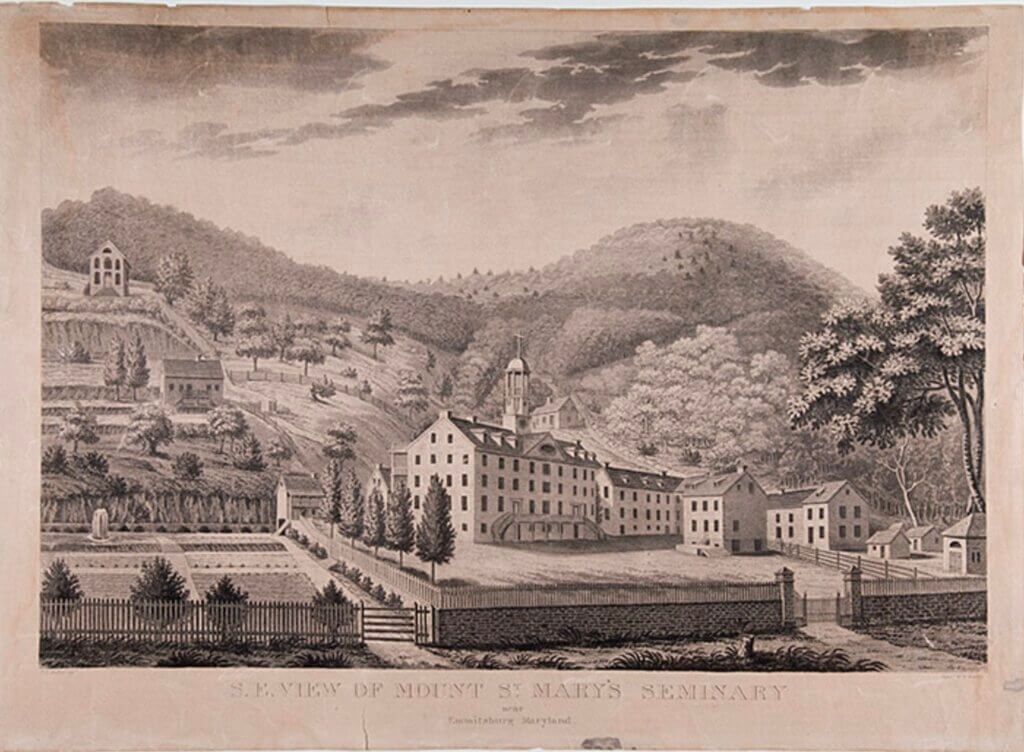
Catholic histories later stated that Bishop John Dubois modeled the proposed Nyack seminary after the Maryland institution.
The project also marked another milestone. The first Catholic Mass ever celebrated in Rockland County took place in a small house on the property near Broadway. For a short time, a school operated there under Father John McCloskey, later the first American cardinal.
For Dubois, the isolated hillside in Upper Nyack represented the beginning of a permanent Catholic presence in Rockland County.
Then came the fire.
The Night the Seminary Burned
By 1838, the seminary neared completion. Workers were finishing the interior joinery when fire suddenly erupted in the south wing.
The flames spread rapidly through piles of dry wood shavings stacked inside the unfinished building. Nyack possessed only primitive firefighting equipment at the time. The village’s lone fire company, located more than two miles away, operated a hand-powered “bucket” engine with no effective alarm system.
Once the fire gained momentum, there was little hope of saving the structure.
According to Frank Green, the bitterness surrounding the seminary was so intense that “cheers were heard when the roof fell in.”
That reaction fueled immediate suspicion among local Catholics that the fire had been deliberately set.
The timing certainly encouraged rumors. Anti-Catholic violence elsewhere in America was already becoming common. In 1834, only a few years before the Upper Nyack fire, an anti-Catholic mob burned the Ursuline convent near Boston. A decade later, riots in Philadelphia would destroy Catholic churches and schools.
Was Upper Nyack another example?
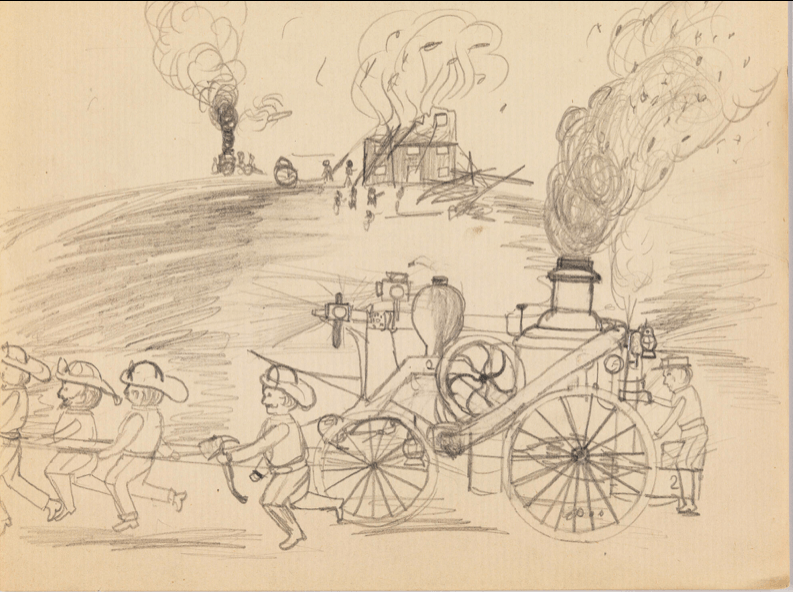
In this early, boyhood sketch by Nyack artist Edward Hopper, firefighters pull a hand-powered engine uphill to a fire in the 1890s. Equipment in the seminary era was even more primitive, making the blaze nearly impossible to stop. Courtesy of the Whitney Museum of American Art.
Accident or Arson?
Forty years after the fire, Frank Green attempted to investigate what had happened.
Interviewing both Protestants and Catholics who either witnessed the blaze or worked on the building, Green concluded that the fire may have begun accidentally.
According to his account, one of the mechanics had removed the inner box from a glue pot to boil eggs for dinner over a small fire in one of the unfinished rooms. The floor was covered with wood shavings six inches to a foot deep. Doors and window sashes leaned against the walls nearby.
The worker reportedly stepped away for a few moments. When he returned, the shavings had ignited and flames were spreading rapidly across the room.
In panic, he attempted to smother the fire by throwing a door onto the burning pile. Instead, the rush of air scattered the flaming shavings across the room and the entire wing burst into flames.
Green believed the explanation was credible.
Yet even he acknowledged the powerful hostility surrounding the project. The cheering crowd, the widespread anti-Catholic prejudice, and the destruction of Catholic institutions elsewhere in America left many unconvinced.
Nearly two centuries later, the truth remains uncertain.
The Seminary That Vanished
The fire effectively ended Catholic ambitions in Upper Nyack for a generation.
The intense heat cracked and warped the stone walls. Faced with rebuilding costs and continuing hostility, Bishop Dubois abandoned the project.
Yet the seminary did not entirely disappear.
According to later Catholic accounts, laborers dismantled the ruined brownstone walls and shipped the stone to Brooklyn for another planned diocesan seminary. Frank Green later confirmed that the walls were taken down and the stone removed from Nyack, although he could not determine exactly where it was ultimately used.
Piece by piece, the failed seminary vanished from the Upper Nyack hillside. Its stones disappeared into another city and another chapter of Catholic history.
For years, the foundations reportedly remained visible south of Lexow Avenue. Today, no trace survives.
By the 1860s, the Catholic population in Nyack had grown enough to support a permanent parish. In 1870, St. Ann’s Church opened on Jefferson Street, a sign that attitudes toward Catholics had gradually begun to change in the village.
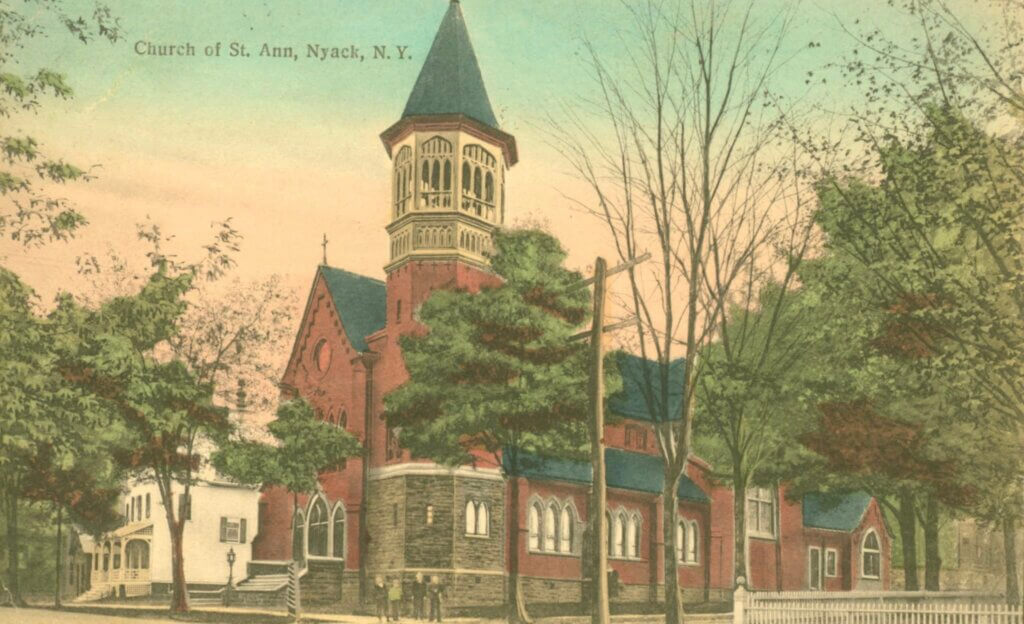
St. Ann’s Church on Jefferson Street opened in 1870. More than three decades after the seminary fire, Catholics had established a permanent and accepted presence in Nyack. Courtesy of the Nyack Library.
The church that finally took root in Nyack stood far from the vanished seminary on the Upper Nyack hillside.
But the memory of the fire endured.
In another version of history, Upper Nyack might have become the religious center of Catholic Rockland County. Instead, the great stone seminary disappeared almost as quickly as it appeared — leaving behind only rumors, scattered stones, and one lingering mystery.
About the author
Mike Hays has lived in the Nyacks for 38 years. After a career as an executive at McGraw-Hill Education in New York City, he now focuses on researching, writing, and interpreting local history.
He serves as Treasurer and past President of the Historical Society of the Nyacks. He is also a Trustee of the Edward Hopper House Museum & Study Center and Historian for the Village of Upper Nyack. In these roles, he works with community partners to preserve historic resources and expand public understanding of the area’s past.
Since 2017, he has written the popular Nyack People & Places column for Nyack News & Views. The series chronicles the history, architecture, and personalities of the lower Hudson Valley.
Hays has also developed museum exhibitions, written interpretive materials, and led well-attended walking tours that bring Nyack’s history to life.
He is married to Bernie Richey. He enjoys cycling, history walks, and winters in Florida. You can follow him on Instagram at @UpperNyackMike
Editor’s note: This article is sponsored by Sun River Health and Ellis Sotheby’s International Realty. Sun River Health is a network of 43 Federally Qualified Health Centers (FQHCs) providing primary, dental, pediatric, OB-GYN, and behavioral health care to over 245,000 patients annually. Ellis Sotheby’s International Realty is the lower Hudson Valley’s Leader in Luxury. Located in the charming Hudson River village of Nyack, approximately 22 miles from New York City. Our agents are passionate about listing and selling extraordinary properties in the Lower Hudson Valley, including Rockland and Orange Counties, New York.