A devastating factory explosion killed workers and shook the village. Yet the disaster may also have spared Nyack’s waterfront from decades of industrial pollution.
“The explosion shook the entire village and sent windows crashing from buildings along Broadway.”
— Nyack Evening Journal, January 31, 1919
January 31, 1919, began as an ordinary winter morning in Nyack. Workers reported to factories along the railroad tracks, students filled classrooms at Liberty Street School, and printers prepared the next edition of the Nyack Evening Journal.
Then the village shook.
Arthur Halliman, foreman of the Journal, suddenly felt the newspaper office tremble. The building stood only two blocks from the American Aniline Products Corporation factory.
“Then I heard a loud crash,” he later recalled. “All the windows flew out, not just the glass but the frames too.”
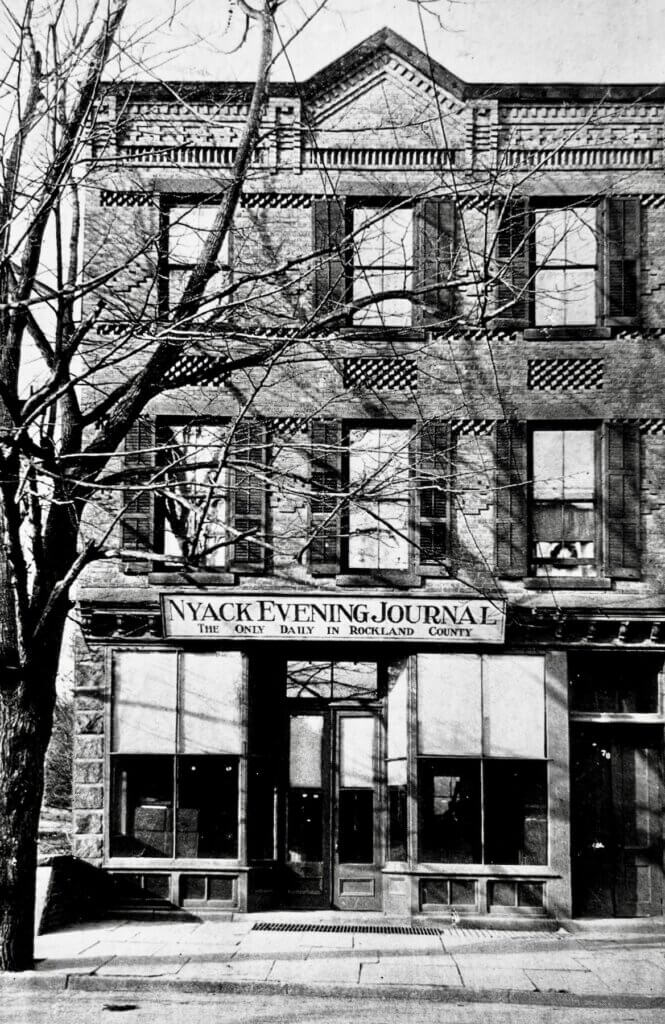
The newspaper office stood only two blocks from the American Aniline Products factory and the building still stands today. Foreman Arthur Halliman felt the building shake violently when the explosion rocked the village. From Nyack and Vicinity in Pictures, 1925.
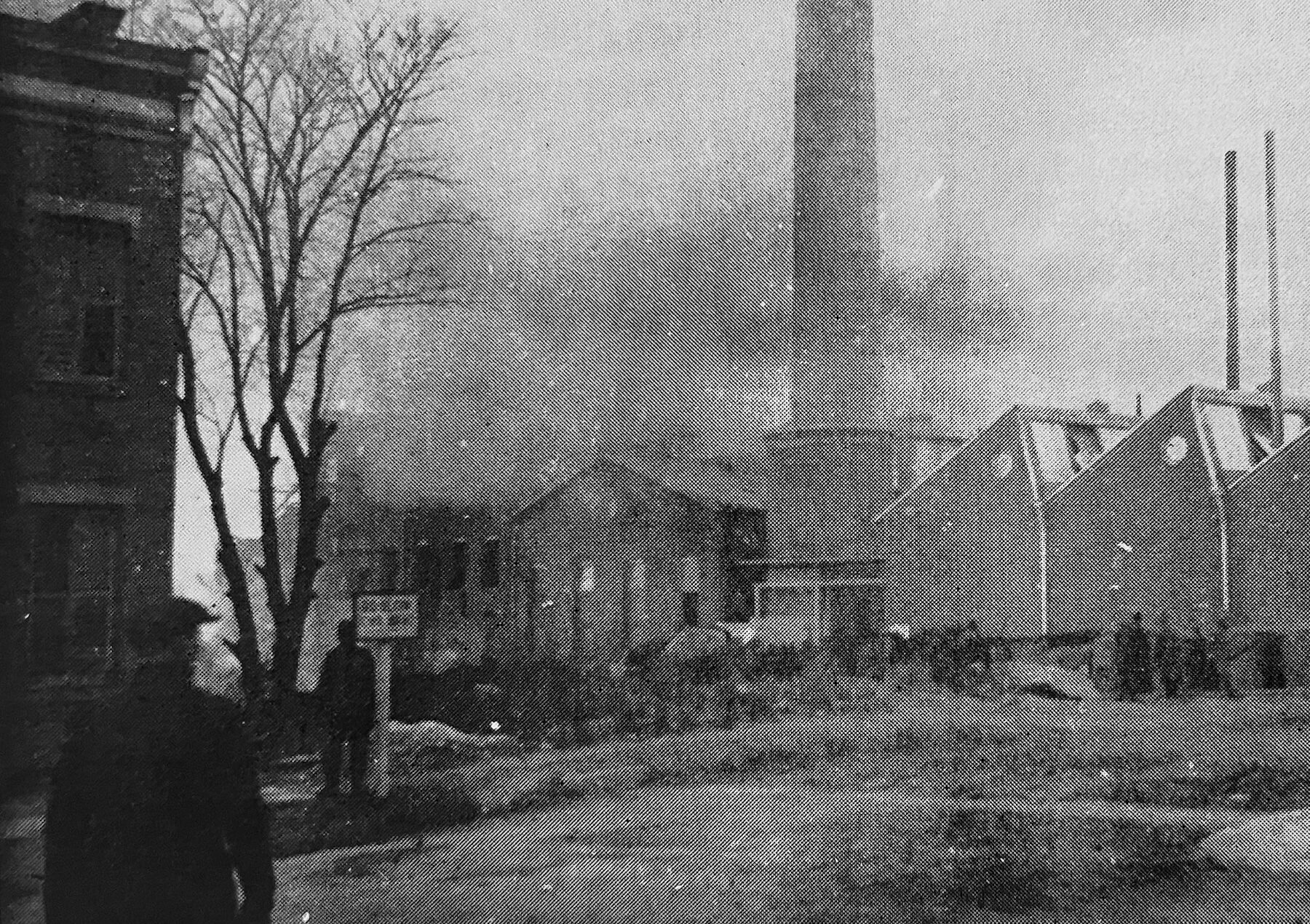
The first blast destroyed the south side of the American Aniline Products plant along Cedar Hill Avenue. Explosions continued through the morning, tearing through the Hudson, Railroad, and Florence Avenue sides of the building. The blasts killed at least two workers, injured thirteen others, and reduced the three-story factory to burning ruins on the site where the Pavion apartments stand today.
Meanwhile alarming rumors quickly spread through the village. Some commuters in New York City even heard that the nearby Liberty Street School had collapsed.
Fortunately, those rumors proved false.
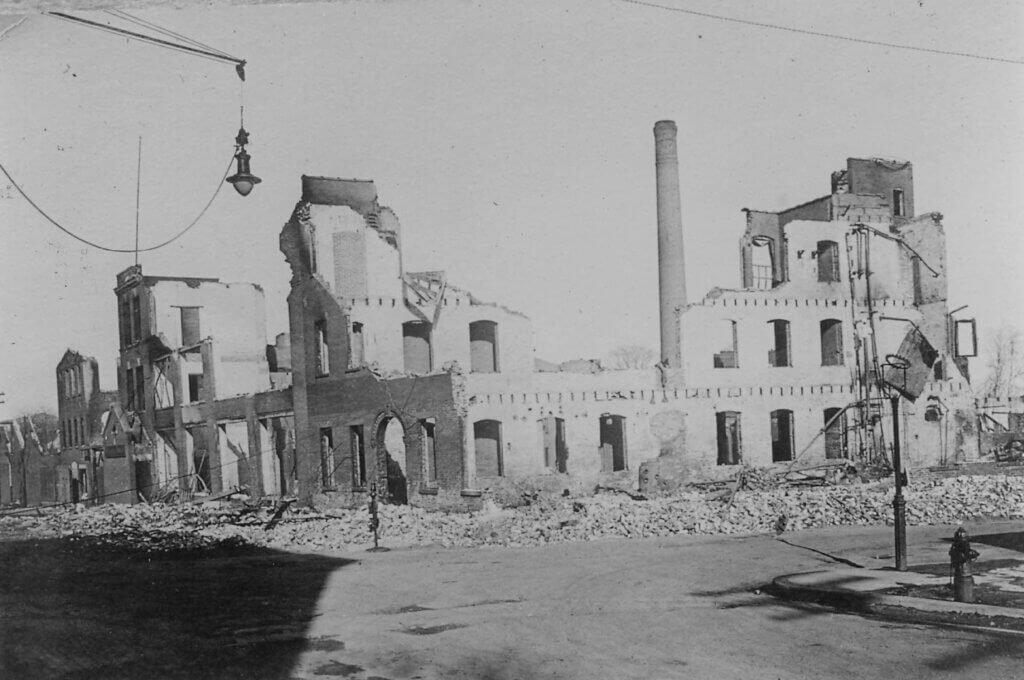
A view of the destroyed plant from the intersection of Cedar Hill and Railroad Avenues. The 125-foot chimney remained standing above the rubble after the explosion and fire. Courtesy of the Nyack Library.
A Remarkable Silver Lining
Remarkably the disaster carried an unexpected silver lining. In fact, there were three.
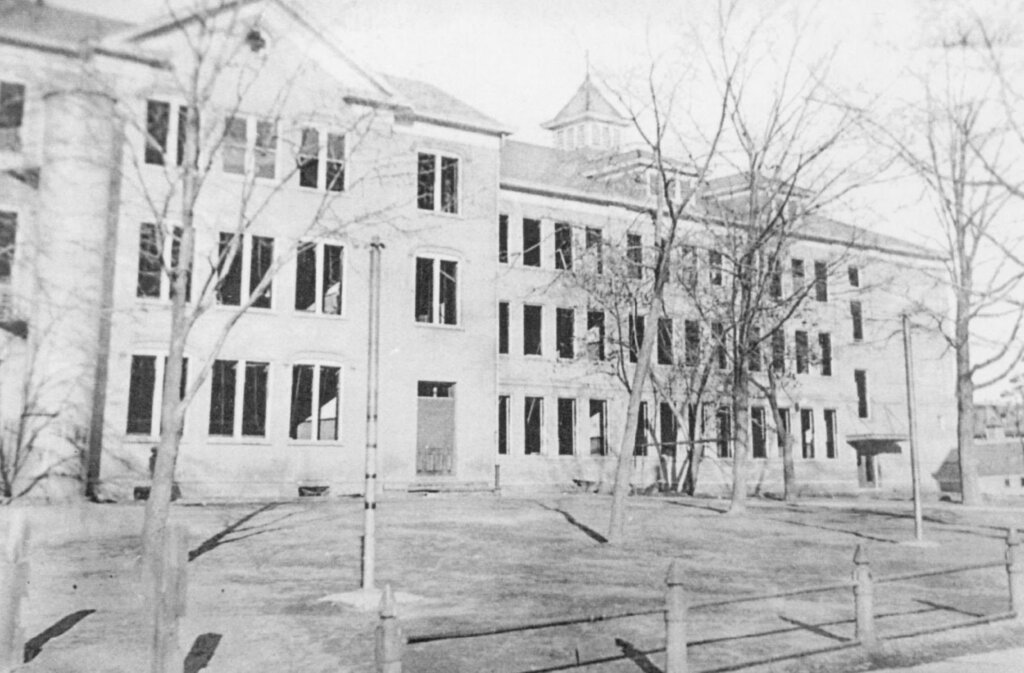
More than 1,200 students were inside when the explosion shattered the windows and cracked the walls. Courtesy of the Nyack Library.
First, the 9:30 a.m. explosion shattered the windows of Liberty Street School and cracked several walls. Yet the roof held. Teachers calmly evacuated more than 1,200 students, and only one child suffered a minor injury from flying glass.
Second, the Nyack Fire Department had already prepared for a possible chemical accident. Chief Harry Williams studied the plant and ordered gas masks for his firefighters. Because of that preparation, crews responded quickly. However, falling walls covered shutoff valves, and nearby hydrants produced only a feeble stream. Firefighters were forced to abandon one building after another as explosions continued. Despite these challenges, they prevented the blaze from spreading into nearby neighborhoods.
Third, the American Aniline Products Company plant operated in Nyack for less than a year. The company had received approval from the village to build pipelines to the Hudson River. Although the pipelines were never built, they could have been used to ship aniline dyes by tanker or to discharge toxic byproducts from the manufacturing process that would otherwise have entered the Nyack sewer system. Aniline dye production generates highly toxic compounds that can persist in river sediments for years. After the explosion, the company never returned. In retrospect, the disaster may have spared the village from decades of industrial pollution along the Hudson River shoreline.
What Are Aniline Dyes?
Aniline is a chemical derived from coal tar, a waste product produced from gas manufacturing. Although the substance smells strongly of rotten fish, chemists discovered in 1856 that acids could transform it into brightly colored dyes.
Soon afterward scientists developed a wide range of synthetic colors that quickly replaced dyes made from plants and insects. German chemical companies such as BASF, Bayer, and AGFA soon dominated the global market.
Meanwhile chemists discovered that coal tar derivatives could produce new medicines. Aspirin emerged from that research, and the modern pharmaceutical industry began to take shape.
While dye production reused coal tar, a waste product, it also generated its own toxic byproducts, including benzene based compounds and other hazardous chemicals.
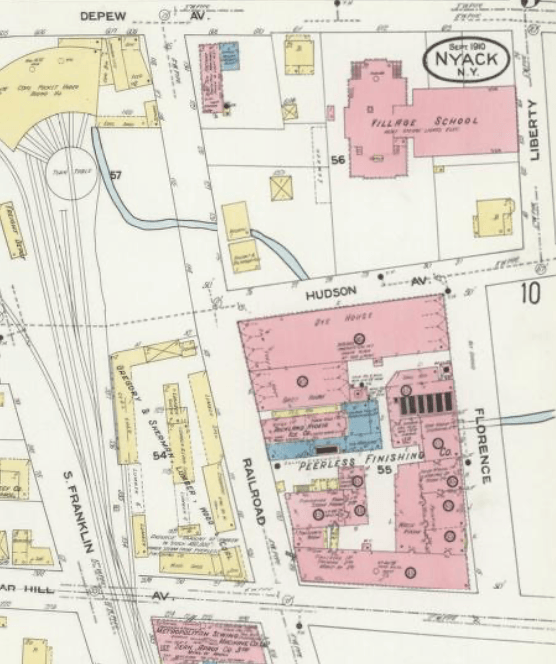
The industrial complex stands one block east of the railroad tracks near Nyack Brook. Liberty Street School appears at upper right. Courtesy of the Library of Congress.
How the Plant Came to Nyack
World War I dramatically changed the dye industry. Once the war began German dyes no longer reached Allied markets. As a result, American entrepreneurs rushed to establish domestic production.
The Hudson River Valley soon attracted several start-up chemical companies, drawn by river access, rail connections, and available industrial plants.
Nyack already had a suitable industrial plant. The Peerless Finishing Company, a large textile printing and dye works, expanded the original 1877 three-story Jackman shoe factory on Cedar Hill. The expanded, multi-story building included a distinctive louvered roof that allowed natural light to enter the factory.
However poor management forced the company into default in 1912.
In January 1918 the Nyack Village Board approved an application by the American Aniline Products Company to acquire the property. The company also received permission to build a rail spur and two pipelines to the Hudson River for transporting petroleum and other chemicals.
Warnings Before the Explosion
Across the country industrial accidents were becoming a grim feature of the new chemical age. Just two weeks earlier a Boston molasses tank failure killed twenty-one people when a massive storage tank burst and flooded a neighborhood.
Meanwhile closer to home the Standard Aniline Products Company plant in Wappingers Falls exploded in 1916 with the force of an earthquake. The blast killed a worker and destroyed the factory in the fire that followed.The disaster revealed the dangers of the new chemical industry spreading along the Hudson River.
Yet only two years later Nyack welcomed its own aniline dye plant. Smaller fires soon broke out at the Nyack facility during 1918. These incidents caught the attention of the nearby fire department.
Chief Harry Williams carefully studied the layout of the plant and its hazardous chemicals. Anticipating trouble, he ordered gas masks and strict procedures for responding to fires at the factory.
Those precautions soon proved critical.
Explosion, Fire, and Fear
At 9:30 a.m. an explosion erupted in the dye works section facing Cedar Hill Avenue. About one hundred people were inside the plant.
Within minutes a column of smoke rose above the railroad yards, visible across the village and along the Hudson River shoreline.
The photograph shows the east side of the factory and its towering chimney as the fire spread through the buildings. The building at left, 45 Hudson Avenue, still stands today. The burning chemicals produced the colored flames later described by witnesses. From Nyack Fire Department 125th Anniversary Commemorative History, 1988.
One of the company’s chemists, H. A. Nakamura, was pulled from the wreckage but later died at Nyack Hospital. Another worker, Louis Yashima, and possibly one additional employee were blown apart in the blast.
Rescuers carried injured workers from the burning structure and rushed them to the nearby Metropolitan Machine Company diagonally across Railroad Avenue.
Within minutes flames engulfed the factory. Explosions continued as chemicals ignited inside the building. Around 10:15 a.m. another powerful blast shook the neighborhood.
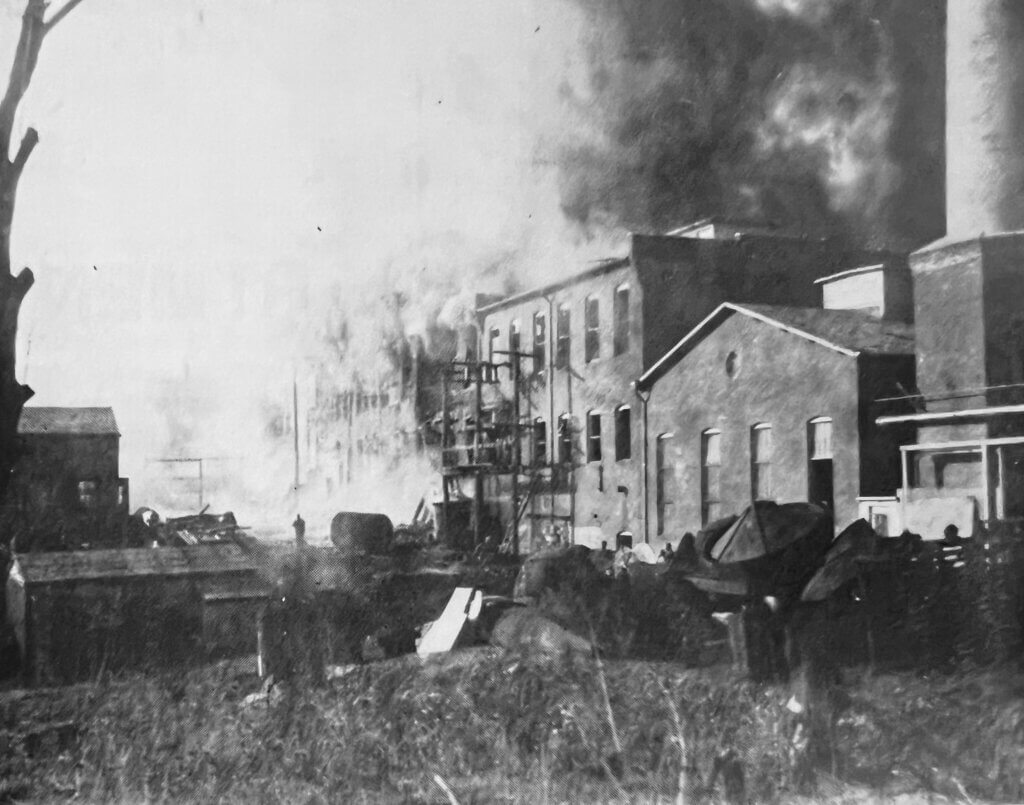
Large sections of the plant remained standing as thick smoke poured from the buildings during the fire that followed the explosion. From Nyack Fire Department 125th Anniversary Commemorative History, 1988.
Meanwhile burning debris ignited several nearby structures. Embers started fires in nearby homes and in the abandoned Shoddy Mill along the Hudson River.
Despite the chaos the Nyack Evening Journal still published its evening edition describing the disaster.
“Witnesses described flames of many colors rising from the burning factory. Greens, blues, and yellows appeared as the chemicals used to produce aniline dyes ignited in the fire.”
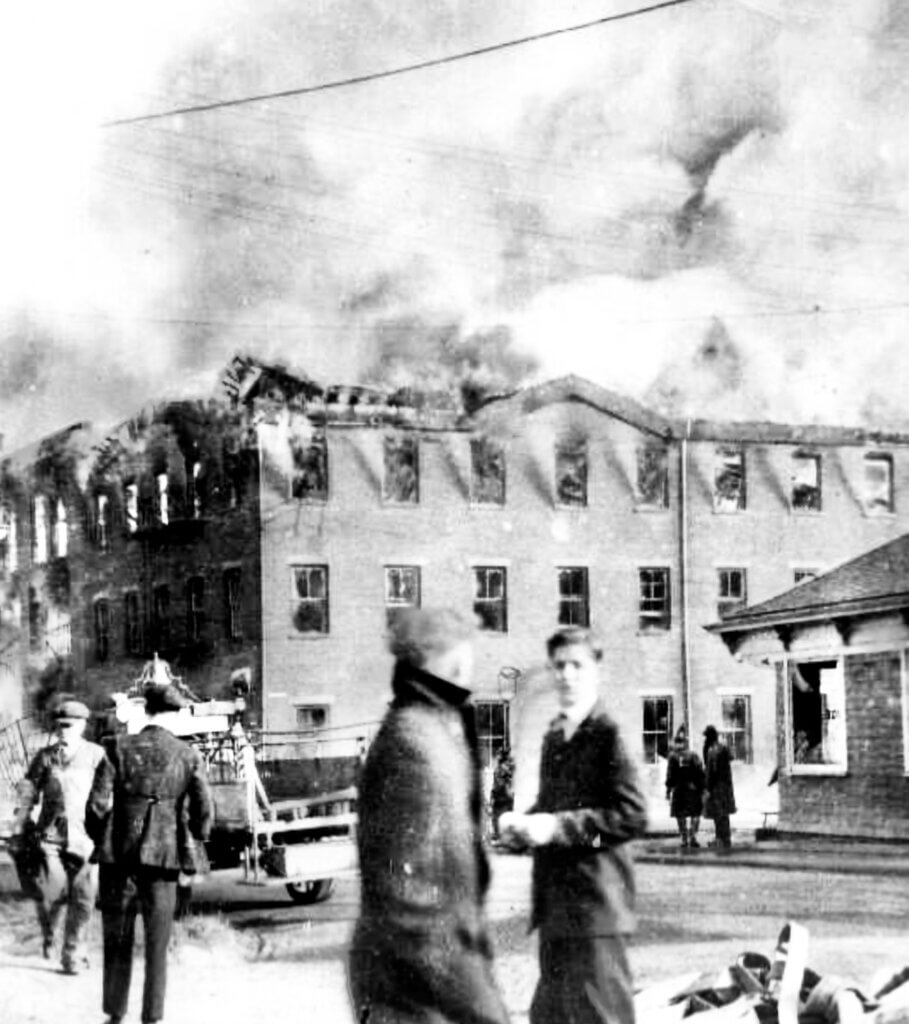
Residents gathered at a distance as flames and smoke consumed the American Aniline Products factory. Courtesy of the Nyack Library.
Firefighters Battle the Blaze
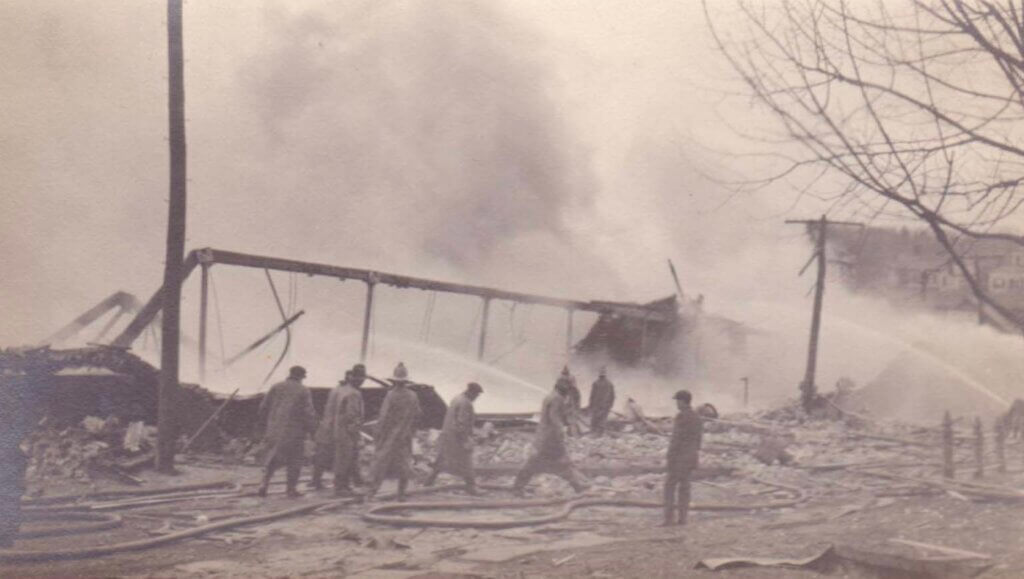
Crews from Nyack, Sparkill, and Piermont fought the fire for hours as collapsing walls forced repeated retreats. Courtesy of the Historical Society of Rockland County.
Firefighters from Nyack, Sparkill, and Piermont soon arrived to battle the blaze. However, collapsing walls repeatedly forced them to retreat from the factory buildings. Bricks and debris buried many water mains. As a result, firefighters stretched hose nearly 1,000 feet to reach water supplies.
Meanwhile police and firemen ran and drove through the village urging residents to open windows and stay away from flying glass. By 3 p.m. firefighters finally brought the fire under control. Crews continued to watch the smoking ruins for several days.
Soon afterward hundreds of villagers visited the site to see the destruction firsthand.
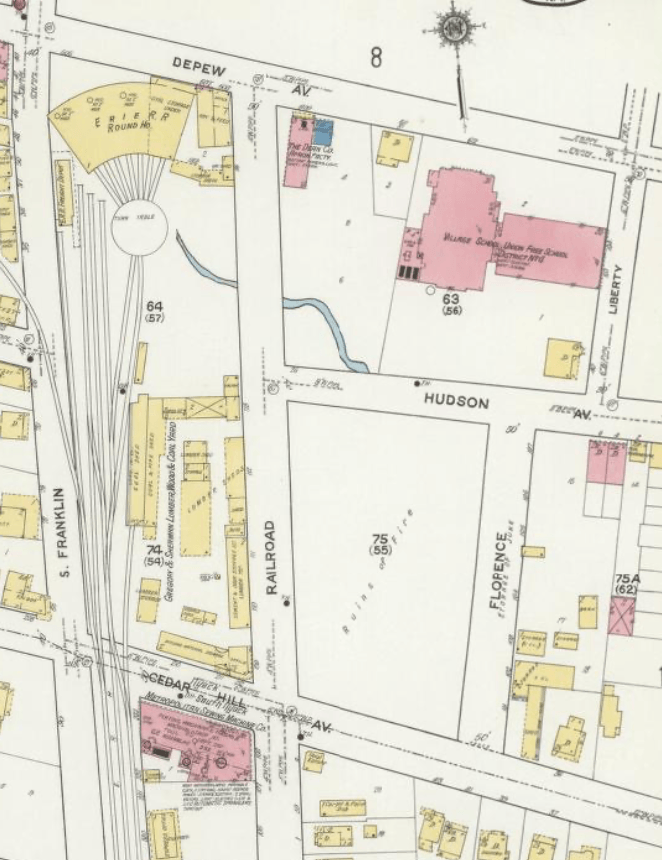
Where a large industrial complex once stood near the railroad tracks, the map now records the block simply as “ruins.” Courtesy of the Library of Congress.
Before and After: January 31, 1919
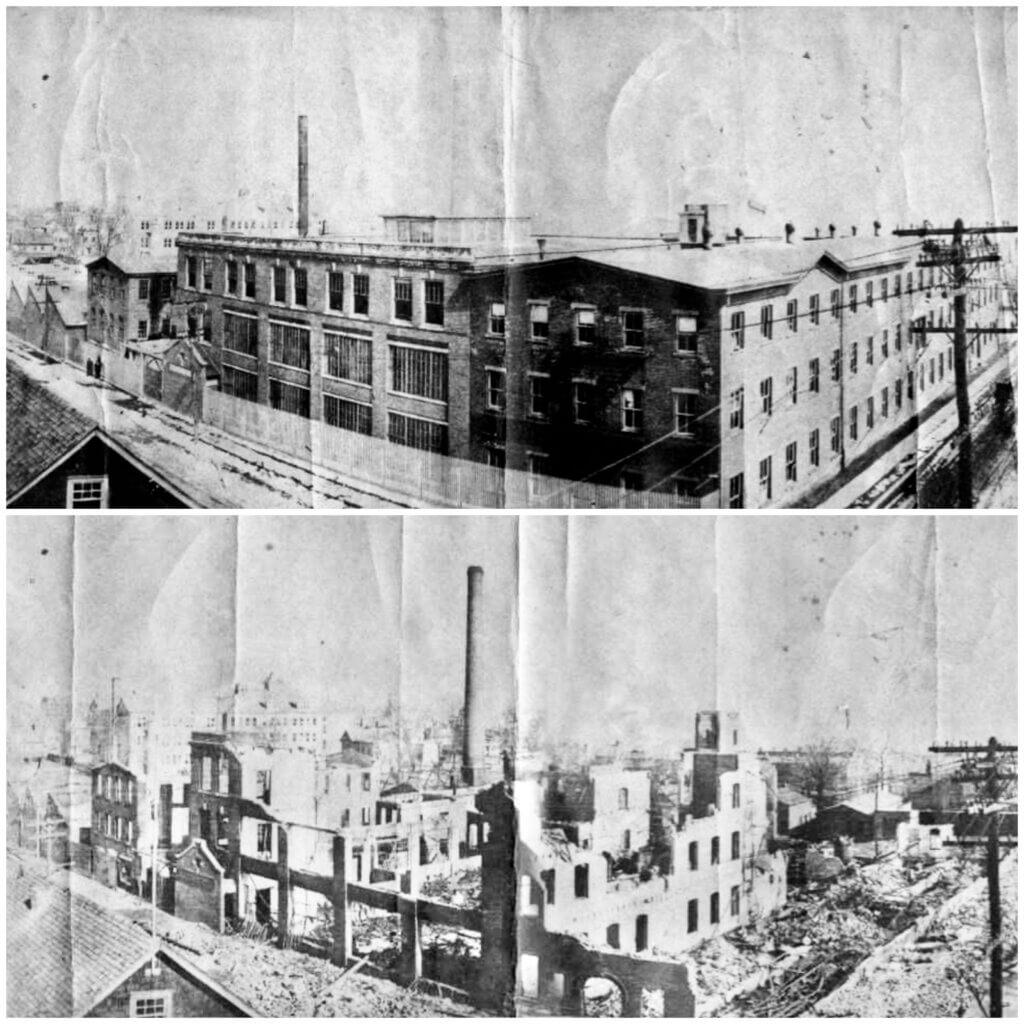
Top: The American Aniline Products factory buildings stand intact along Cedar Hill Avenue circa 1903. Bottom: The same view after the January 31, 1919 explosion shows the complex reduced to rubble, with only the chimney and fragments remaining. Both images were taken from the Metropolitan Sewing Machine Company building, diagonally across the intersection of Cedar Hill and Railroad Avenues. Liberty Street School appears in the background of both images. Courtesy of the Nyack Library.
The Morning Nyack Shook: January 31, 1919
9:30 a.m. First Explosion
A violent blast erupts in the dye works section of the American Aniline factory.
Moments Later Factory Engulfed in Flames
Fire spreads rapidly through the multi-story plant.
Shortly After Liberty Street School Evacuated
Teachers lead more than 1,200 students safely out of the building.
Around 10:15 a.m. Second Major Explosion
Another powerful blast shakes the village.
Late Morning Nearby Fires Ignite
Embers ignite fires in nearby homes and in the abandoned Shoddy Mill.
3:00 p.m. Fire Under Control
Firefighters finally contain the blaze after hours of work.
Evening Newspaper Prints the Story
The Nyack Evening Journal publishes its account of the disaster.
The Long-Term Silver Lining
Careless plant management and unstable chemical reactions produced a devastating explosion. Yet the disaster may also have spared Nyack from another fate.
The pipelines approved for the factory might have carried toxic industrial chemicals directly to the Hudson River that otherwise would have been dumped into the sewer system. Similar chemical plants later created environmental disasters in places such as Toms River, New Jersey.
Instead, the American Aniline Products factory disappeared from Nyack after less than a year in operation, and the company remained embroiled in court cases for years.
On that winter morning in 1919 the blast shook every corner of the village. In the long run however, it may also have protected the community that survived it.
Special Thanks to Andrew Goodwillie
Andrew Goodwillie, trustee of the Historical Society of the Nyacks and an expert on the explosion, provided valuable comments on this article and helped me identify the exact locations shown in these photographs.
Mike Hays has lived in the Nyacks for 38 years. Following a career as an executive at McGraw-Hill Education in New York City, he now devotes much of his time to researching, writing, and interpreting local history.
He serves as Treasurer and past President of the Historical Society of the Nyacks, a Trustee of the Edward Hopper House Museum & Study Center, and Historian for the Village of Upper Nyack. In these roles, he works closely with community partners to preserve historic resources and expand public understanding of the area’s past.
Since 2017, he has written the popular Nyack People & Places column for Nyack News & Views, chronicling the rich history, architecture, and personalities of the lower Hudson Valley. In addition, he has researched and developed museum exhibitions, written interpretive materials, and leads well-attended walking tours that bring Nyack’s layered history to life.
Married to Bernie Richey, he enjoys cycling, history walks, and winters in Florida. You can follow him on Instagram at @UpperNyackMike.
Editor’s note: This article is sponsored by Sun River Health and Ellis Sotheby’s International Realty. Sun River Health is a network of 43 Federally Qualified Health Centers (FQHCs) providing primary, dental, pediatric, OB-GYN, and behavioral health care to over 245,000 patients annually. Ellis Sotheby’s International Realty is the lower Hudson Valley’s Leader in Luxury. Located in the charming Hudson River village of Nyack, approximately 22 miles from New York City. Our agents are passionate about listing and selling extraordinary properties in the Lower Hudson Valley, including Rockland and Orange Counties, New York.