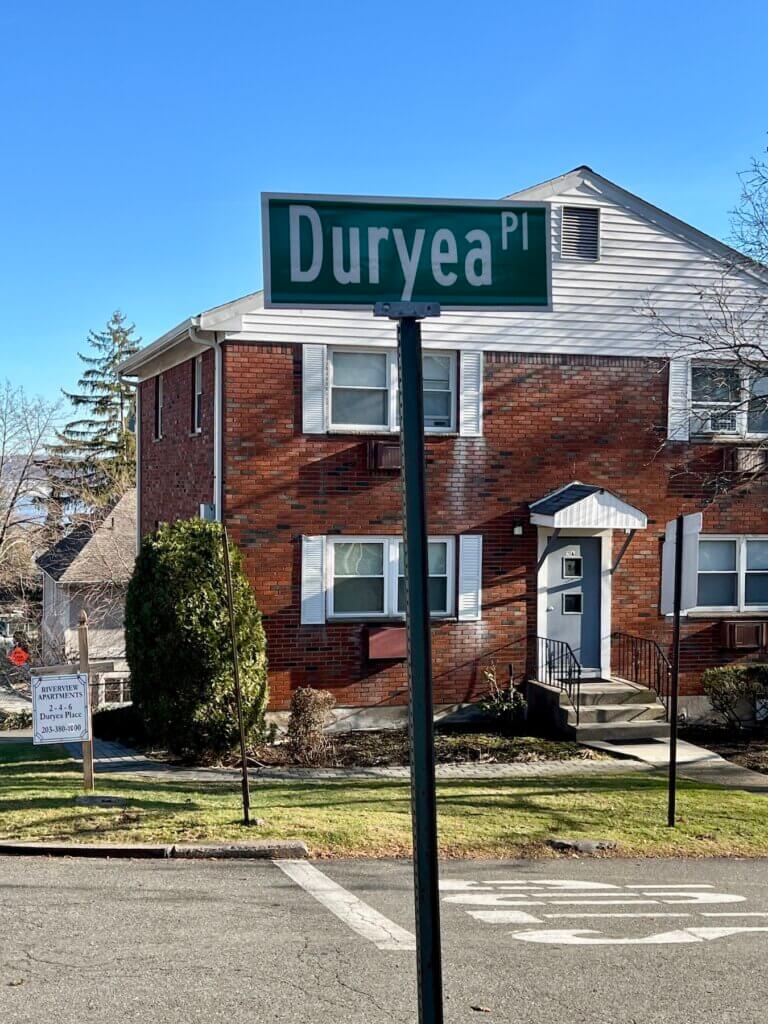
The small lane preserves the name of the former Duryea estate, which once occupied the hillside above the Hudson River.
At the height of the Gilded Age, a massive stone mansion crowned Nyack’s hillside above the Hudson, signaling that extraordinary wealth had arrived in the village. The estate belonged to William Duryea, a starch magnate whose fortune flowed from Long Island factories to Manhattan offices and, each summer, to Nyack. Before Duryea’s arrival in 1884, the property was known as Aspinwall Place, named for its original owner, James S. Aspinwall, whose estate we explored in an earlier article. Duryea’s residence projected success and permanence. His family life, however, would become anything but quiet.

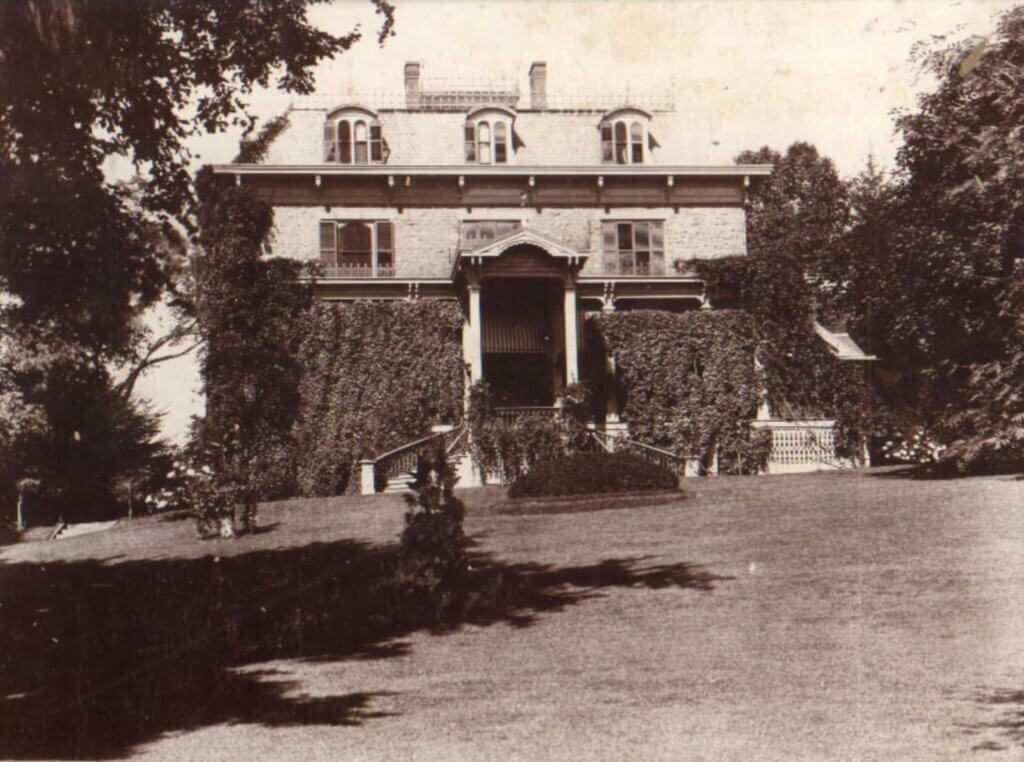
The tall, stone, mansard-roofed mansion dominates the hillside above the Hudson. Ivy climbs the exterior walls, reinforcing the estate’s image of age and permanence.
The Duryeas improved the house and grounds and soon became fixtures in Nyack’s summer society. Although Nyack attracted many prosperous families during the Gilded Age, the Duryeas almost certainly ranked among the wealthiest. Their prosperity, however, did not shield them from turmoil. Within a few years, the family found itself in the headlines.

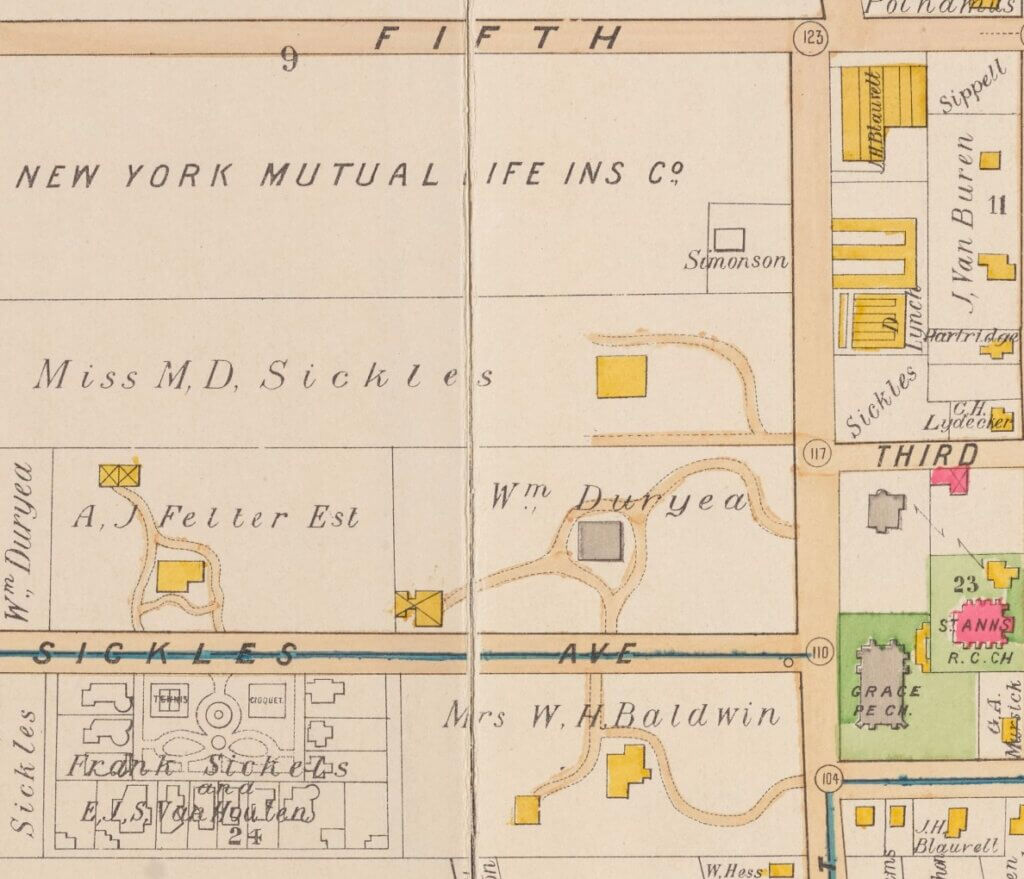
The property labeled “Wm. Duryea” occupies a large tract between Third Avenue and Sickles Avenue facing Franklin. Nearby parcels include the Baldwin property, later central to the 1913 marriage controversy.
Glen Cove: The Industrial Engine Behind the Duryea Wealth
The family fortune originated at the Glen Cove Starch Works, founded in the 1850s along Glen Cove Creek. What began as a modest mill grew into a 30-acre industrial village of brick factories, tall chimneys, warehouses, and a wharf with direct access to Manhattan markets.

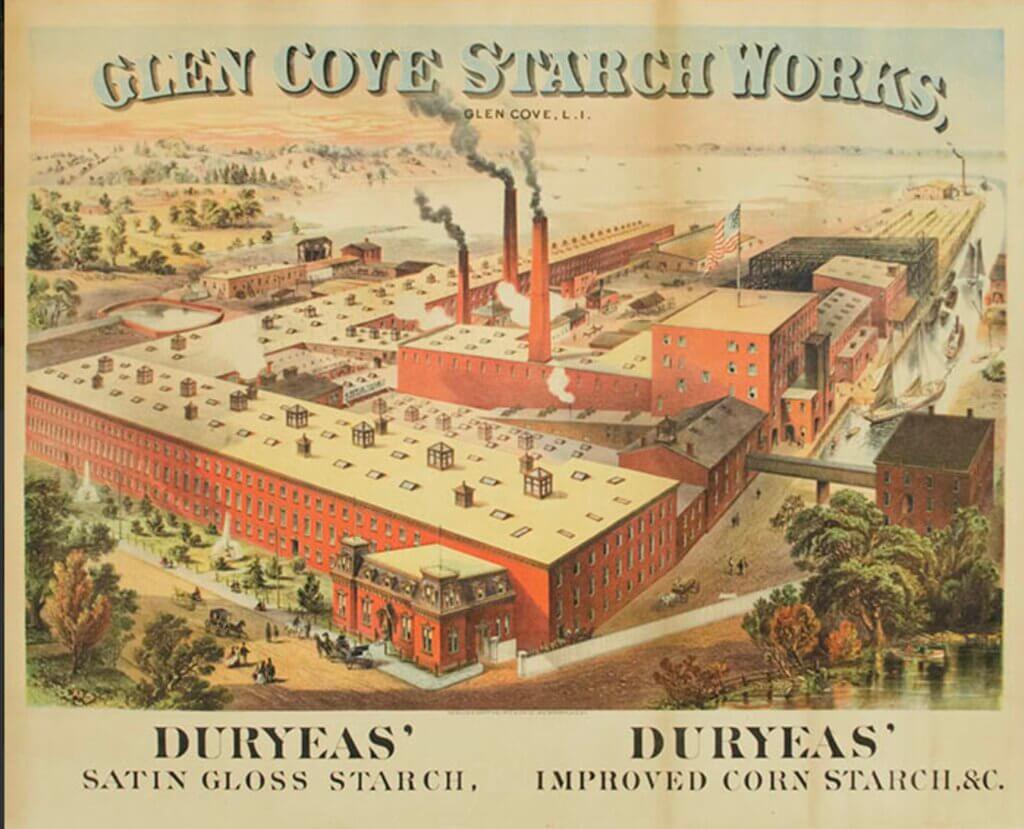
Brick factory buildings, tall chimneys, and waterfront access illustrate the industrial scale behind the Duryea family fortune.Screenshot
The works produced the Duryeas’ two signature products, Maizena and Satin Gloss Starch, and promoted them with lavish chromolithographed trade cards that reached homes across America. William managed the Manhattan office and national distribution. His brother, Wright Duryea, oversaw production at Glen Cove.
Their success eventually placed the family in leadership roles within the consolidated National Starch Company. In turn, this industrial wealth financed the transformation of the former Aspinwall villa into a grand summer estate on Nyack’s hillside.


Three Duryea starch product packages.
Maizena and Satin Gloss Starch became household staples through nationwide advertising and distribution.
Family Origins and Social Standing
The Duryeas traced their American lineage to Dutch colonial Brooklyn. William, born in 1829, was the second son of Hiram and Elizabeth Duryea. After early work at the Oswego Starch Works, he joined his brothers in building the Glen Cove enterprise.
In 1857, he married Frances Colver Littlefield, who devoted herself to charitable work. Their household included daughters Hettie, Sarah, and Lillian, as well as their adopted son, William J.
Family life frequently appeared in the newspapers. William J. died in 1902, two years after his marriage to Katherine Walker, who later fought successfully for her inheritance. Sarah married Professor Charles Hazen of Smith College. Lillian’s marriage to neighbor Wilbur Baldwin, following his controversial Reno divorce, became a widely discussed scandal.
William Duryea (1829–1907)
Duryea became a leading figure in the Glen Cove business and a director of the National Starch Company. His obituary praised his integrity, generosity, and civic engagement. He served on the YMCA board, attended Grace Church, and spent his later years at the Fifth Avenue Hotel in Manhattan.
He died in New York City on April 26, 1907, and was buried in Oak Hill Cemetery. His estate was valued at the equivalent of roughly $87 million today.
Each spring, the Duryeas “returned to their beautiful Nyack home.” Each autumn, William “went back to New York for the winter.” This seasonal rhythm was typical of mercantile elites. The former Aspinwall villa soon became known simply as the Duryea House, a name later echoed in a street known today as Duryea Place.
A surviving photograph shows a tall, mansard-roofed mansion dominating its sloping lawn—an unmistakable symbol of industrial wealth brought to the Hudson.
Duryea’s geography of success formed a triangle: industry at Glen Cove, business in Manhattan, and summer leisure in Nyack.
Updating the House
Duryea renovated the estate in early 1884, just in time for it to appear in its final form on the 1884 Burleigh illustrated map of Nyack. The original mid-century villa already displayed Second Empire characteristics, but Duryea enlarged and refined the structure.
He extended the broad porches, known at the time as piazzas, on both the east and west fronts. A split stairway emphasized the formal approach. On the north side, he added a porte cochère that allowed carriages to arrive under cover.
Both the piazzas and the porte cochère were illuminated by centrally placed gas lamps. These were not minor details. They signaled comfort, wealth, and modernity.
The elaborate carriage house on Sickles Avenue and the stepped walkways visible in early photographs also date from this period.
A Parallel Transformation Next Door: Haven Court
The makeover of the Duryea House paralleled changes on the adjoining De Cantillon property, which evolved into the Haven Court Country Club in the early twentieth century. Like the Duryea estate, Haven Court began as a mid-century villa.
However, its later transformation reflected a different social model. Private family retreats gave way to semi-public institutions centered on organized leisure.
Together, these neighboring properties show how Nyack’s earliest estates were expanded, reinvented, or replaced as the village entered a new era of clubs, larger houses, and eventual subdivision.


Large additions at the back of the building illustrate the property’s transformation from a family villa into a full-scale country club.
“I’ll Wed Anyhow”
After William’s death, Katherine Walker Duryea, widow of William J., announced she would marry the Rev. Angus despite a clause in her father-in-law’s will threatening her $20,000 inheritance.
She contested the restriction. Katherine won. She also avoided a steep inheritance tax. Newspapers reported the story with relish.


Scandal headlines, 1907 and 1913.
Katherine Walker Duryea’s defiant “I’ll Wed Anyhow” and the later Baldwin–Duryea marriage following a Reno divorce drew national attention and prolonged public scrutiny.
The Baldwin–Duryea Affair
In 1913, Lillian Duryea caused another stir by marrying neighbor Wilbur Baldwin after his Reno divorce. Baldwin left behind a wife and child on nearby Sickles Avenue.
Nyack ministers refused to officiate, citing doubts about the legitimacy of the separation. The couple instead married in New York City. Local sympathy remained with Baldwin’s first wife, Ethel, daughter of Rev. J. L. Campbell, who was said to be quietly supported by the Duryea family.
What Happened to the Aspinwall–Duryea House

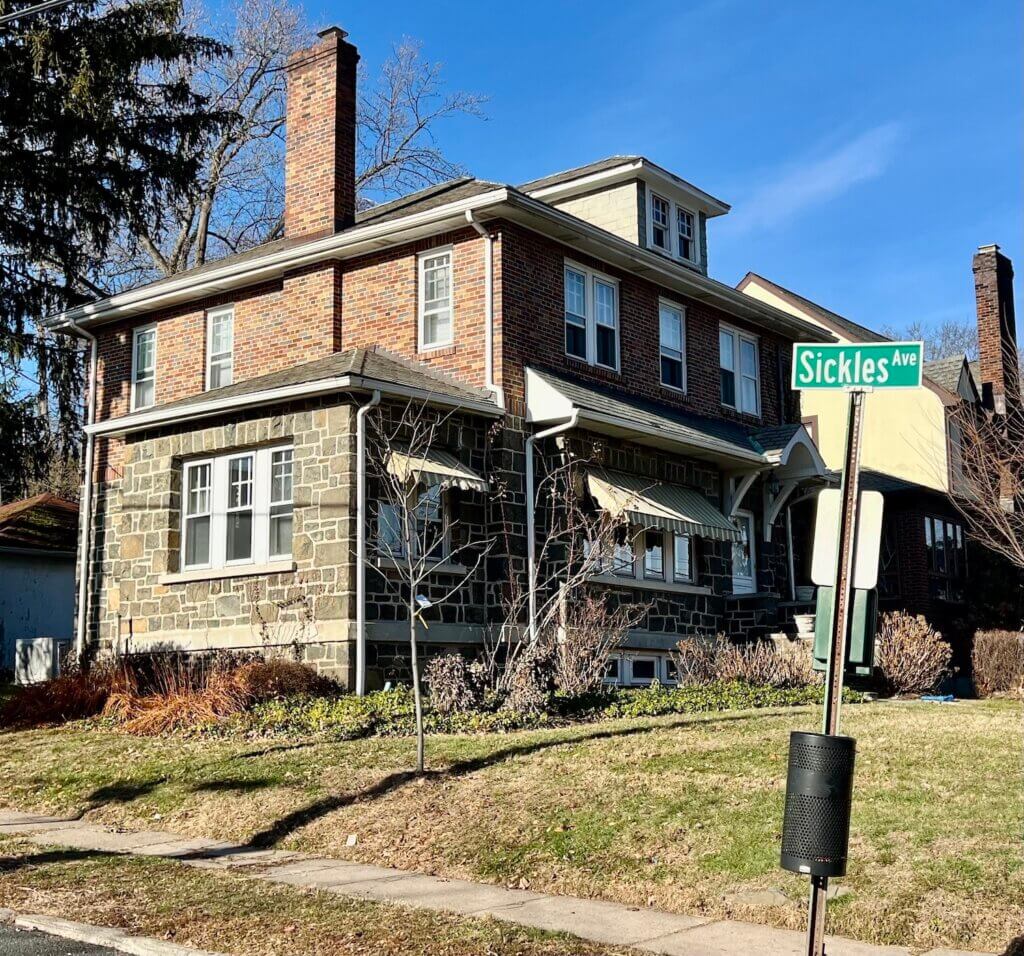
Local tradition holds that stone from the demolished Duryea mansion was reused in nearby foundations and retaining walls.
The Duryeas lived on the property until at least 1913. The estate remained intact until its sale in 1920. By 1929, newspapers noted that the house had been “chopped into lots,” marking the end of the estate era.
The mansion was likely demolished between 1920 and 1925 to create new house lots and to open Duryea Place.
Local tradition holds that stone from the house was reused for nearby foundations and retaining walls. This practice was common in the 1920s.
The transformation of the hillside mirrors Nyack’s own evolution. Grand nineteenth-century estates gave way to denser residential neighborhoods. Their memory survives in street names and scattered architectural fragments.
Mike Hays has lived in the Nyacks for 38 years. Following a career as an executive at McGraw-Hill Education in New York City, he now devotes much of his time to researching, writing, and interpreting local history.
He serves as Treasurer and past President of the Historical Society of the Nyacks, a Trustee of the Edward Hopper House Museum & Study Center, and Historian for the Village of Upper Nyack. In these roles, he works closely with community partners to preserve historic resources and expand public understanding of the area’s past.
Since 2017, he has written the popular Nyack People & Places column for Nyack News & Views, chronicling the rich history, architecture, and personalities of the lower Hudson Valley. In addition, he has researched and developed museum exhibitions, written interpretive materials, and leads well-attended walking tours that bring Nyack’s layered history to life.
Married to Bernie Richey, he enjoys cycling, history walks, and winters in Florida. You can follow him on Instagram at @UpperNyackMike.
Editor’s note: This article is sponsored by Sun River Health and Ellis Sotheby’s International Realty. Sun River Health is a network of 43 Federally Qualified Health Centers (FQHCs) providing primary, dental, pediatric, OB-GYN, and behavioral health care to over 245,000 patients annually. Ellis Sotheby’s International Realty is the lower Hudson Valley’s Leader in Luxury. Located in the charming Hudson River village of Nyack, approximately 22 miles from New York City. Our agents are passionate about listing and selling extraordinary properties in the Lower Hudson Valley, including Rockland and Orange Counties, New York.