Old Nyack, though not the North Pole, was no stranger to winter wonders. In addition, beyond the famed ice bridge connecting it to Tarrytown, Nyack was a hub for the exhilarating sport of sleigh racing during the pre-automobile era. On January 20, 1891, a historic event unfolded as horse-driven sleighs gathered for an adrenaline-pumping competition from Upper Nyack to the First Baptist Church on North Broadway. As a result, excitement filled the air. Crowds lined the streets, eager to witness racers vying for a substantial purse, equivalent to $3,500 in today’s currency.


Lithograph. Currier & Ives. Courtesy of the Library of Congress.
In those days, sleighs were indispensable. They served as the primary means of reliable transportation on snow packed, icy roads and even across the frozen Hudson River on the ice bridge. Nyack, nestled in the Lower Hudson Valley, emerged as a thriving center for sleigh manufacturing. It attracted enthusiasts seeking both practical and stylish sleighs.


Photograph by Frank Brush. Courtesy of the Win Perry Collection
Sleigh-Making Craftsmanship in Nyack
Two prominent sleigh manufacturers, E.L. Wright and the Christie family, set the stage for Nyack’s sleigh making prowess. At the same time, operating from around the Civil War through the automobile age, these factories were a hive of activity. Skilled craftsmen in metalwork, upholstery, carpentry, leatherwork, and painting worked under one roof to produce masterfully crafted sleighs.

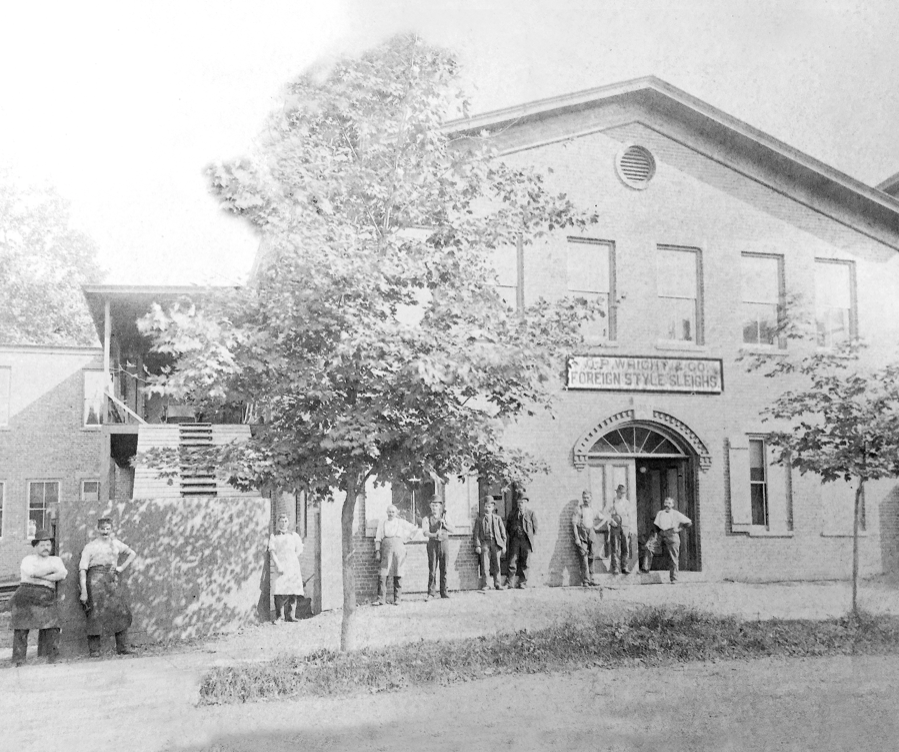
Factory exterior. Courtesy of the Nyack Library.
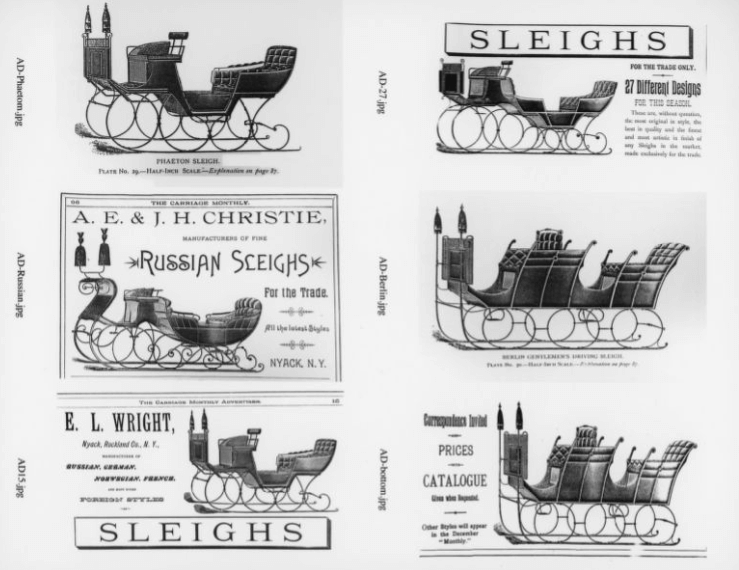
The Portland cutter, a nineteenth century equivalent of the “Model T,” was a single seat, two person sleigh that combined affordability with ease of use. In contrast, Nyack’s uniqueness shone through local design. Builders infused European influences, creating custom sleighs that ranged from fancy two seaters to opulent three seat models favored by high rollers.
Wright’s brick factory on Hudson Avenue, later overseen by Ornan P. Wright, and Christie’s establishment on Liberty Street stood at the forefront of sleigh innovation. Noteably, O.P. Wright’s designs appeared in national magazines and showcased exquisite detail. The Christies, meanwhile, offered a fancy six passenger Russian sleigh in 1888.

Sleigh Road Adventures and Mishaps


Engraving. Currier & Ives. Courtesy of the Library of Congress.
With the proliferation of sleighs, conflicts were inevitable on Nyack’s winter roads, much like today’s traffic disputes. For example, tales of road antics added color to the record. One involved an amusing “brush,” when two horses touched during a race, between A.J. Smith and Edgar Smith. As A.J. headed home from the train station one morning, he assumed Edgar, passing him on Broadway, wanted to race. Instead, A.J. bolted ahead, only to discover Edgar had turned off. Villagers laughed at the spectacle. Meanwhile, accidents were also part of the experience, with overturned sleighs and mishaps scattered through the historical record.


Currier & Ives lithograph. Courtesy of the Library of Congress.
The 1891 Sleigh Race on N. Broadway
Picture a snowy Tuesday afternoon in 1891. At that moment, a quarter mile stretch of North Broadway lay before more than ten horses and sleighs poised for an informal but fiercely competitive race. Notable participants included George Chapman, an officer of the Nyack National Bank, lending the event a touch of prestige.
Although, the exact course and rules remain unclear, the promise of substantial prize money drew eager competitors.
The Rockland County Journal captured the moment, noting that “many groups gathered on both sides of Broadway to witness the contests, and that the sleighing was superb.” By day’s end, as the sun set beyond the Nyack hills, echoes of the races lingered in the winter air. Another chapter in Nyack’s sleighing history had been written.
The First Sleigh Ride –an Early Edison Manufacturing Company moving picture, circa 1897

Mike Hays has lived in the Nyacks for 38 years. A former executive at McGraw-Hill Education in New York City, he now serves as Treasurer and past President of the Historical Society of the Nyacks, Trustee of the Edward Hopper House Museum & Study Center, and Historian for the Village of Upper Nyack.
Since 2017, he has written the popular Nyack People & Places column for Nyack News & Views, chronicling the rich history, architecture, and personalities of the lower Hudson Valley. As part of his work with the Historical Society, Mike has researched and developed exhibitions, written interpretive materials, and leads well-attended walking tours that bring Nyack’s layered history to life.
Married to Bernie Richey, he enjoys cycling, history walks, and winters in Florida. You can follow him on Instagram as @UpperNyackMike.
Editor’s note: This article is sponsored by Sun River Health and Ellis Sotheby’s International Realty. Sun River Health is a network of 43 Federally Qualified Health Centers (FQHCs) providing primary, dental, pediatric, OB-GYN, and behavioral health care to over 245,000 patients annually. Ellis Sotheby’s International Realty is the lower Hudson Valley’s Leader in Luxury. Located in the charming Hudson River village of Nyack, approximately 22 miles from New York City. Our agents are passionate about listing and selling extraordinary properties in the Lower Hudson Valley, including Rockland and Orange Counties, New York.