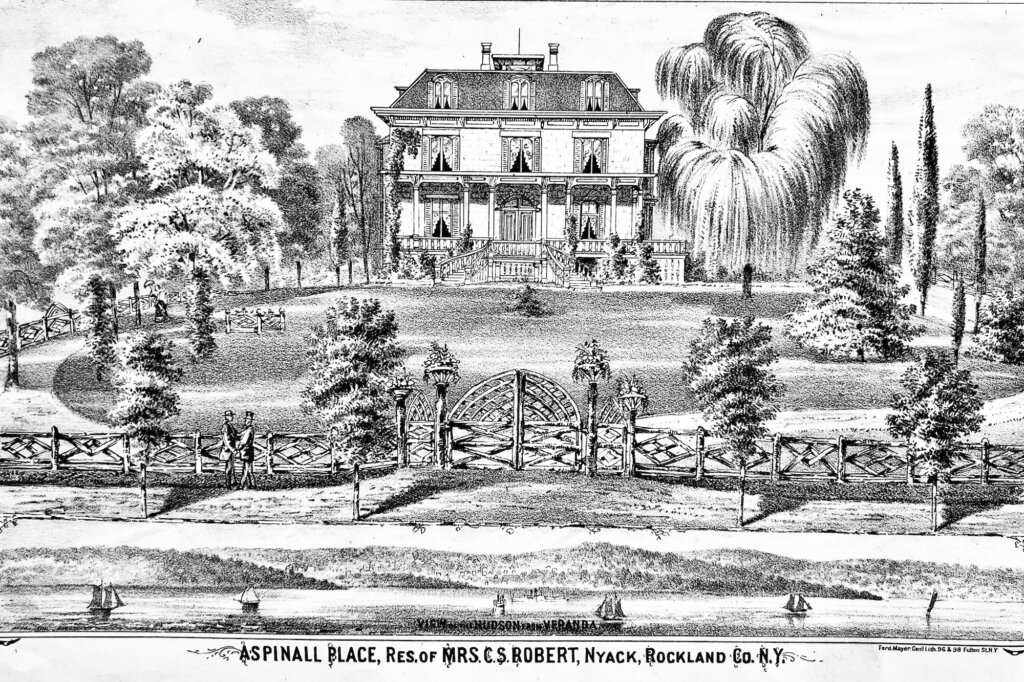
Bird’s-eye view of the Aspinwall estate as illustrated in the 1876 Combination Atlas Map of Rockland County, New Yorkby F. A. Davis. A narrow strip at the bottom depicts the Hudson River vista as seen from the front porch.
James S. Aspinwall did not arrive in Nyack as a speculator or a Gilded Age magnate. He came earlier, nearly a decade before building his stone villa in 1866, when the village’s northern rise was still semi-rural. A member of a prosperous Manhattan mercantile family, he was already firmly established among New York’s commercial elite.
His villa stood beside the residence of Richard De Cantillon on Franklin Street, between Sickles Avenue and Third Street. Together, the houses formed one of the village’s earliest clusters of elite properties. Although what first drew him to Nyack remains unclear, records place as a landowner by 1858. Nearly ten years later, his Civil War–era stone house marked a new phase in the Hudson River’s transformation. Working river towns were becoming landscapes shaped by seasonal wealth.
Aspinwall arrived a decade before he built his stone villa—one of the village’s first true hilltop estates.
In that sense, Aspinwall’s story shows how Manhattan fortunes began reshaping Nyack decades before the Gilded Age reached its peak.
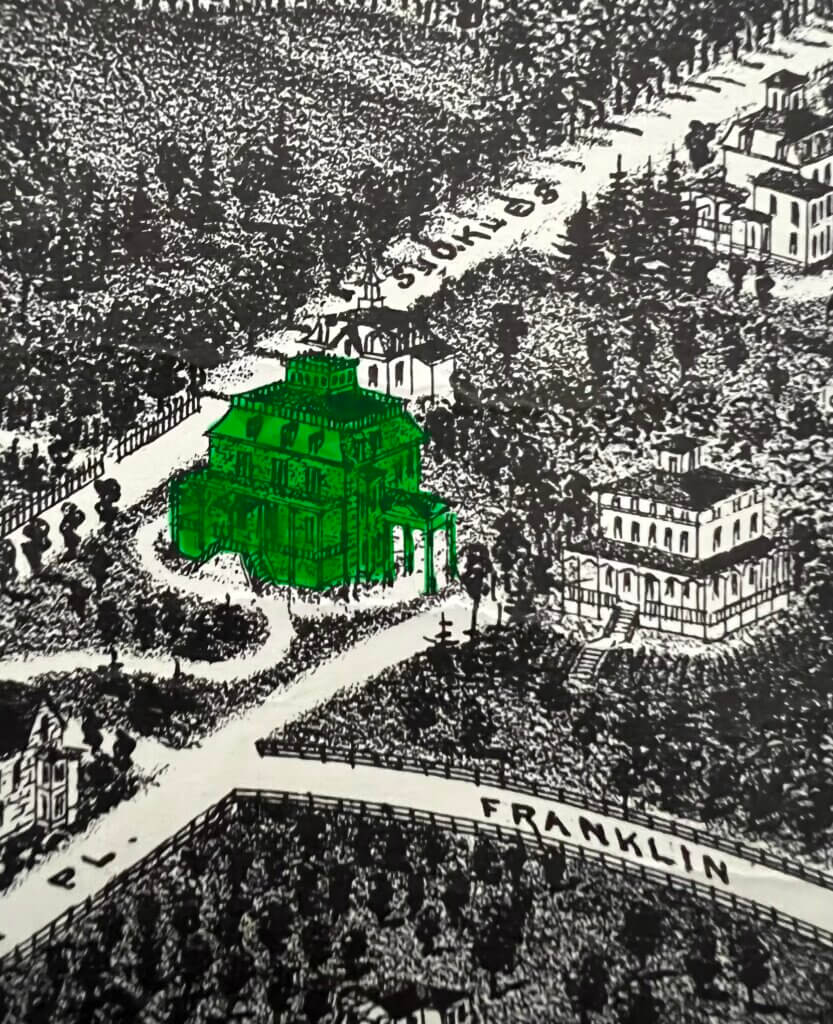
The Aspinwall place appears at left and the De Cantillon residence at right. The contrast in architectural styles is clearly visible, and the surrounding area remains largely wooded.
A Mercantile Lineage in Old New York
The Aspinwall family arrived in America in 1630. By the early nineteenth century, James belonged to one of New York’s long-established commercial dynasties. These families dominated the city’s shipping, warehousing, and importing trades. The Aspinwalls thrived in a world of clipper ships, counting houses, and global trade networks. They also maintained close ties to other mercantile clans. Together, they formed a dense web of business and marriage alliances. That network shaped New York’s commercial elite.
This environment gave Aspinwall opportunity and standing, but his own professional success, not inheritance alone, produced his fortune.
Aspinwall’s Fortune in the Drug Trade: Rushton & Aspinwall
In 1830, at age twenty-three, Aspinwall partnered with William L. Rushton to form Rushton & Aspinwall, soon one of New York’s best-known wholesale and retail drug houses. By the 1840s, the firm operated from prominent locations at 86 William Street and 110 Broadway, supplying physicians, hospitals, and a rapidly expanding consumer market.
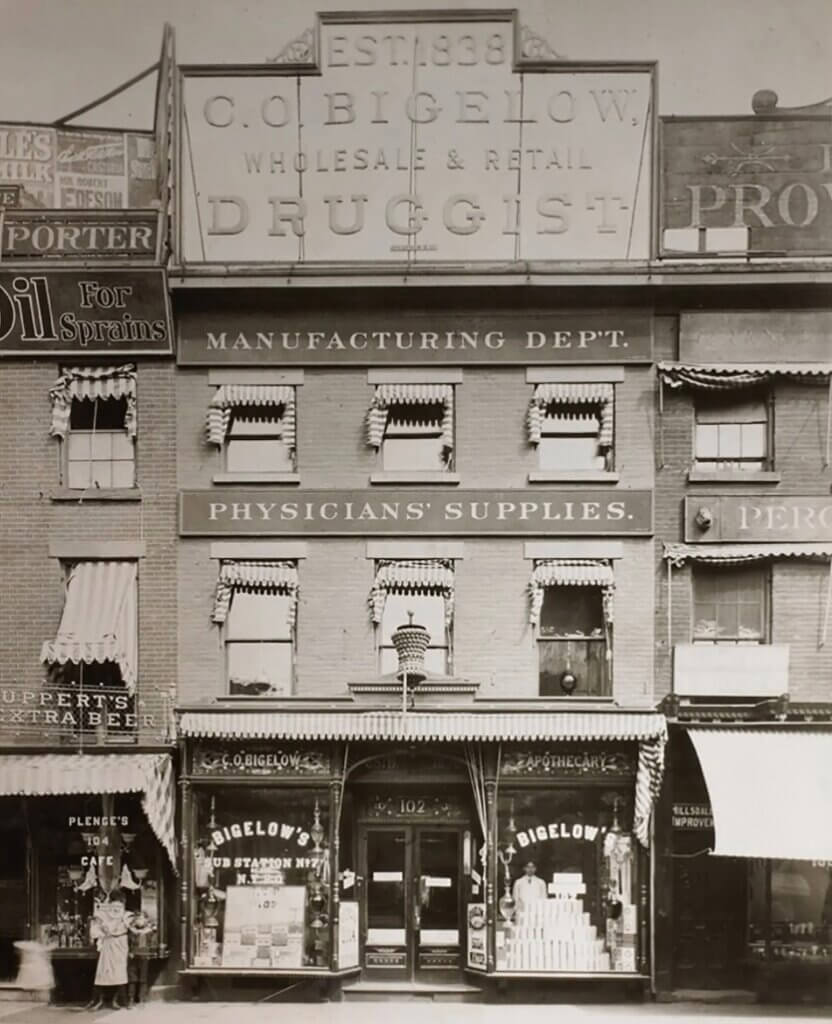
This interior shows the type of pharmacy operated by James S. Aspinwall and his partners. From the New York Times.
At the same time, the firm built its reputation on proprietary medicines and hygiene products, including Compound Chlorine Tooth Wash, Rushton’s Cod Liver Oil, and bottled soda and mineral waters. Their products circulated widely, and collectors still identify the firm’s distinctive bottles today.
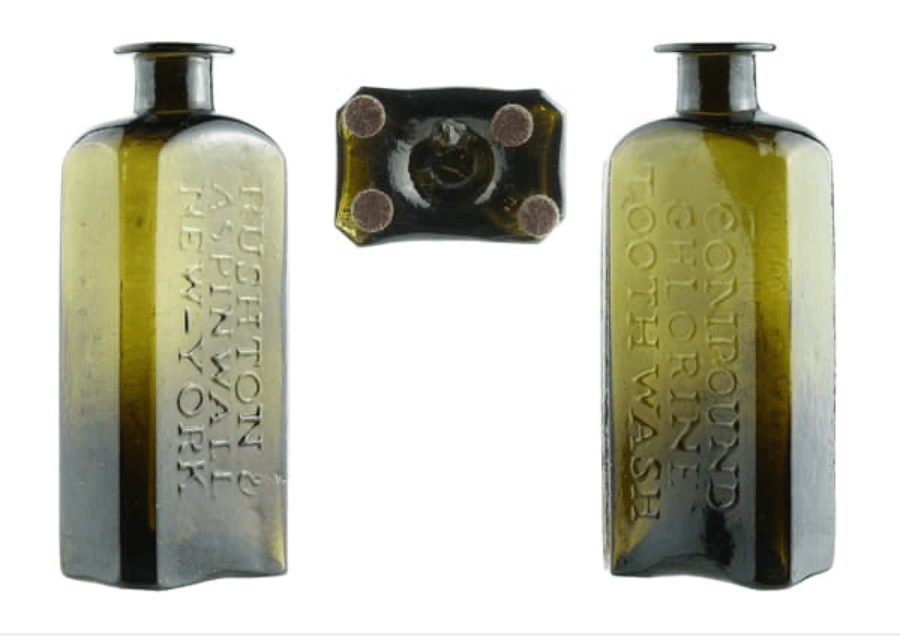
Examples of proprietary medicine containers produced by Aspinwall’s firm. Such bottles are collectible today.
In 1843, a talented employee, William Hegeman, acquired one branch and developed it into Hegeman & Co., a company that survived into the twentieth century. Aspinwall continued independently at 86 William Street, concentrating on wholesale distribution. By 1855, his fortune exceeded $100,000—roughly $3.8 million in modern purchasing power. As a result, he earned a place in Wealthy Men of New York. He was now among the most successful figures in the pre–Civil War drug trade.
That success enabled him to build one of Nyack’s earliest substantial summer estates.
The Personal World of James S. Aspinwall
Behind his public reputation, James Scott Aspinwall (1807–1873) lived a life defined by discipline, family continuity, and the habits of New York’s merchant elite. Born in Manhattan on May 21, 1807, he was the son of Gilbert Aspinwall, a successful trader in the city’s maritime economy. From an early age, he trained in the shipping district, absorbing the rigor and punctuality that characterized commercial life along the East River.
That discipline became central to his identity. An 1863 account claimed he never missed a day of work or suffered illness during decades in business. Whether exaggerated or not, the story reflects how contemporaries viewed him: methodical, steady, and dependable.
“He never missed a day of work or suffered illness during decades in business.”
— 1863 account
In 1840, he married Margaret Maxwell, daughter of a respected Scottish physician. By the late 1840s, they resided at 299 East 10th Street in Manhattan, in a substantial Greek Revival home designed in 1846 by architect James Trench. The couple also maintained a small country property on Long Island, signaling an early interest in seasonal retreat.
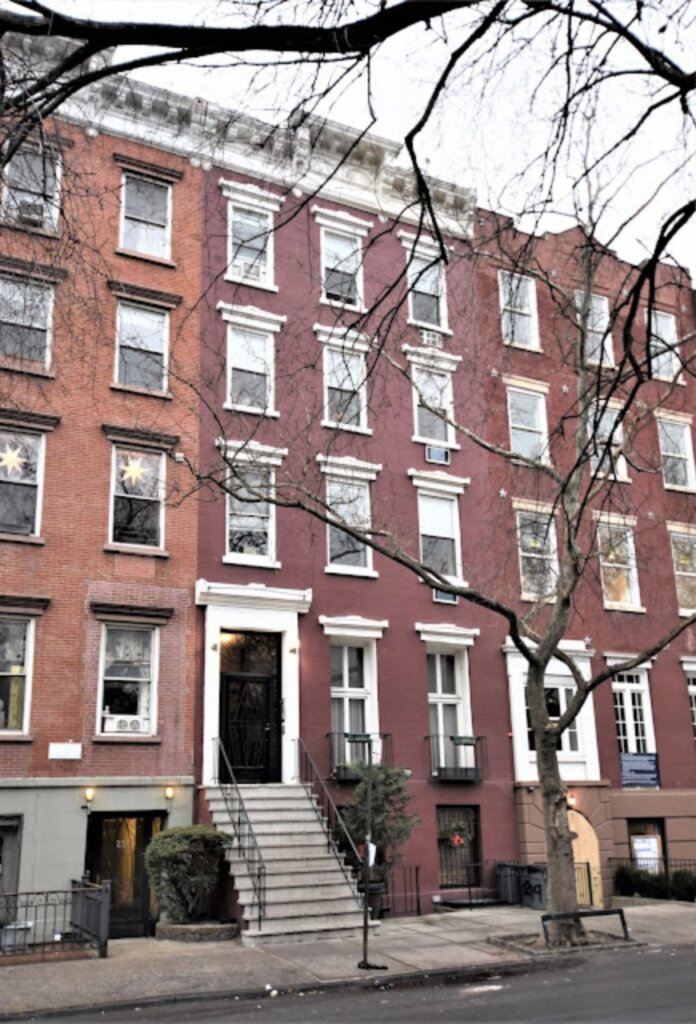
Family connections reinforced his standing. His cousin, William Henry Aspinwall—later a founder of the Panama Railroad—ranked among the most influential businessmen of his era. Such ties placed him within a powerful network of kinship and commerce. However, lineage alone did not create his fortune. It came from the drug trade.
That financial independence would soon allow him to experiment not only in business, but in landscape.
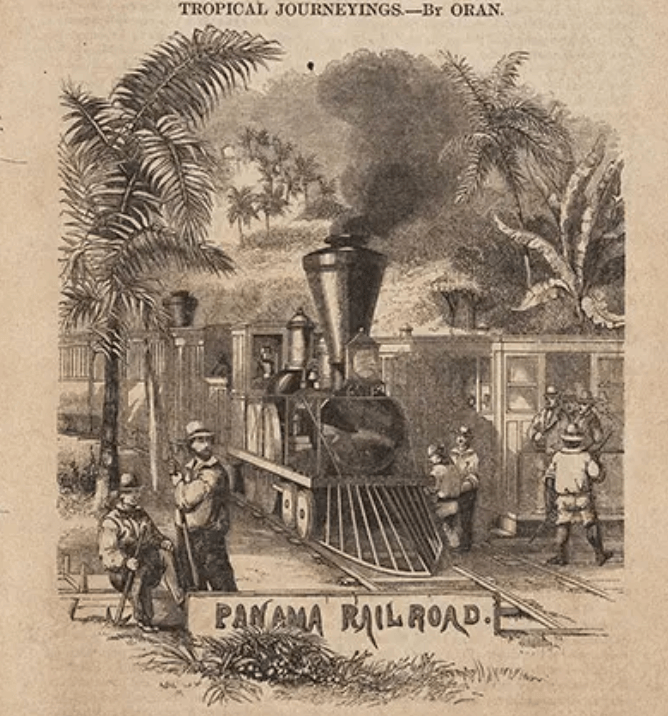
Aspinwall’s cousin helped lead construction of the Panama Railway, one of the most ambitious engineering projects of the mid-19th century.
Faith, Civic Duty, and Institutional Influence
If business shaped Aspinwall’s wealth, civic and religious institutions shaped his public identity. The Aspinwalls worshiped at Grace Episcopal Church in Nyack and even hosted a church bazaar in their home—an act that reflected both devotion and social standing.
At the same time, Aspinwall became increasingly active in Nyack’s institutional life. In 1858, he served as a vice president of the Rockland Female Institute, working closely with its founder, Simon Sickles. He later endorsed Rutherford’s Classical and Commercial Academy, the school that evolved into the Nyack Military Institute. In 1865, he served on Nyack’s Fourth of July Committee, participating visibly in village life during the final year of the Civil War.
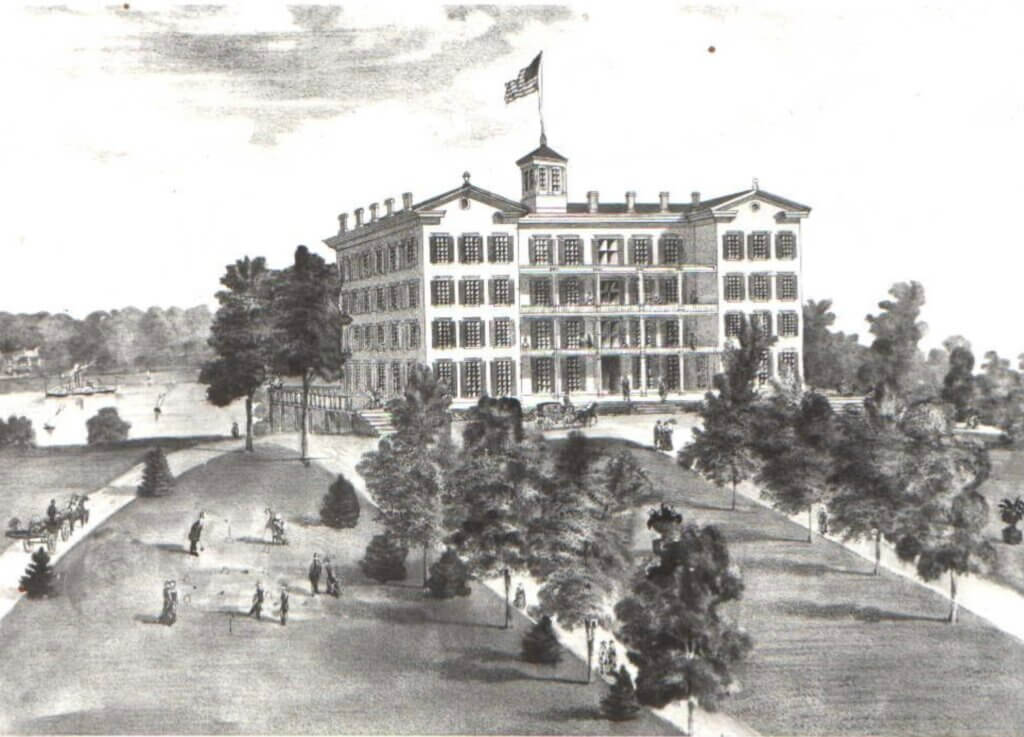
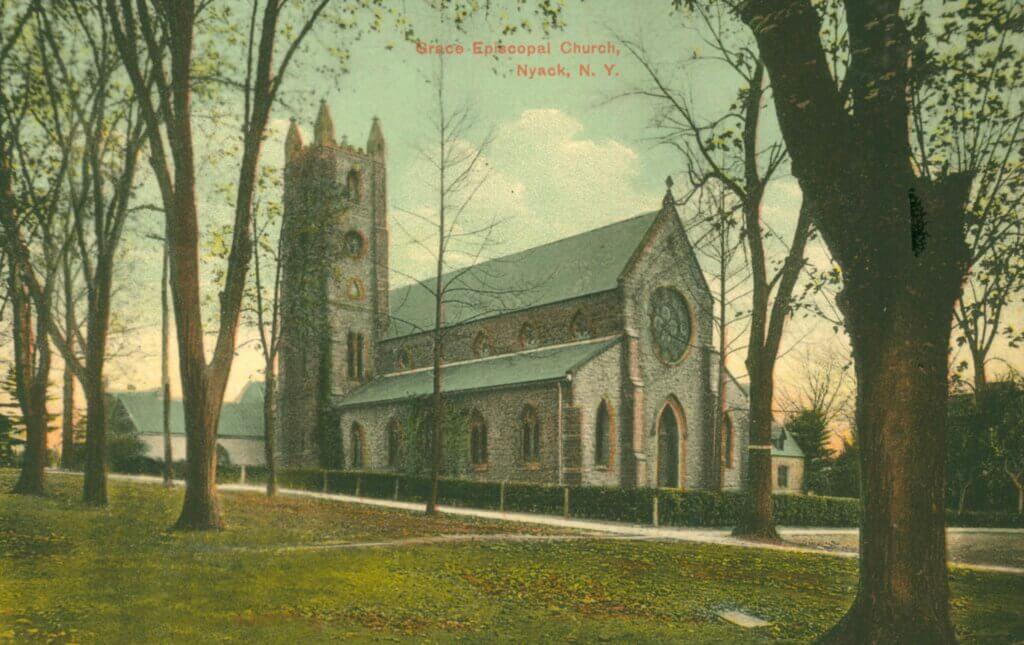
Educational and religious institutions supported by James S. Aspinwall.
Aspinwall served as a vice president of the Rockland Female Institute and later became a warden of Grace Episcopal Church, reflecting his active role in Nyack’s civic and institutional life. Courtesy of the Nyack Library.
These commitments were not incidental. Instead, they show how early summer residents integrated themselves into the civic life of the communities they reshaped. Aspinwall was not merely building a retreat; he was investing in the educational, religious, and social infrastructure of a growing river town.
By the mid-1860s, his disciplined habits, accumulated wealth, and expanding Hudson River ties made him a natural participant in a new cultural pattern: the seasonal migration of Manhattan elites seeking elevation, scenery, and social distinction.
It was within that context that his stone villa rose on a “beautiful eminence” above Franklin Street.
A Civil War–Era Stone Villa on a “Beautiful Eminence”
Aspinwall’s Nyack villa appears to have been constructed in 1866, making it one of the earliest substantial hillside homes in the village. An 1868 Rockland County Journal notice described the house as standing on a “beautiful eminence”. Soon afterward, construction began on the new Grace Episcopal Church across the street, and Aspinwall became a church warden.
Second Empire style arrived in American residential architecture during the 1860s, bringing a new sense of height, fashion, and modernity. Its hallmark mansard roof added a full upper floor while projecting urban sophistication drawn from Paris under Napoleon III. In river towns like Nyack, Second Empire houses often occupied elevated sites, where tall windows, deep porches, and bracketed cornices emphasized status as much as scenery. For merchants like James S. Aspinwall, the style signaled both prosperity and permanence at the moment when summer estates began reshaping the Hudson Valley landscape.
By contrast, architecturally, the villa reflected early Second Empire influence. Built of dark gray stone, it featured a high front porch, a broad lawn shaded by mature trees, and rustic seating that invited passersby to linger. A cupola rose above the attic story, and vines soon softened the stone exterior. To the north stood the Italianate De Cantillon residence. Together, the two houses formed an early enclave of wealth along Franklin Street, both crowned with cupolas and celebrated for their sweeping vistas of the Hudson.
Interior of the Aspinwall Villa
Inside, the villa included a parlor and dining room on one side and a sitting room and library on the other, trimmed in dark woods—black walnut alternating with ash ornamented with star motifs. The second floor contained numerous bedrooms. Unusual for its time, the house included a bathroom with hot and cold running water piped from the basement.
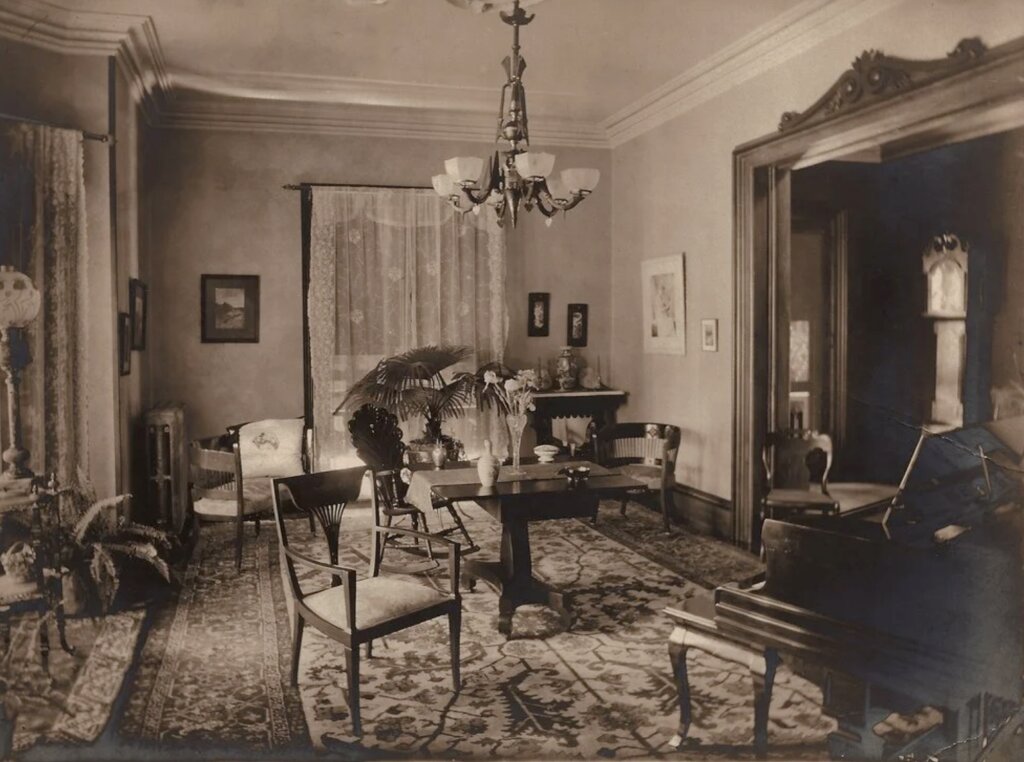
Illustrates the type of formal sitting room likely found in homes such as the Aspinwall villa, with dark wood furnishings, patterned textiles, and decorative plasterwork.
Mason G. D. Onderdonk and carpenter James Woolsey built the house at a cost of $39,000—roughly $15.7 million today when measured by GDP per capita.
Across the River: The Aspinwalls and Rockwood Hall
Aspinwall’s mercantile success becomes even clearer when viewed across the Hudson. Directly opposite Nyack, in Sleepy Hollow, stood Rockwood Hall, a property once owned by his cousin, William T. Aspinwall. Later, Rockwood became famous as the estate of William Rockefeller, Jr., co-founder of Standard Oil.
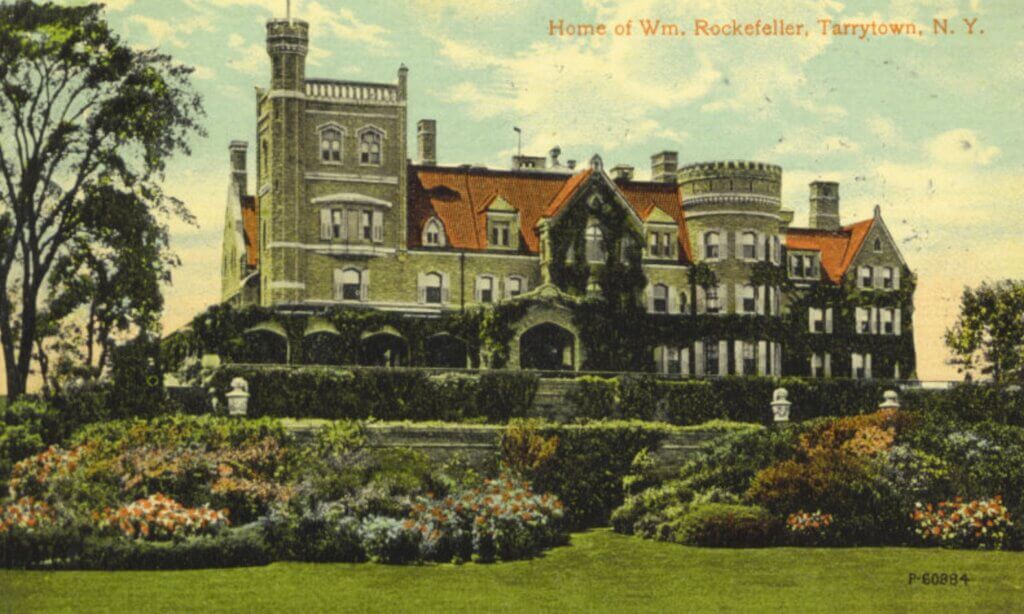
Originally associated with the Aspinwall family and later transformed by William Rockefeller into one of the largest private residences in the United States.
Rockefeller transformed Rockwood Hall into a 204-room mansion set on nearly 1,000 acres. At the time, it ranked as the second-largest private residence in the United States, surpassed only by the Vanderbilt Biltmore. Its size symbolized the extraordinary concentration of wealth in the late 19th century—and the heights to which members of the broader Aspinwall network could rise.
The Beginning of future Gilded Age Summer Villas & Resorts
Seen alongside Rockwood Hall, Aspinwall’s stone villa in Nyack appears as an early expression of the same impulses of prosperity, mobility, and the desire for seasonal escape that would later define the Hudson River’s grandest estates. Yet Aspinwall’s story does not stand alone. His villa established a pattern that later owners would expand, transform, and ultimately erase.
The house is gone, but the hillside still carries his imprint. Long before grand estates lined both shores of the Hudson, Aspinwall helped establish Nyack as a place where the wealthy could choose not only how they lived, but when and where they withdrew from the city.
Author’ Note
Next week’s column explores how the Aspinwall villa passed into the hands of the immensely wealthy Duryea family, whose starch fortune transformed the property into one of Nyack’s grandest summer estates. Industry, society, and scandal collide in The Duryea House: A Gilded Age Estate of Industry, Society, and Scandal in Nyack.
Mike Hays has lived in the Nyacks for 38 years. Following a career as an executive at McGraw-Hill Education in New York City, he now devotes much of his time to researching, writing, and interpreting local history.
He serves as Treasurer and past President of the Historical Society of the Nyacks, a Trustee of the Edward Hopper House Museum & Study Center, and Historian for the Village of Upper Nyack. In these roles, he works closely with community partners to preserve historic resources and expand public understanding of the area’s past.
Since 2017, he has written the popular Nyack People & Places column for Nyack News & Views, chronicling the rich history, architecture, and personalities of the lower Hudson Valley. In addition, he has researched and developed museum exhibitions, written interpretive materials, and leads well-attended walking tours that bring Nyack’s layered history to life.
Married to Bernie Richey, he enjoys cycling, history walks, and winters in Florida. You can follow him on Instagram at @UpperNyackMike.
Editor’s note: This article is sponsored by Sun River Health and Ellis Sotheby’s International Realty. Sun River Health is a network of 43 Federally Qualified Health Centers (FQHCs) providing primary, dental, pediatric, OB-GYN, and behavioral health care to over 245,000 patients annually. Ellis Sotheby’s International Realty is the lower Hudson Valley’s Leader in Luxury. Located in the charming Hudson River village of Nyack, approximately 22 miles from New York City. Our agents are passionate about listing and selling extraordinary properties in the Lower Hudson Valley, including Rockland and Orange Counties, New York.