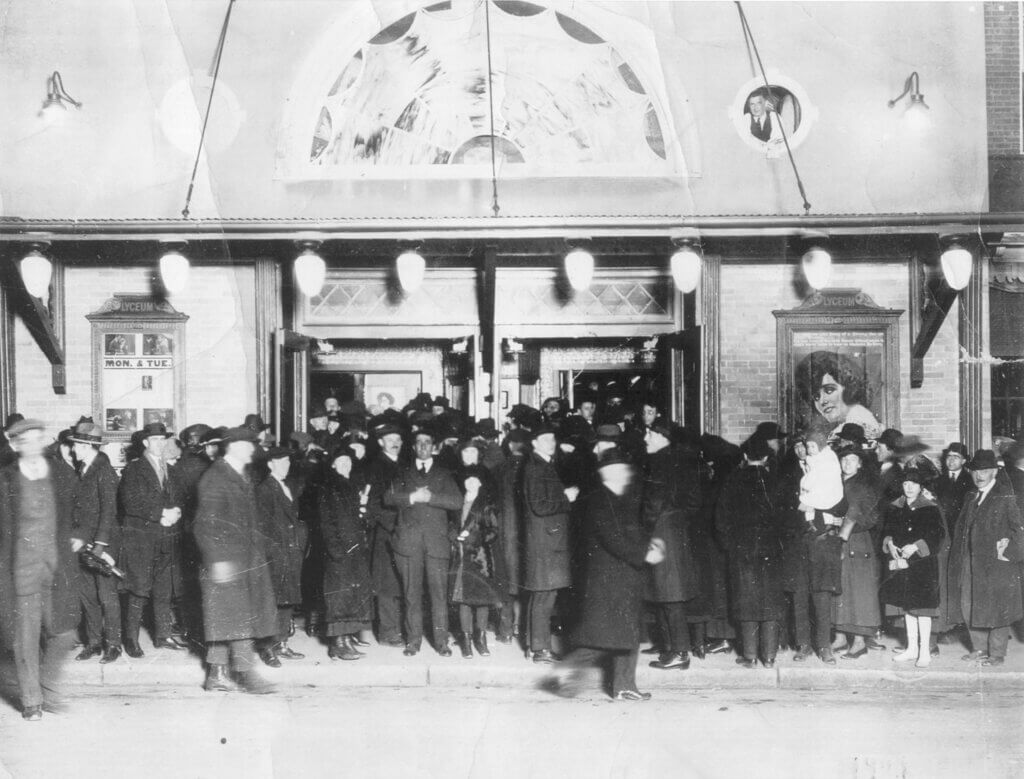
With one of the most distinctive storefronts in downtown Nyack, the Lyceum Theater at 142 Main Street opened in June 1911—just six months before the larger Broadway Theater debuted. Over the next decade, these two entertainment venues competed fiercely for audiences until a merger brought them under single ownership. At the time of the Lyceum’s opening, the Franklin and Main Street area boasted three movie venues. Only the Lyceum endured for any length of time.
Birth of a Theater District
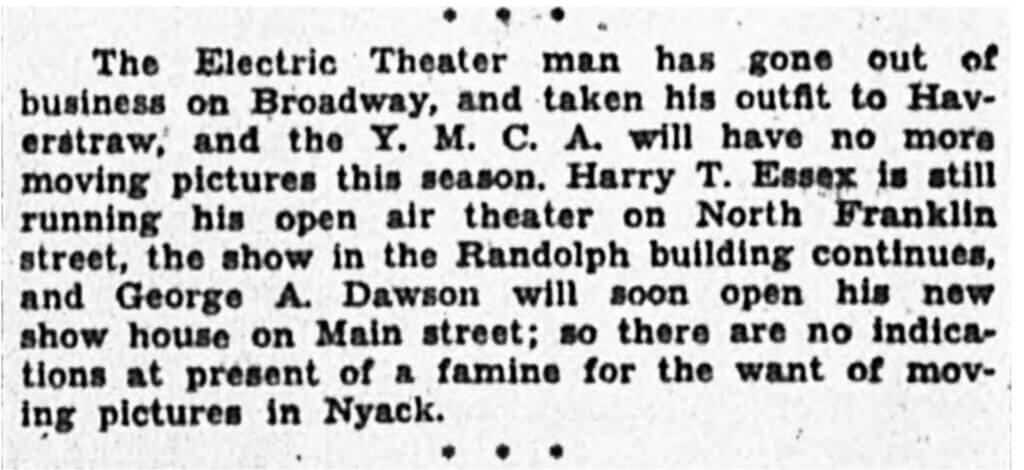
Moving pictures first came to Nyack in the early 1900s, shown in community spaces such as the Opera House, YMCA, and local churches. The success of the Nickelodeon in Pittsburgh in 1905 led to a national boom in storefront movie theaters, including Nyack’s Electric Theater in the Commercial Building at the southwest corner of Broadway and Burd Street. By 1910, more than 26 million Americans were attending movies weekly.
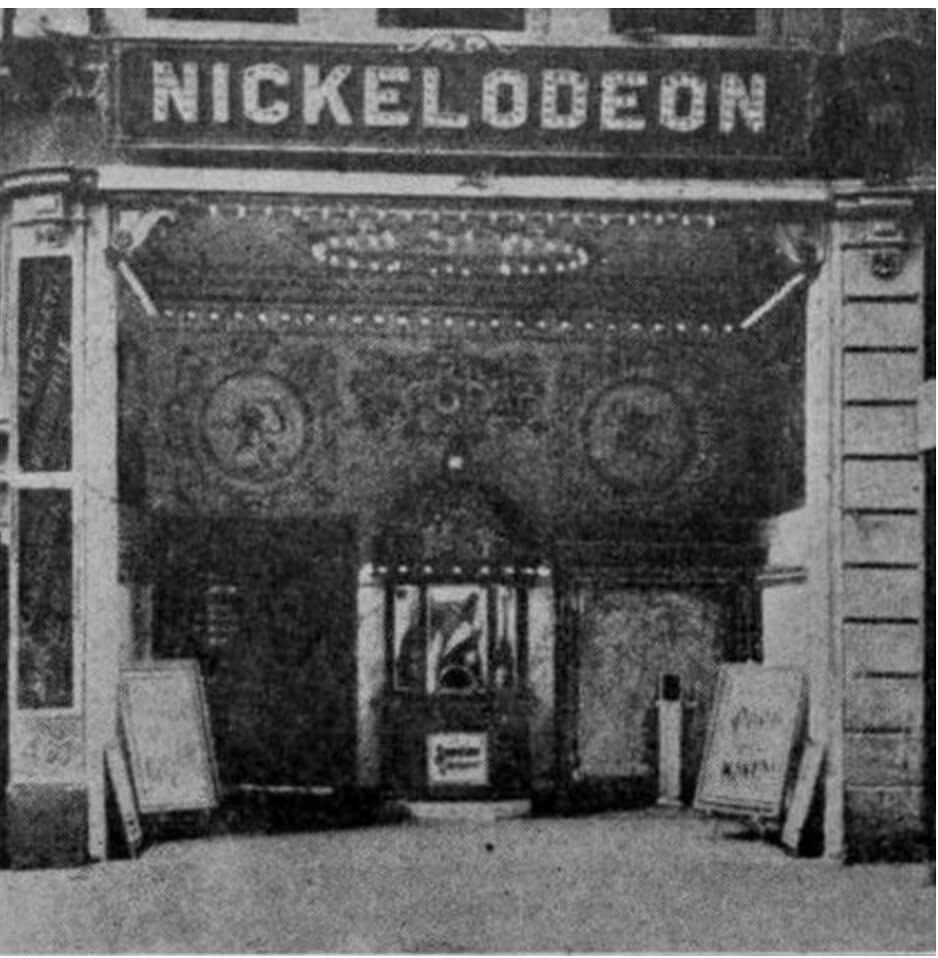
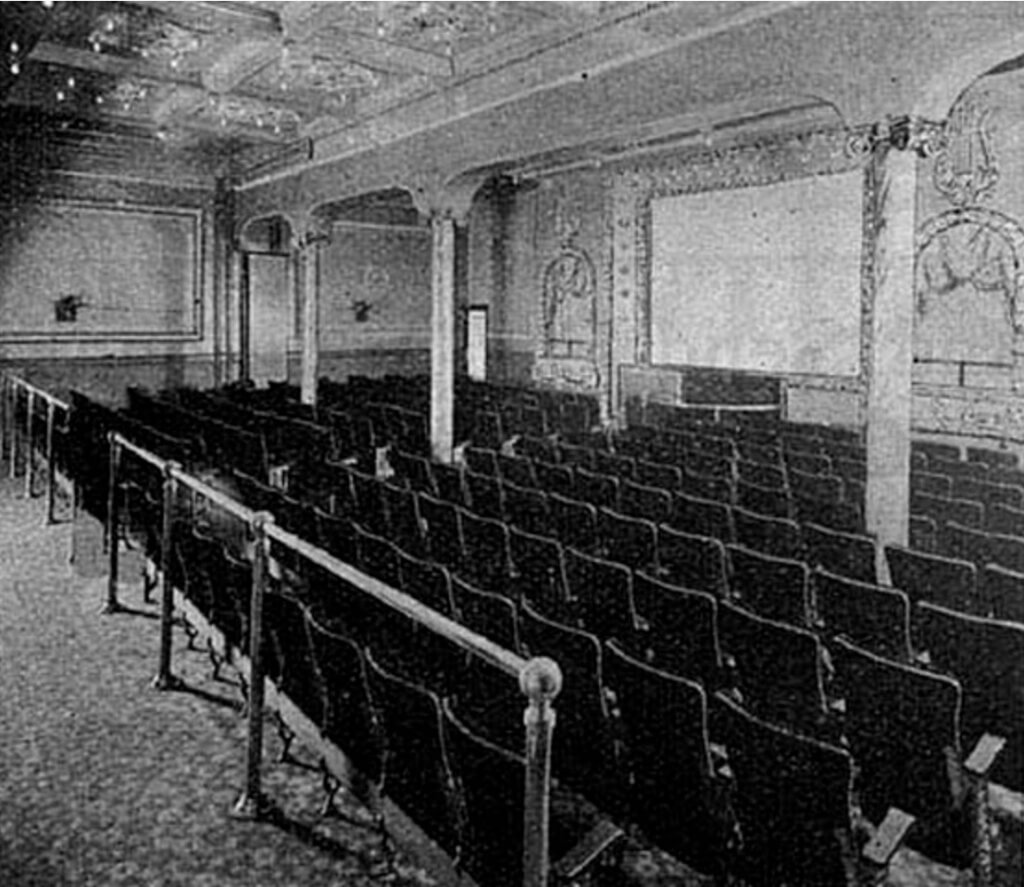
Exterior and interior of the first Nickelodeon in Pittsburgh.
Safety concerns over flammable nitrate film led to laws requiring enclosed projection booths. These new regulations effectively ended the era of makeshift theaters and ushered in purpose-built movie houses—like the Lyceum and the Broadway.
“Franklin and Main Street might have at one time been called the theater district of Nyack.”
Journal News, November 24, 1950
When the Lyceum opened in June 1911, it joined the Airdrome, an outdoor theater on Franklin Street near High Avenue, and a short-lived venue possibly known as Otto’s in the Randolph Building at 143 Main. The Lyceum and the Broadway Theater quickly outlasted their competitors, and by the end of the decade, their ads were fixtures in local newspapers.
Why the Name Lyceum?
The word “Lyceum” originates in ancient Greece, where Aristotle held lectures in a temple of that name. In 19th-century America, lyceums were public forums for lectures, debates, and intellectual improvement. By the early 1900s, “Lyceum” had become a popular name for theaters, most notably the grand Lyceum on 45th Street in New York City, opened in 1903.
Nyack village trustee George Dawson likely chose the name to reflect cultural prestige and civic pride. His theater aimed to elevate filmgoing as both entertainment and enlightenment.
A Classical Façade for a Modern Theater
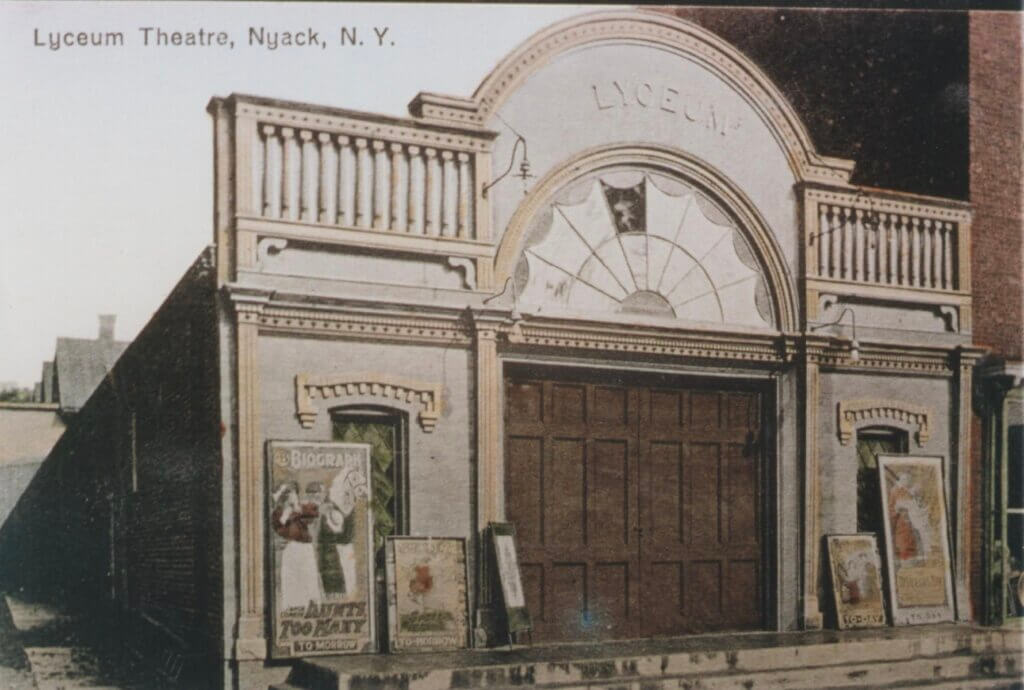
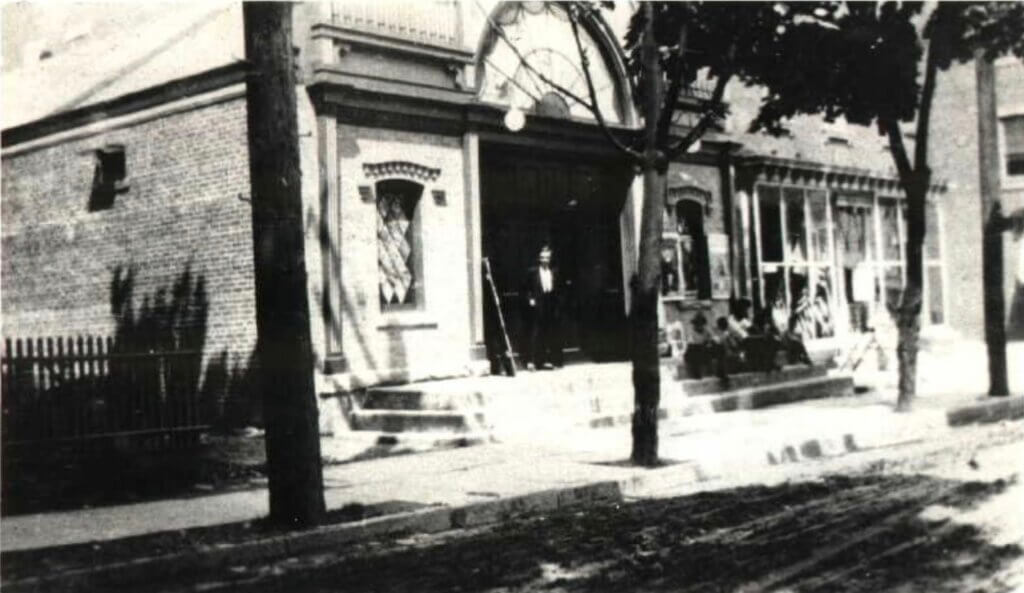
The Lyceum stood out architecturally. Its symmetrical brick façade combined Neoclassical formality with Late Victorian ornamentation. A central arch, reminiscent of a Palladian fanlight, topped the building, flanked by fluted pilasters that framed its large wooden entry doors. The doors, when open, blocked the sidewalk—a topic frequently debated by the village board.
Above, a decorative balustrade echoed the look of a Renaissance villa. Brick lintels, arched side windows, and ornamental cornices added texture and character. Display panels for posters and playbills were built into the front façade, making movie ads part of the architecture.
Though modest in size, the Lyceum projected the ambition of urban theaters. It wasn’t just a place to show movies—it was built to give cinema cultural legitimacy.
Speculations About the Lyceum Interior
No known photographs of the Lyceum’s interior have survived, so we can only make educated guesses based on the architecture, period norms, and comparable theaters from the era.
Judging from exterior photographs, the Lyceum likely seated 300–400 patrons in a long, narrow auditorium. It may have included a small, raised gallery, but had no grand balcony. The shallow stage—about 10 to 15 feet deep—supported vaudeville acts, lectures, and live music. A modest proscenium arch, footlights, pull curtain, and painted backdrops created a theatrical setting.
For films, a small canvas screen was rolled down in front of the stage. The projection booth, located above the audience in a well-ventilated room, protected viewers from the dangers of nitrate film.
Without air conditioning, summer evenings could be stifling.
“On warm summer nights, a side door of the Lyceum would be left open for ventilation. Outside, on a grassy bank, we boys would recline and watch the silent movies—for free.”
Oral history, Nyack in the 20th Century
What Was Playing in 1911–1912?
Newspapers from the Lyceum’s early years rarely mentioned specific films, calling them “fine” and focusing more on vaudeville acts. In those days, the experience of going to “the movies” was more important than the titles themselves.
The Lyceum hosted a wide variety of live performers: singers, comedians, magicians, dancers, and musicians. In November 1911, David Lubin & Company presented a southern vaudeville act titled The Humming Coon, a now deeply offensive performance that reflects the racist entertainment norms of the time.
That same year, Vincent Hamilton, a well-known female impersonator, performed dances and impersonations including “The Russian Gypsy.” The Mazeppa Fire Company hosted a benefit there in August 1911 with illustrated songs the audience sang along with.
The Lyceum also staged plays. In November 1912, the Broadway melodrama A Daughter of the People played to a packed house.
“The play was finely set, and the acting so creditable as to convince Nyack people that it is not necessary to go to New York City for a diversion of that kind.”
Nyack Evening Journal, November 8, 1912
A Fierce Rivalry with the Broadway Theater
Advertising grew more aggressive after World War I as films became more polished and longer. Studios produced large-format posters, and star power became a draw. In a postcard showing the Lyceum, a poster is visible for Aunts, Too Many, a six-minute 1913 comedy.
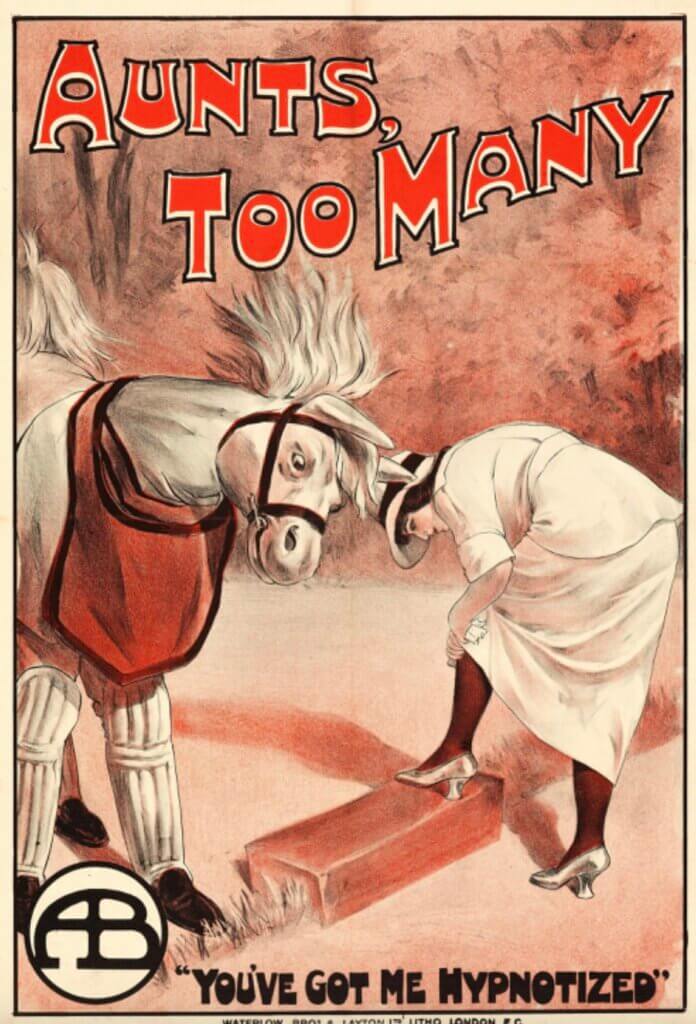
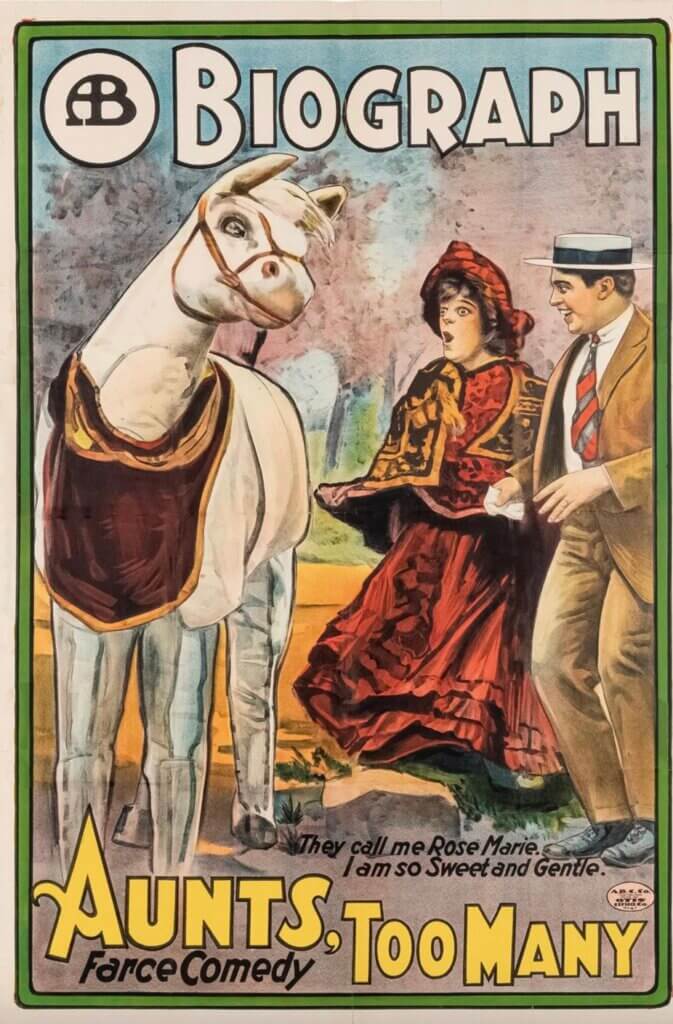
Two Biograph ads for Aunts, Too Many
As vaudeville faded, feature films, newsreels, and comedies became the main attractions. Competition between the Lyceum and the Broadway intensified. The Lyceum sought to set itself apart not just through programming, but through consistent branding—its slogan, proudly printed in every ad, declared:
“Quality Never Fails to Win Recognition.”
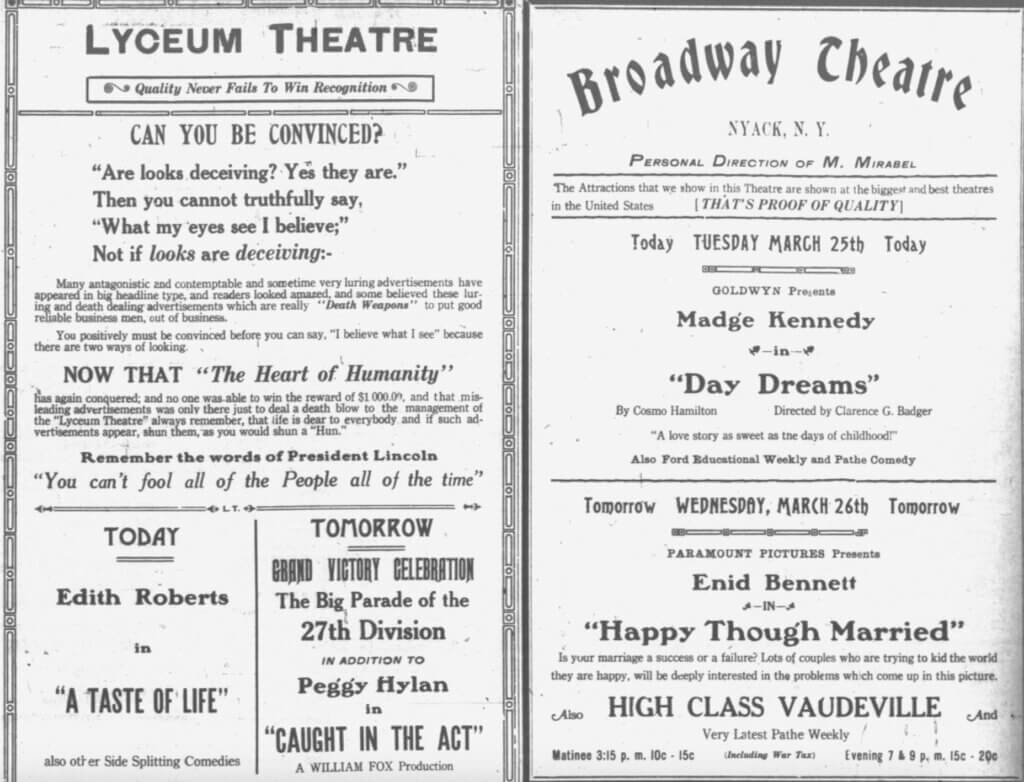
In early 1919, both theaters screened patriotic war dramas: D. W. Griffith’s Hearts of the World starring Lilian Gish at the Broadway, and The Heart of Humanity at the Lyceum. The Griffith film received more press, featuring a synchronized score that local musicians could accompany live. Lyceum owner Ralph Krastner accused the Broadway Theater of false advertising and even offered $1,000 to anyone who could prove his claim wrong. No one did.
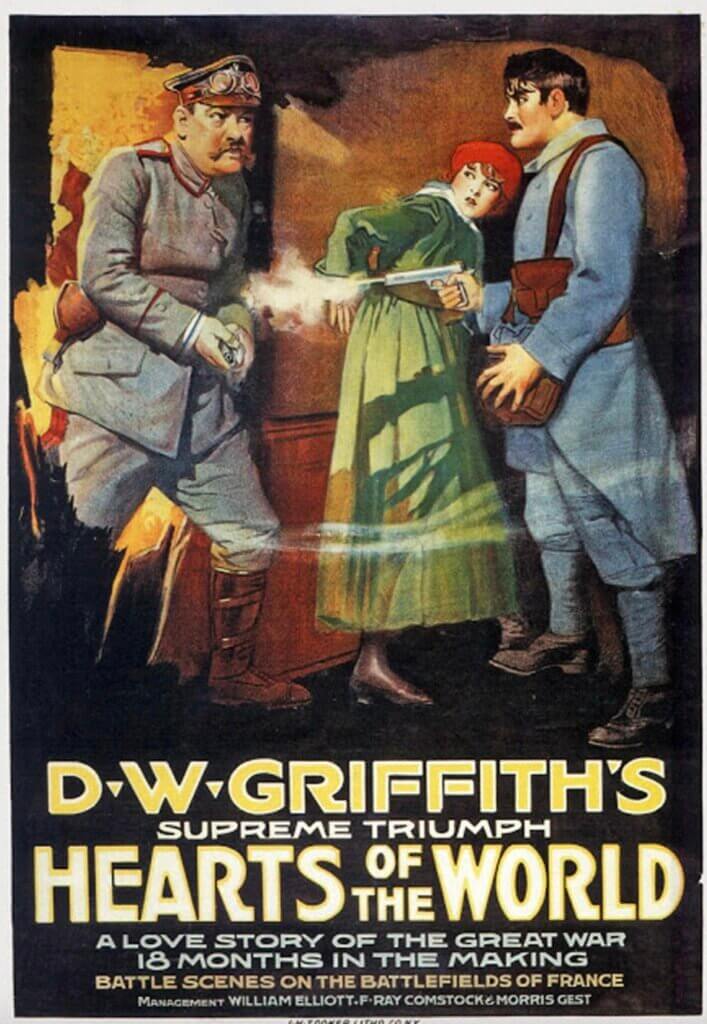
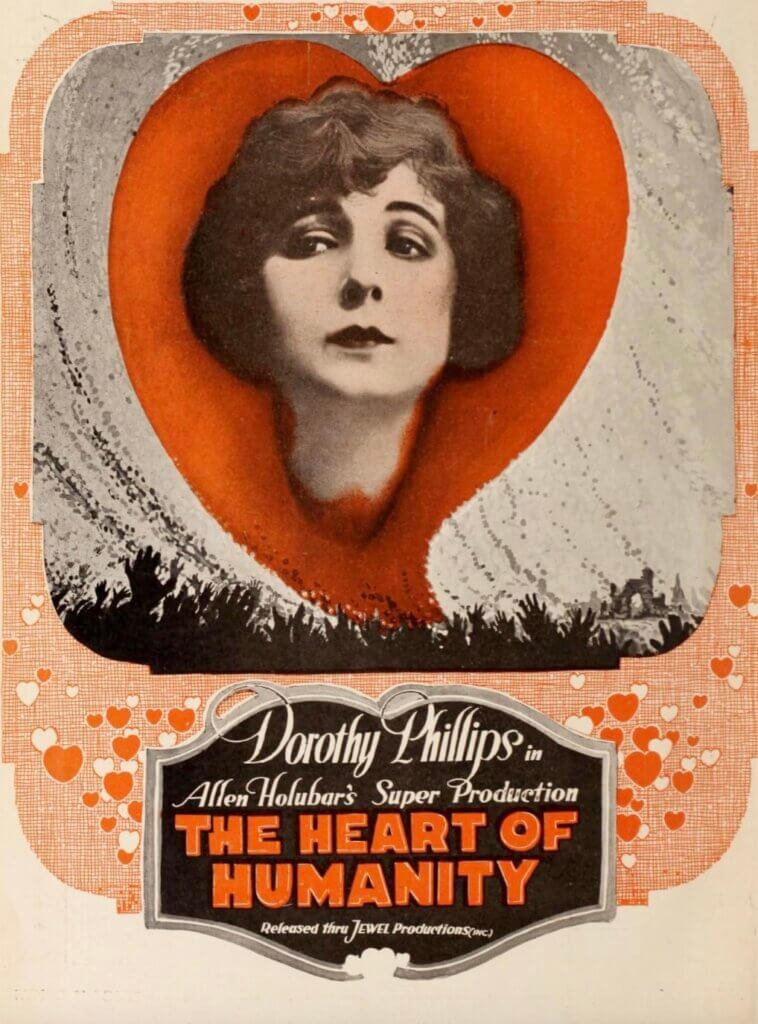
Movie posters for the two WW1 patriotic movies
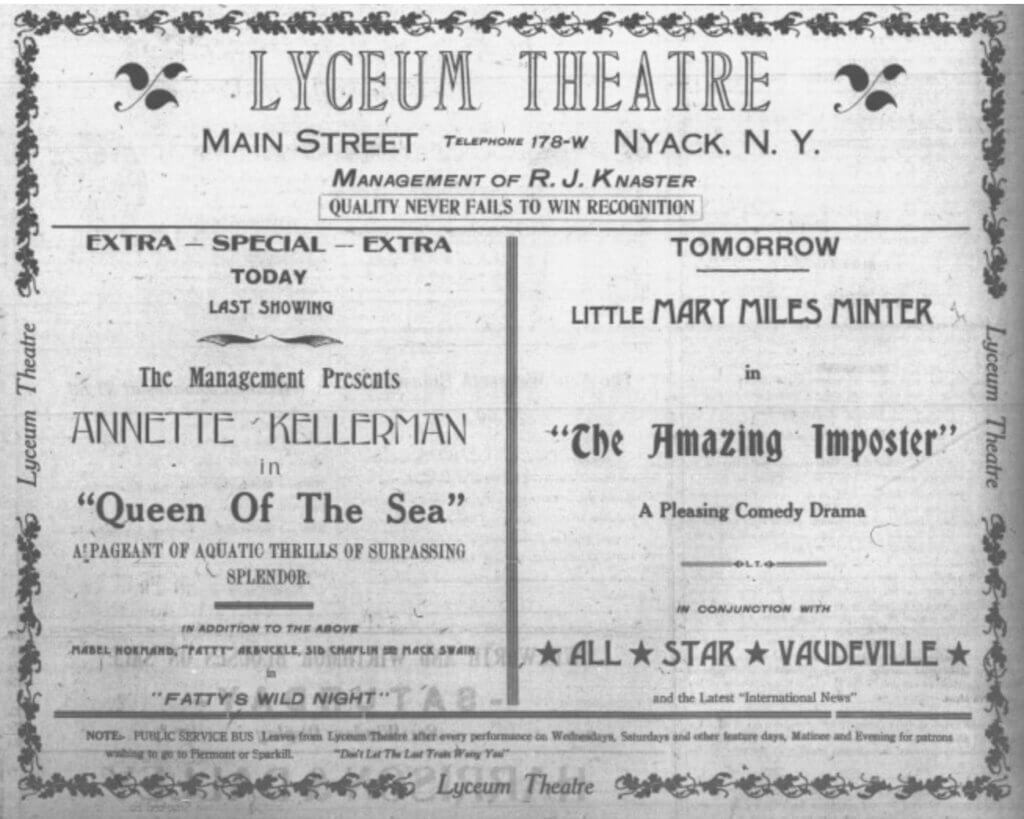
In 1919, the Lyceum even provided bus service to Piermont and Sparkill to compete for moviegoers:
“Don’t let that last train worry you.”
Lyceum ad, February 28, 1919
The End of an Era
By 1921, a single owner had acquired both the Lyceum and the Broadway Theater. The Broadway was expanded and modernized, and the Lyceum was reduced to showing films on Friday and Saturday nights in the summer. Its final screening took place in 1923.
For the next half-century, Nyack became a one-theater village.
From Theater to Retail
After its closure, the Lyceum hosted political rallies and community events before being purchased in 1928 by the Hawvermale Hardware store, which also operated in the adjacent building, first owned by the Ernst Brothers. The Lyceum’s interior was gutted and repurposed as retail space. Wolson & Hawvermale handled both plumbing and hardware services, and eventually the business became known simply as Hawvermale’s.
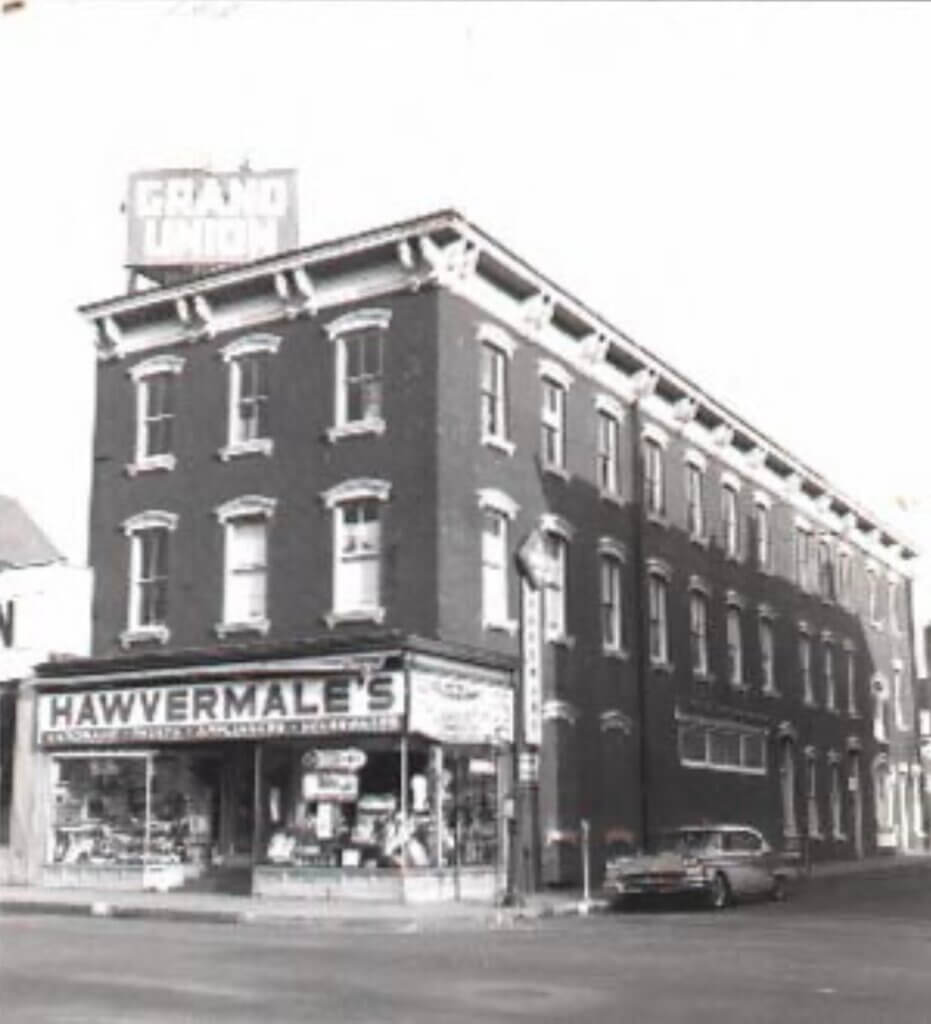
Around 1935, Grand Union took over the site, adding a parking lot on the High Street side. A devastating fire in 1948 led to another renovation. The Grand Union remained in the building until 1979.
Timeline: The Life of the Lyceum Theater
A century of transformation at 142 Main Street, Nyack
- June 1911: Lyceum Theater opens as Nyack’s first purpose-built movie house.
- 1911–1923: Hosts silent films, vaudeville, lectures, and local events.
- 1919: Owner Ralph Krastner offers $1,000 to disprove a competitor’s ad claim.
- 1921: Merged under same ownership with the Broadway Theater.
- 1923: Final screenings; building closes as a theater.
- 1928: Purchased by Hawvermale Hardware, interior converted to retail.
- Mid-1930s: Grand Union grocery store moves in, adds parking on High Street.
- 1948: Major fire leads to renovation.
- 1979: Grand Union closes.
- 1980s: Reopens as Franklin Antique Center during Nyack’s antiques boom.
- 2017: Renovated and reopened as Mainstream Commons with updated storefront.
Timeline of the Lyceum Theater
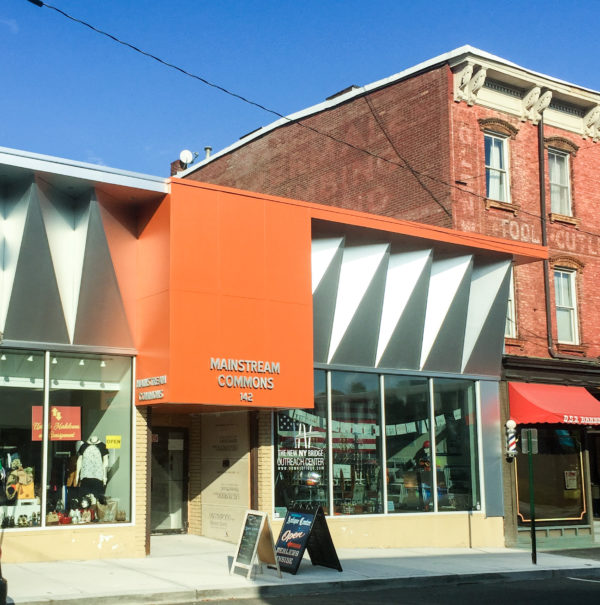
In the 1980s, the building was reborn as the Franklin Antique Center, part of Nyack’s bustling antiques district. That chapter ended in the 2000s. In 2017, new owners again renovated the site, creating Mainstream Commons, a space with a unique, modern storefront—a nod to the dramatic architecture of the Lyceum a century earlier.
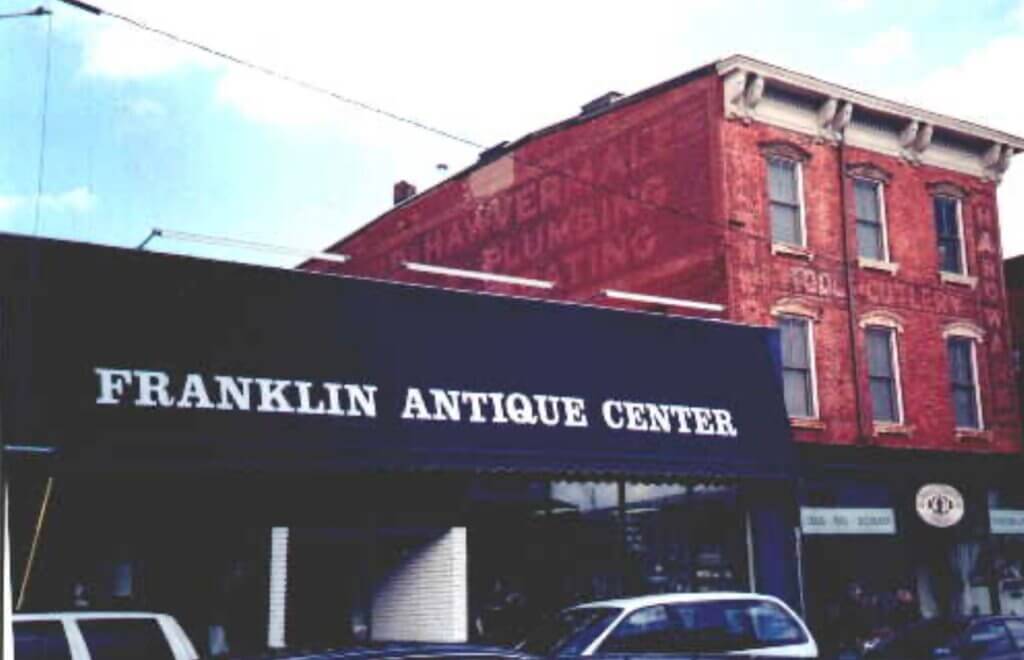
Legacy
It’s hard to imagine today—when streaming services make movies instantly available at home—just how transformative early movie theaters were. The Lyceum gave the community an affordable, exciting new way to come together and experience the world beyond Nyack. It brought vaudeville, music, drama, and the magic of silent film to the village. For a brief but memorable chapter in Nyack’s history, the Lyceum stood as a cultural anchor, a place where everyone gathered to be entertained, enlightened, and amazed.
Mike Hays has lived in the Nyacks for 38 years. A former executive at McGraw-Hill Education in New York City, he now serves as Treasurer and past President of the Historical Society of the Nyacks, Vice President and Trustee of the Edward Hopper House Museum & Study Center, and Historian for the Village of Upper Nyack.
Since 2017, he has written the popular Nyack People & Places column for Nyack News & Views, chronicling the rich history, architecture, and personalities of the lower Hudson Valley. As part of his work with the Historical Society, Mike has researched and developed exhibitions, written interpretive materials, and leads well-attended walking tours that bring Nyack’s layered history to life.
Married to Bernie Richey, he enjoys cycling, history walks, and winters in Florida. You can follow him on Instagram as @UpperNyackMike.
Editor’s note: This article is sponsored by Sun River Health and Ellis Sotheby’s International Realty. Sun River Health is a network of 43 Federally Qualified Health Centers (FQHCs) providing primary, dental, pediatric, OB-GYN, and behavioral health care to over 245,000 patients annually. Ellis Sotheby’s International Realty is the lower Hudson Valley’s Leader in Luxury. Located in the charming Hudson River village of Nyack, approximately 22 miles from New York City. Our agents are passionate about listing and selling extraordinary properties in the Lower Hudson Valley, including Rockland and Orange Counties, New York.