When the Randolph era ended, the 1879 brick building at Main and Franklin began a new phase of adaptation. Many residents today associate 143 Main Street with Lydecker Realty, the long running real estate firm that occupied the building for decades.
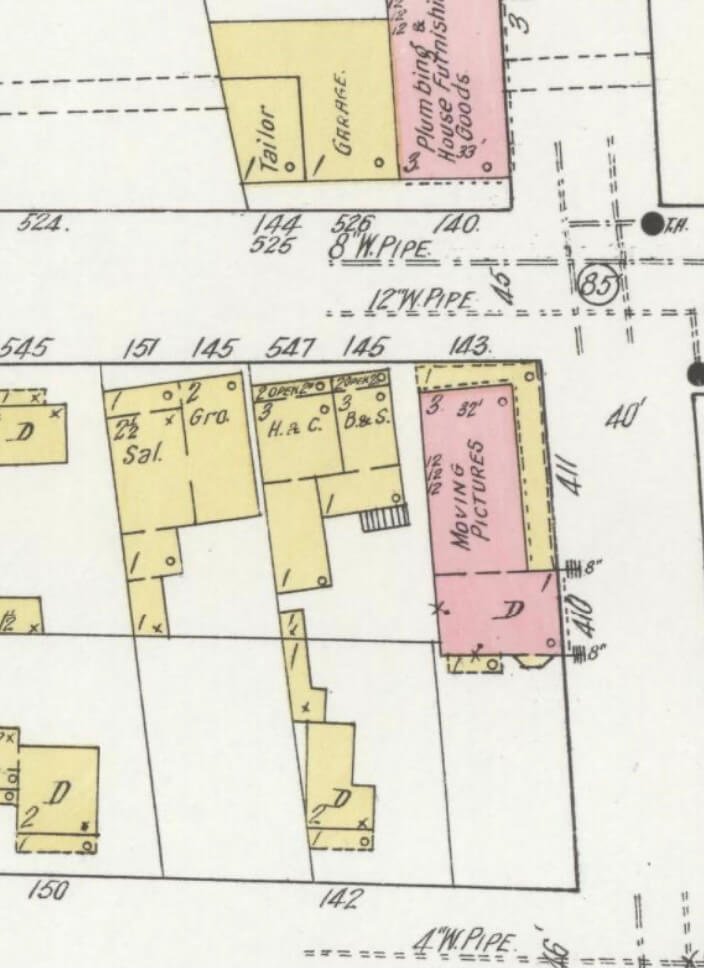
This detail from a 1910 Sanborn Insurance map identifies a moving picture theater operating on the first floor of the building. Within a year, the Lyceum Theater would rise across the street and help establish this section of Main Street as part of Nyack’s early theater district.
However, before the Lydeckers moved in, the structure passed through two lesser-known chapters that few now remember. By 1910, the first floor housed one of Nyack’s earliest moving picture theaters, while vaudeville dressing rooms occupied the second floor above. Later, the Goldfinger family operated a dry goods store here for nearly three decades. Each phase altered the building in different ways, yet the brick shell endured.
The Moving Picture Theater and Nyack’s Theater District
Documentation of the theater that operated in the former Randolph building remains limited. Nevertheless, a funeral notice for Warren L. Minnerly, a Tarrytown postal worker, credits him with establishing the first theater in Nyack at this address. The 1910 Sanborn Insurance map also confirms theatrical use.
By 1910, 143 Main Street housed one of the village’s earliest moving picture theaters.
The arrangement was straightforward. Patrons watched motion pictures on the first floor, while performers prepared in dressing rooms upstairs. That configuration reveals how quickly the building shifted from mercantile to entertainment use. Instead of flour barrels and feed sacks, the storefront now accommodated seating, projection equipment, and stage activity.
Meanwhile, the surrounding neighborhood embraced entertainment. In 1911, the Lyceum Theater opened directly across Main Street. Just north on Franklin Street, the outdoor Airdrome drew summer crowds. For a brief period, therefore, the intersection functioned as a compact theater district, with multiple venues operating within a few steps of one another.
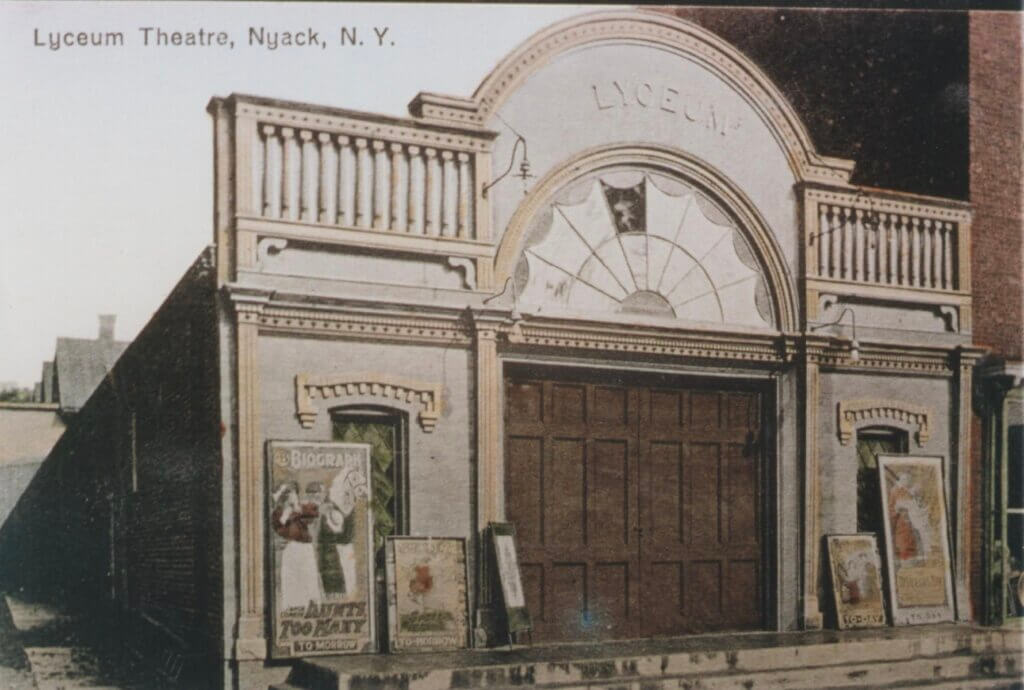
This 1913 postcard shows the Lyceum Theater, whose distinctive architecture set it apart from most Nyack buildings of the period. The poster on display advertises the motion picture Aunts, Too Many. Courtesy of the Nyack Library.
Although the moving picture chapter proved short lived, it marked the building’s first clear departure from retail trade. It also demonstrated the flexibility of the original 1879 structure.
The Goldfinger Store
Before occupying 143 Main Street, Aron, known locally as Herman Goldfinger, had already established himself in Nyack. Beginning in 1883, he operated a dry goods store nearby. In addition to his storefront, he ran a traveling wagon store that circulated through Congers, Rockland Lake, Blauvelt, and Tappan. Brooms hung from the wagon’s sides, while pots and kitchenware filled its interior.
The Goldfingers operated in Nyack for more than eight decades before retiring in 1950.
In 1922, after the building briefly housed an A&P grocery store, the Goldfingers moved into the former Randolph space. Inside, they retained much of its nineteenth century character. A pot-bellied stove remained on the sales floor. Gas lighting persisted before electricity arrived. Later, they installed central heat but avoided major modernization.
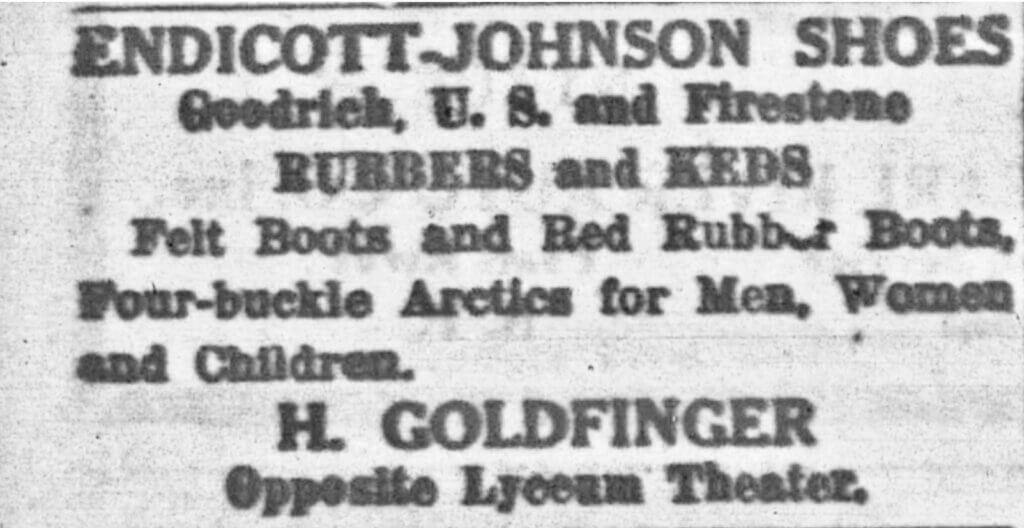
This advertisement promoted the dry goods store operated by Herman (H.) Goldfinger near the corner of Main and Franklin. The notice lists winter footwear and clothing and identifies the shop as located “opposite the Lyceum Theater,” linking the store to Nyack’s early theater district. From Nyack Evening Journal.
The store sold clothing, carpets, trunks, luggage, boots, and umbrellas. Although it never aimed for spectacle, it offered consistency.
Life Above the Store
Although the shop rarely felt crowded, it cultivated strong loyalty. Customers returned year after year. Actress Helen Hayes shopped there after settling in Nyack, drawn to its simplicity. One regular reportedly warned, “If you ever change this store, we won’t come back.” The Goldfingers obliged.
Joseph and Benjamin Goldfinger eventually operated the business together. They lived upstairs in the former vaudeville dressing rooms, converting the space into kitchen and living quarters. Neither brother married. Their routines centered on the store and the village.
After eighty-three years in business, the Goldfingers retired in 1950 and sold the property. With their departure, the corner prepared for another transformation.
MidCentury Renovation
After the Goldfingers sold the property in 1950, Frank Raso and Sons purchased the building and soon undertook a major renovation. As work progressed, the New York Telephone Company became one of the first tenants and occupied office space in the updated structure.
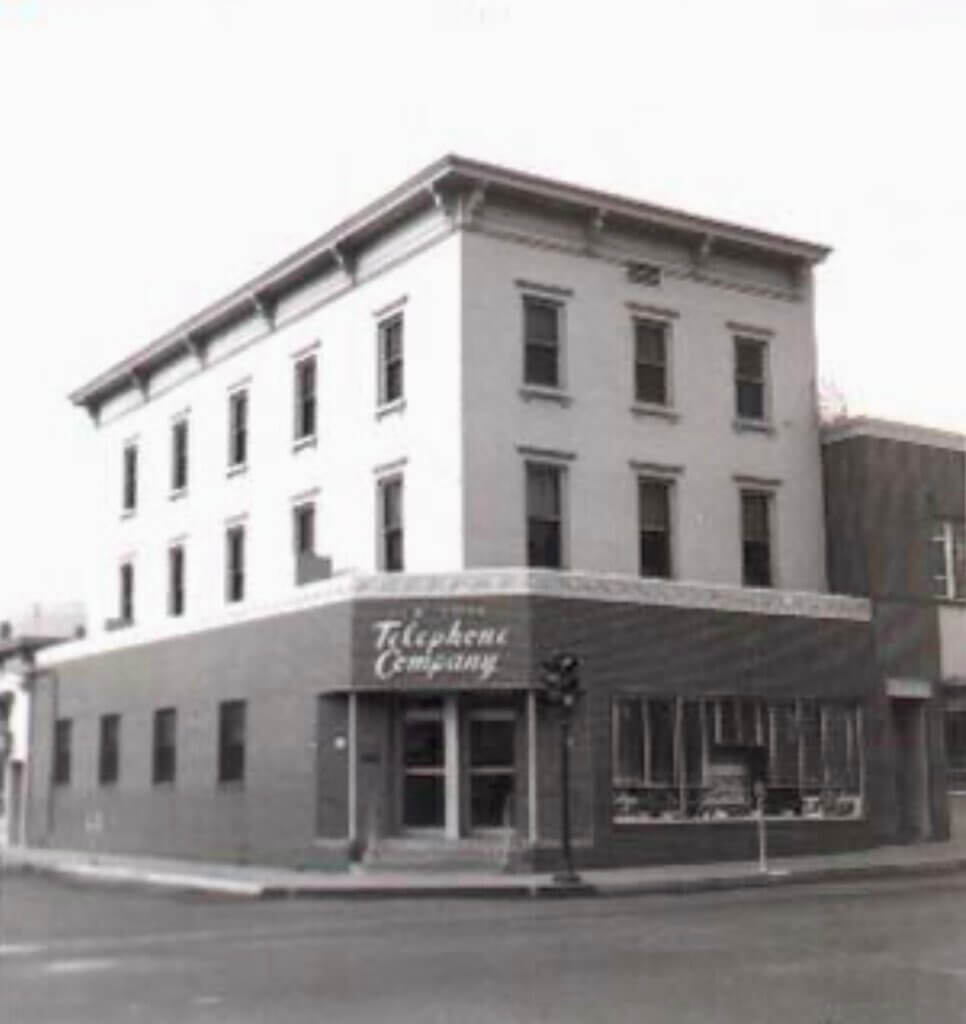
After purchasing the building in 1950, Frank Raso and Sons modernized the storefront. Workers removed the original wraparound porch and enclosed the base in brick, introducing a strong mid-century façade at the corner of Main and Franklin. Courtesy of the Nyack Library.
The renovation reshaped the building’s appearance. Workers removed the original wraparound porch and enclosed the façade in brick. They also relocated the entrance to the corner and introduced a strong horizontal base capped with an Art Deco–influenced frieze. These changes gave the building a distinctly mid-twentieth-century character while preserving the original brick shell.
The modernization echoed similar alterations made at the Rockland Savings and Trust Company building nearby, where renovations also concealed earlier storefront details.
The Lydecker Era
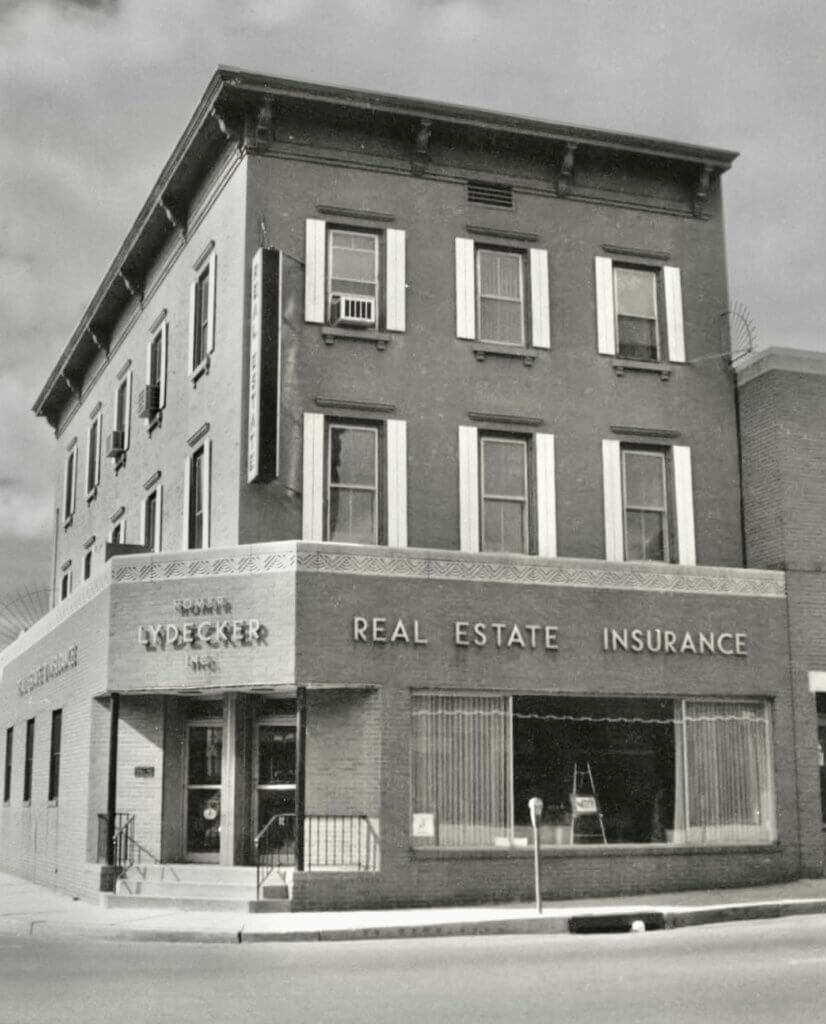
This 1984 photograph shows 143 Main Street during the years when Lydecker Realty occupied the building. The mid-twentieth-century renovation had already removed the original wraparound porch and reshaped the storefront along Main Street. Courtesy of the Nyack Library.
In 1962, Lydecker Realty moved into 143 Main Street. Founded in 1931 by Homer Bartlett Lydecker Sr., the firm had already become Rockland County’s oldest family run real estate business. Homer Sr. combined real estate, insurance, and mortgage services under one operation.
Later, his son Homer Jr. joined the firm and served as President of the Board of Realtors while holding leadership roles with the YMCA and Nyack Hospital. In 1975, Dale Lydecker entered the business after collegiate athletics and a season in professional baseball.
Lydecker Realty, founded in 1931, remains a family enterprise across three generations.
The Lydecker family’s roots in Nyack extend to the early 1800s. Their ancestors owned farmland uphill from Main Street and stored ice from Rockland Lake. Over time, highways and development reshaped that landscape. From offices at 143 Main Street, however, Lydecker Realty helped guide property transactions during decades of regional growth.
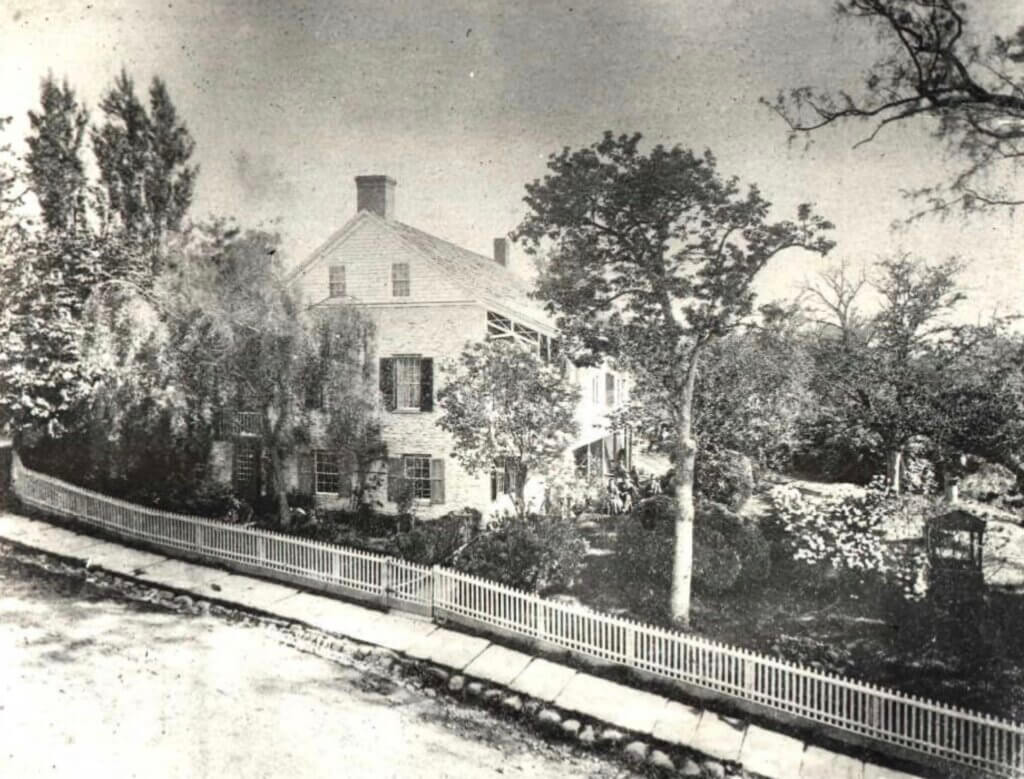
This early view shows the original Lydecker house on Main Street near the junction with Piermont Avenue. Members of the Lydecker family sit on the front porch of the farmhouse, reflecting the family’s arrival in Nyack in the early nineteenth century. Generations later, their descendants founded Lydecker Realty, which operated for many years from 143 Main Street. Courtesy of the Nyack Library.
Dominick R. Pilla Associates Engineering and Consulting
Today, Dominick R. Pilla and Associates occupies the building. The firm specializes in structural, civil, and mechanical engineering, as well as design approvals and construction management. Notably, it also participated in renovating the structure itself.

This view of the entrance shows a redesigned interior that respects the building’s historic fabric. Large windows face Main Street while exposed brick walls reveal portions of the original structure. Courtesy of D. R. Pilla Engineering.
Recent interior work preserved the nineteenth century brick shell while adapting the interior for contemporary use. Designers retained exposed brick walls and wood flooring. At the same time, they introduced open work areas, meeting rooms, expanded windows, improved circulation, and an elevator. Consequently, the building now supports modern engineering practice while maintaining continuity with its past.
A Structure That Outlived Its Owners
Over more than a century, 143 Main Street has passed from merchant to theater operator, from dry goods dealer to real estate broker, and now to engineer. Each generation adjusted the interior and, at times, the exterior to meet changing needs. Yet the brick structure erected in 1879 continues to anchor the corner of Main and Franklin.
Mike Hays has lived in the Nyacks for 38 years. Following a career as an executive at McGraw-Hill Education in New York City, he now devotes much of his time to researching, writing, and interpreting local history.
He serves as Treasurer and past President of the Historical Society of the Nyacks, a Trustee of the Edward Hopper House Museum & Study Center, and Historian for the Village of Upper Nyack. In these roles, he works closely with community partners to preserve historic resources and expand public understanding of the area’s past.
Since 2017, he has written the popular Nyack People & Places column for Nyack News & Views, chronicling the rich history, architecture, and personalities of the lower Hudson Valley. In addition, he has researched and developed museum exhibitions, written interpretive materials, and leads well-attended walking tours that bring Nyack’s layered history to life.
Married to Bernie Richey, he enjoys cycling, history walks, and winters in Florida. You can follow him on Instagram at @UpperNyackMike.
Editor’s note: This article is sponsored by Sun River Health and Ellis Sotheby’s International Realty. Sun River Health is a network of 43 Federally Qualified Health Centers (FQHCs) providing primary, dental, pediatric, OB-GYN, and behavioral health care to over 245,000 patients annually. Ellis Sotheby’s International Realty is the lower Hudson Valley’s Leader in Luxury. Located in the charming Hudson River village of Nyack, approximately 22 miles from New York City. Our agents are passionate about listing and selling extraordinary properties in the Lower Hudson Valley, including Rockland and Orange Counties, New York.